Book Now
Price from
US$2499

Lobuche Peak Climbing with Everest Base Camp Trek - 18 Days

1087 reviews in TripAdvisor
238 reviews in Google
19 reviews in TrustPilot
Trip Facts
Duration
18 Days
Difficulty Level
Moderate
Maximum Altitude
6119
Starts
Kathmandu
Ends
Kathmandu
Group Size
2+
Activities
Trekking, Climbing And Cultural Excursion
Season
March-June and Sept-November

Introduction: Lobuche Peak Climbing with Everest base camp trek

Lobuche Peak Climbing with Everest Base Camp Trek leads you to one of the most exciting adventures within close range of mighty surrounding mountains with Mt. Everest, Lobuche Peak Climb took as not an easy mountain to climb, where enough skill in technical experience required.

Lobuche Peak stands at just above 6,119 m/11,287 ft high but a tough peak to tackle to reach the summit where you can enjoy the awesome panorama of the world's highest mountains that surrounds you on the summit of Lobuche Peak.

People can get confused while planning this great adventure climb on Lobuche peak, with two peaks of Lobuche, the west and the east where we have chosen this trip is climb on top of Lobuche East Peak, which is quite popular and accessible than its sister peaks of West Lobuche as well taking a short duration to climb.

Lobuche East Peak Climb grade as TD means ‘Technical Difficule’ as per French and Swiss Alpine Climbing Classification Systems a mountain that can be climbed with some knowledge of technical sides, as the climb to some tough technical sections to encounter.

We have planned and designed the itinerary programs with much care allowing days to acclimatize and with some practice if required before this big climb and ascent on top of Lobuche Peak.

Maintaining our itinerary days with a combination of treks to Everest Base Camp and climbs of the high scenic hill Kalapathar which provides you with many exercises and getting along with the high terrain, harsh climate, and landscapes.

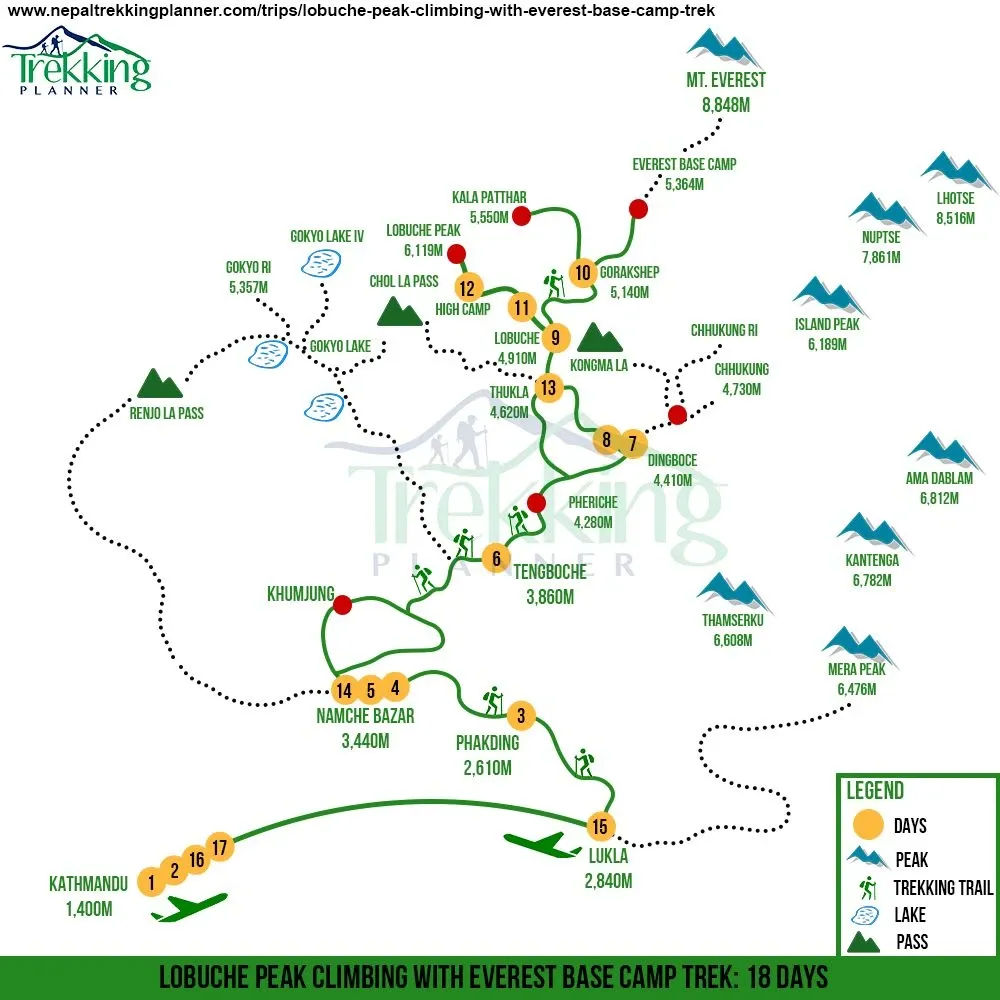
Lobuche Peak Climbing starts with a flight to Lukla and walking to the famous Namche Bazaar having rest days to explore its surrounding scenic hills and observe local Sherpa Buddhist culture, and then heading higher into beautiful woodland at Thyangboche Monastery and then towards arid and barren country towards Lobuche Peak Base Camp.

After much walking exercise visiting Everest Base Camp and with the final major highlight Lobuche Peak Climbing, after a successful and tough ascent with a great experience on mountaineering headed back to Lukla for a flight to Kathmandu, with overwhelming memories of the adventure on Lobuche Peak Climb.

Highlights of Lobuche Peak Climbing

Lobuche Peak Climbing is a journey that includes amazing mountain views, gorgeous landscapes, and a unique climbing experience. The famous EBC trek is a challenging climb before Lobuche Peak (6,119 m/20,075 ft.) in the Khumbu area of Nepal.

  • The experience begins with an exciting flight from Kathmandu to Lukla (2,805 m/ 9202.76 ft.), a small town in the Everest area noted for its difficult airport.
  • Everest Base Camp is one of the renowned walks through magnificent Sherpa towns, thick forests, and glaciers to the famous Everest Base Camp (5,364 m/17,598 ft.), the starting point for most Everest expeditions.
  • The trek to Kala Patthar (5,545 m/18,192 ft) offers one of the most incredible vistas of Mt. Everest (8848.86 m) and other Himalayan giants such as Lhotse, Nuptse, Pumori, Ama Dablam, Changtse and so on.
  • Lobuche Peak climbing provides stunning views of the Khumbu region and its neighboring peaks such as Mount Everest (8,848.86 meters / 29,031.69 feet), Lhotse (8,516 meters / 27,940 feet), Nuptse (7,861 meters / 25,791 feet), Ama Dablam (6,812 meters / 22,349 feet), Makalu (8,485 meters / 27,838 feet), Cho Oyu (8,188 meters / 26,864 feet), Baruntse (7,129 meters / 23,389 feet).
  • The trek takes you through many Sherpa communities, giving you a taste of the unique Sherpa culture and way of life. It offers you a taste of the day-to-day life of actual Sherpa people.

Advantage of booking Lobuche Peak Climbing with Trekking Planner Nepal

  • Private vehicles pick up and drop off passengers at all airports.
  • First-aid kit box.
  • Trekking Planner’s down jackets, t-shirt, and cap, if necessary.
  • Arrangement of emergency evacuation service (you should have insurance for emergency evacuation, which will be paid for by your travel insurance company).
  • We use an oximeter to check your pulse, oxygen saturation, and heart rate, and we provide oxygen cans on request.
  • Sim cards are provided by our company for travelers, so there won’t be any networking issues.

What is the specialty of Lobuche Peak Climbing and Everest Base Camp?

Climbing Lobuche Peak and Trekking to Everest Base Camp is a popular adventurous activity in the Khumbu area of Nepal. This itinerary normally lasts 18 Days and includes trekking to Everest Base Camp, a popular trekking destination, climbing Lobuche Peak, and exploring the surrounding area. Trekking Planner Nepal shares some of the interesting things about the trek.

It provides a whole Everest Region experience: The trip to Everest Base Camp is one of the most popular treks in the world, and it takes you through some of the most magnificent scenery of the Khumbu region. Climbing Lobuche Peak provides an added degree of adventure to the journey, as well as the excitement of summiting a mountain. Beside the trip also offers to explore the actual life style of the Sherpas

You will also get the opportunity to climb Lobuche Peak, a stunning mountain in the Khumbu area. Climbing this peak will be a physical and mental effort, but the reward of reaching the summit and enjoying the breathtaking views will be well worth it.

The trek includes visits to many other spectacular Everest area locations, including Namche Bazaar, Tengboche Monastery, Dingboche, and Gorak Shep. These locations are rich in culture and history, offering a glimpse into the lives of the people in this region.

Overall, the Lobuche Peak Climb is a beautiful journey that provides a unique opportunity to see Nepal's natural beauty, culture, and history. This trek will surely leave you with a fantastic experience, whether you are a seasoned explorer or a first-time trekker.

Is Lobuche Peak Climbing a right choice for trekkers and climbers?

Lobuche Peak is a challenging expedition that requires high physical fitness and a positive mindset. Before going on the trekking, Trekking Planner Nepal suggests you some important factors you need to consider:

  • Altitude: The trek takes you to high altitude, so you'll need to acclimate properly to avoid altitude sickness. Individuals with specific medical disorders, such as heart or lung difficulties, may be more susceptible to altitude sickness and should see their doctor before embarking on this adventure. We help you with proper itinerary with enough days for acclimatization as per your demand and budget.
  • Physical fitness: The journey involves both trekking and climbing at the same time. You requires walking along through long trails and challenging climbing, so you must be in good physical condition to complete it. Frequent exercise, including cardio and strength training, is required to prepare for the trek. Besides, we suggest you to have your health checked up to ensure about your health condition.
  • Experience: It is always believed that "where there is will, there is way", still Trekking Planner Nepal suggest you to gain some similar experience. This will help you to understand the challenges of trekking in advance and also prepare you for the physical challenges you may face during the trek.
  • Age: Although there is no age restrictions and limit, when you keen to do something still it is important to keep in mind that it is a challenging adventure that requires physical fitness and stamina. Older people may need to consult their doctor before embarking on the trek to ensure that they are fit enough to complete it.

So, the above factors need to be considered and make sure you check all these actors to know if the trek is suitable for you.


Lobuche Peak Climbing with Everest Base Camp Trek - 18 Days Itinerary

Day 1

Arrival in Kathmandu 1,350 m and transfer to Hotel.

Max Altitude: 1,350m (4,429ft)

On arrival at Kathmandu international airport via respective airlines, where you will be received by our office staff and guide with warm welcome then transfer to your hotels in the hub of the city.

After checking into your rooms and getting refreshed join the other groups for briefing on Lobuche Peak Climb and Treks, where our guide offers you with useful important information regarding trek and your stay in Nepal with us including some short details on climb with technical know-how.

Evening includes welcome dinner in a nice and authentic Nepalese restaurant with Folk Culture program of Nepal while having your dinner.

Included accommodation in Kathmandu and standard meals (welcome Dinner)

Day 2

Full day in Kathmandu with half day sightseeing tour.

Max Altitude: 1,350m (4,429ft)

Morning, depart from the hotel for exciting tour around Kathmandu at places of great interest,  Kathmandu city and its valley steeped with historical and religious monuments temples and monasteries listed as World Heritage Sites.

Afternoon our climb guide will help you with list of climbing and trekking gear required for the adventure to Lobuche Peak climb, rest of the day free to relax and preparation for next early morning flight to Lukla.

Included accommodation on BB in Kathmandu and standard meals (Breakfast )

Day 3

Fly to Lukla 2,830 m and trek to Phakding 2,640 m - 04 hrs.

Max Altitude: 2,830m (9,284ft)

Starting early morning transfer to domestic airport for short and scenic flight to Lukla, taking a smaller aircraft (Twin Otter or Dornier) during 30 minutes on air with amazing panorama of Himalayan series of peaks with Mt. Everest, as the plane lands on its unique uphill runways reaching at Tenzing & Hillary airport in Lukla.

From here a slow start with few hours of walks on downhill past many Sherpa farm villages with well tended crops and vegetable fields and terraces with occasional views of snow capped peaks of Kwangde and Kusum Khanguru, and then reaching our first overnight stop of the trek at Phakding in the comfort of nice and cozy lodge located by the raging Dudh Kosi River.

Included standard accommodation and  meals (Breakfast + Lunch + Dinner), Tea/Coffee

Day 4

Trek to Namche Bazaar 3,440 m - 06 hrs.

Max Altitude: 3,440m (11,286ft)

Early morning refresh yourself with Yoga course for an hour, and the after breakfast where day leads you to long uphill walk to reach at famous Namche Bazaar, starting with gradual walk following Dudh Kosi River upstream crossing few bridges to reach Sagarmatha National Park entrance near Monjo village.

Sagarmatha for Everest in Nepalese while Sherpa calls Chomolungma (of Tibetan origin) in both languages means 'Great Mother', from here a pleasant walk on river bed then climb for few hours into forested trail with views of snow capped peaks, as this scenic walk reaches you at exciting Namche Bazaar.

Included standard accommodation and  meals (Breakfast + Lunch + Dinner), Tea/Coffee

Day 5

Rest day at Namche Bazaar for acclimatization and local excursion.

Max Altitude: 3,440m (11,286ft)

Morning Yoga routine as per given time by our Instructor and Guru today a free and rest day at Namche Bazaar for necessary acclimatization, before heading higher area an ideal spot for free day at this height above 3,440 m high.

In Namche spend the day with scenic hike to view points on top Namche facing Mt. Everest-Amadablam and other range of peaks, afternoon explore the streets and shops, Namche holds a colorful and busy Saturday Market once a week.

Included standard accommodation and  meals (Breakfast + Lunch + Dinner), Tea/Coffee

Day 6

Trek to Thyangboche Monastery 3,867 m - 05 hrs.

Max Altitude: 3,867m (12,687ft)

Starting early morning Yoga class on lawn with the views of peaks, or indoor in a large dining hall, after a hearty breakfast, depart from Namche where walk leads you on gradual scenic path with downhill to Imjatse River at Phunge-Tenga for lunch, afternoon uphill climb into rhododendron, pines, fir forest with grand views of snowcapped peaks.

After few hours of climb reaching at Thyangboche Monastery, enjoy marvelous views of Everest, Nuptse, Lhotse, Kangtenga, Thamasarku, Kwande with magnificent Amadablam, afternoon with time to visit its interesting monastery and observe monks and priest on prayer.

Thyangboche a scenic and beautiful spot where once a year in the month of mid October or November a festival is held called Mani-Rimdu, where you can observe monks adorned on different deity masks wading evil spirits.

Included standard accommodation and  meals (Breakfast + Lunch + Dinner), Tea/Coffee

Day 7

Trek to Dingboche 4,260 m - 05 hrs.

Max Altitude: 4,260m (13,976ft)

With morning majestic views, morning downhill walk for short while to reach Imjatse River, after crossing a bridge walk into open country where tree lines stops for few short juniper and  rhododendron bushes, uphill for a while to reach at Pangboche village at 3,900 meters.

Pangboche last permanent village before Dingboche and beyond, from here a slow climb to Somara for lunch and continue walk with climb to Dingboche village for overnight stop, located within scenic Imjatse valley with excellent views of Amadablam and Island Peak.

Included standard accommodation and  meals (Breakfast + Lunch + Dinner), Tea/Coffee

Day 8

Rest day at Dingboche for acclimatization and excursion.

Max Altitude: 4,260m (13,976ft)

A rest day for proper acclimatization with longer Yoga exercise facing beautiful landscapes and views of high peaks, option for short hike up to Nakarjung hills for better views of surrounding peaks with Mt. Makalu towards east adjoining.

Afternoon check climbing gear and perhaps with some practice lesson on climb from our guide with more information regarding technical climb of Lobuche peak.

Included standard accommodation and  meals (Breakfast + Lunch + Dinner), Tea/Coffee

Day 9

Trek to Lobuche 4,930 m - 05 hrs.

Max Altitude: 4,930m (16,174ft)

After rest at Dingboche morning walk continues with steep climb for an hour with excellent views of the valley and mountains, and slowly walking on gentle path leading at Thugla for lunch, where Khumbu glacier melts turning into a torrential river. Where trail from Pheriche and Dingboche joins, after rest and lunch with steep climb for an hour to reach on top Thugla ridge, from here an hour of nice pleasant walk to Lobuche for overnight stop.

Included standard accommodation and  meals (Breakfast + Lunch + Dinner), Tea/Coffee

Day 10

Trek to Gorak Shep 5,170 m and Everest Base Camp 5,364 m and return to Gorakshep - 06 hrs.

Max Altitude: 5,170m (16,961ft)

Morning adventure leads to Everest Base Camp, starting with moderate walk for few hour and then climb over glacier and moraine to Gorakshep located at the bottom of Mt. Pumori and Kalapathar hill and view point.

From Gorakshep walk to Everest Base Camp following path close to Khumbu glacier all the way to base camp. On reaching base camp marvel the views of Khumbu Ice Fall and glaciers. After enjoying views of ice falls and mountains, completing our aim and dreams, walk back to Gorakshep for overnight stop.

Included standard accommodation and  meals (Breakfast + Lunch + Dinner), Tea/Coffee

Day 11

Hike to Kalapatthar 5,545 m trek to Lobuche Base Camp 4,865 m.

Max Altitude: 5,545m (18,192ft)

An early morning hike for few hours to reach on top Kalapatthar view point at 5,545 meters, for stunning views of Mt. Everest at close distance with panorama of high mountains, after a great scenic moment return back to Gorakshep and continue walk to Lobuche on the same route for an hour, and then our direction diverts towards Lobuche Base Camp.

Where walk leads on steep and rocky trail along Lobuche glacier facing views of Amadablam, Cholatse, Pokalde, Tharmarserku, Kantega, after a several hours of walk reaching at Lobuche Base at 4,865 m / 15,957 ft, for overnight camping.

Included Tented camp and  meals (Breakfast + Lunch + Dinner), Tea/Coffee

Day 12

Climb to Lobuche High Camp 5,600m / 18,368 ft - 04 hrs.

Max Altitude: 5,600m (18,372ft)

Morning starts with a gentle climb to reach high and advance camp, climb takes almost four hours to reach flat available ground for overnight camp, after climbing past rocks and moraine to High Camp.

Afternoon time to scout the areas with final preparation for the climb and as well practice climbs on ice and rocks face at Lobuche High Camp.

Included Tented camp and  meals (Breakfast + Lunch + Dinner), Tea/Coffee

Day 13

Climb the summit 6,119m / 20,070 ft and Trek to Thugla - 09 hrs.

Max Altitude: 6,119m (20,075ft)

As climb starts early morning towards Lobuche East Peak summit heading with steep climb facing some technical sections; where our guide will fix ropes around necessary places to make the ascent much accessible towards the summit of Lobuche East at above 6,119 m high.

At the top on reaching after a vigorous climb rewards you with breathtaking views of fascinating scenery of mountains and valleys, after a successful climb enjoying panorama that surrounds you with close views of Mt. Everest, Lhotse,

Mt. Amadablam with Mt. Makalu, Chamlang and Baruntse peaks towards south east, after a great adventure and experience of a life time descend safely taking the same route back at base camp. And continues trek down to Thugla for over night stay.

Included standard accommodation and  meals (Breakfast + Lunch + Dinner), Tea/Coffee

Day 14

Trek to Namche Bazaar - 07 hrs walks.

Max Altitude: 3,440m (11,286ft)

Morning after a pleasant stop at Thugla return journey on downhill and up to Thyangboche Monastery after a nice pleasant walk, from Pangboche onward facing views of Amadablam, Nuptse wall, Lhotse, with downhill into lower altitude within tree lines, as walk leads to a climb reaching at scenic Thyangboche.

Walk continues to retrace on the same route from Thyangboche with downhill to Phungi Tenga, after crossing a bridge an hour climb and then on gentle winding trail all the way to Namche Bazaar for last overnight stop before ending the trek at Lukla next day.

Included standard accommodation and  meals (Breakfast + Lunch + Dinner), Tea/Coffee

Day 15

Trek to Lukla - 06 hrs.

Max Altitude: 2,830m (9,284ft)

From Namche continue on downhill walk towards Dudh Kosi River with short climb to reach at Monjo village, after Monjo following Dudh Kosi River bank and then with few short ups and downs to reach at Phakding, retracing the journey back to Lukla on this last day walk of the adventure.

On reaching Lukla for overnight stop where you can have fun with evening party and last dinner around high Khumbu within Everest region.

Included standard accommodation and  meals (Breakfast + Lunch + Dinner), Tea/Coffee

Day 16

Fly to Kathmandu and transfer to hotel.

Max Altitude: 1,350m (4,429ft)

From Lukla flight starts from early morning to Kathmandu in fine clear weather, sometime the flight time can get delayed due to bad weather, as per the flight time board in a small plane for a super, scenic flight back to Kathmandu.

On reaching Katmandu domestic terminal our guide and staff transfer you back to respective hotels in the hub of Kathmandu in and around Thamel area.

Included accommodation on BB in Kathmandu and standard meals (Breakfast )

Day 17

In Kathmandu with sightseeing tour.

Max Altitude: 1,350m (4,429ft)

A day reserved as spare and free day in case of flight delay at Lukla in due to bad weather conditions, with opportunity for sightseeing tour for few hours or at leisure for individual activities.

Included accommodation on BB in Kathmandu and standard meals (Breakfast )

Day 18

International departure for home ward bound.

Max Altitude: 1,350m (4,429ft)

After a great and grand experience around high Khumbu with successful climb on top Lobuche Peak, depart from the hotel to the airport for final departure homeward bound or to respective destinations.

Included standard meals (Breakfast ) and Tea/Coffee

Lobuche East Peak Climb and Everest Base Camp trekking provided with standard Itinerary days where some days walks can be shorter or longer as per your physical fitness, some designated overnight stops can change, due to available rooms and other facilities and etc…….

We will follow the itinerary if its need to be changes in case of weather, landslides and difficulties on walks requiring more days where our leader and lead head guides decides holding full authority for Trekking Planner Nepal.

Dates & Availability

Trip Duration
18 Days
Trip Starts & Ends Point
Kathmandu / Kathmandu
Plan your trek schedule
  • This trip departs every day of the year.
  • This trip is fully customizable. We can customize the trip as per your need.
  • This trip is available on both Fixed Departure and Private Group Basis.
  • This trip can be booked privately if you’re traveling solo or privately or with family.
  • Have a big group? We can help as per your needs.
  • We can help you make it fit your budget.
  • We accept instant booking and online payment.
  • If the given date is not appropriate for you, Please CONTACT US 
  • Trekking Planner also organizes various trips in small groups that can suit you.
  • We recommend you reserve a seat for yourself by booking with us right away for a wonderful experience with us.
  • Call/email now for a private trip, [email protected]Mobile +977 9851071767 (24 hrs) - WhatsApp and Viber

Cost Details

Trip Includes

  •  All airport pick up drop off by private vehicle (for both international and domestic flights).
  •  Four night twin/double shearing accommodation on BB in Kathmandu.
  •  Guided sightseeing tours in Kathmandu with privet vehicles (entrance fees are extra).
  •  Kathmandu to Lukla to Kathmandu flight with airport departure tax.
  •  National Park entrance fee, Trekking Permit, and Climbing Permit.
  •  Climbing Equipment and expenses for 03 days during the climbing time.
  •  A high experience, helpful, knowledgeable, friendly, English-speaking, well-trained, Government license-holding guide/climbing Sherpa. Price includes his salary, food, drinks, accommodation, transport, and insurance.
  •  Two guests to 01 porter with their insurance, salary, food, accommodation, and equipment.
  •  Your cost includes insurance, wages, food, and lodging for both your guide and porter. We take excellent care of our guides and porters; they are like family to us.
  •  Twin/double shearing lodge accommodation in the mountain during the trekking and tented camp during the climbing.
  •  Climbing incentive and equipment for climbing guides.
  •  Basic climbing gear like main ropes and warm gear for guide-staff and porters.
  •  Basic climbing gear like main ropes and warm gear for guide-staff and porters.
  •  Three meals a day; breakfast, Lunch, and Dinner and tea/coffee during the trekking.
  •  Safe drinking water.
  •  All the necessary equipment for climbing.
  •  Welcome dinner in an authentic restaurant.
  •  First aid kid box.
  •  Trekking Planner’s sleeping bag, down jackets, T-shirt, cap, duffel bags, city and trekking route maps – if necessary.
  •  Arrangement of emergency evacuation service (should have insurance for emergency evacuation and will be paid by your travel insurance company).
  •  Oximeter to check your pulse and oxygen saturation and heart rate twice daily during the trek (very useful to check Altitude Mountain Sickness(AMS) symptoms). This helps ensure your trek is in the safest hands possible.
  •  One-hour complimentary spa/massage in Kathmandu after the trek.
  •  All applicable government and local taxes per the itinerary.

Trip Excludes

  • Your Nepal Visa fees (should bring small accurate fees in USD and Two passport-size photos).
  • All the International airfare from and to Kathmandu (no need to pay a departure tax for international flights).
  • Lunch and Dinner in Kathmandu.
  • Personal travel and health Insurance, Insurance for helicopter evacuation (Helicopter rescue insurance is highly recommended. If you have any problem and you have to be evacuated, without your insurance you have to pay for the helicopter in cash).
  • In case of extra more nights accommodation, lunch, and dinner in the city due to early arrival and late departure as well as early back/return from mountain/trekking (due to any reason) than the given time period of the itinerary.
  • Your Personal expenses such as ( laundry, phone calls, bar and beverage bill, boiled or bottled water {will cost between $1 and $3 a bottle (it gets more expensive towards base camp).}, extra porter.. etc).
  • Wi-Fi, charging batteries, and hot showers. Wi-Fi is available in some tea houses for $3 to $5 an hour. Hot Showers are also available in a few for around $3 and charging costs about $1.50 an hour.
  • Entrance fees for the day tours in Kathmandu.
  • The Tips to the trekking crews and drive.
  • Extra expenses due to flight delays, strikes, weather conditions, or any event out of our control.

Interactive Map

StartMid DaysEnd

Infographic Map

Download

Altitude Chart

Essential Information

What is the best time for Lobuche peak climbing?

Usually, the autumn season is the best time for trekking, and the spring season is perfect for climbing.

  • Autumn Season: The autumn season is the peak trekking season in Nepal , especially the Everest Region. Usually the weather is steady, dry, and clear throughout this period, making it excellent for climbing Lobuche Peak and trekking to Everest Base Camp. The temperatures are warm during the day and chilly at night, making walking and climbing enjoyable. Expect some tourists on the trails around this time of year, but the scenery are spectacular and the atmosphere is cheerful. The lodges also get packed during the peak season because of the high flow of tourists. 
  • Spring Season: This season is also considered as another wonderful time to undertake the Lobuche Peak Climbing Expedition.  The weather is pleasant, and the days are longer than in October, making it an ideal time for trekking. The vistas are also spectacular during this time of year, when the Rhododendron woods are in full bloom. Nevertheless, temperatures can drop at night, and there may be snowfall or severe winds. Still this season is considered as the perfect period for climbing and trekking.
  • Winter Season: During the winter season, the temperature gets extremely cold and snowy, making trekking and climbing less popular. Yet, for experienced climbers seeking for a new challenge, now may be a good time to investigate. The vistas are frequently clear, and the paths are tranquil, making it a relaxing experience. The intense cold, on the other hand, can make trekking and climbing more difficult, and there is a risk of frostbite and hypothermia. Still it totally depends on your taste and preference.
  • Summer Season: The Lobuche Peak Climb is better not performed during the summer season (monsoon season). The paths may be muddy and dangerous during this period, and there is a risk of landslides and avalanches. Visibility is also low, and vistas are frequently obscured by clouds and rain. Yet, if you prefer a more peaceful hike with fewer people, this season may be suitable for you.

In conclusion, the autumn season is the most popular and often regarded as the ideal season for Lobuche Peak Climbing with Everest Base Camp Trek, although spring is still an opportunity. For experienced climbers, winter is a challenging but rewarding season, whereas summer should be avoided owing to the high risk of landslides and limited visibility.

How to prepare for Lobuche Peak Climbing?

For the Everest Base Camp Trek preparation, you may require physical and mental preparation, as well as planning and packing the right gear. Here are some tips and tricks that may help you prepare for the trek:

  • Physical fitness: The most important thing to consider during the journey is your health. The journey is physically challenging, therefore you must be in good physical shape. You can also a training program that includes aerobic activities, strength training, and trekking a few months before your expedition to increase endurance, stamina, and strength.
  • Mental preparation: Trekking to Everest Base Camp and ascending Lobuche Peak can be mentally demanding, therefore it's important to be mentally prepared. You need to be prepared physically and mentally in the same time and keep your mindset positive. To obtain a sense of what to expect, you can also read about the trek and listen to people who have done it previously. To keep focused and motivated during the walk, meditation, visualization, or other mindfulness practices can be done.
  • Get the correct gear: You must carry the right equipment’s and gear and must be well prepared for the trek. Pack lightweight, moisture-wicking clothing, a warm down jacket, a good quality sleeping bag, sturdy trekking boots, trekking poles, and a backpack. Crampons, a harness, and an ice axe may also be required for the Lobuche Peak ascent. If you don't want to carry heavy luggage during the trek, We facilitates you with proper gears and equipment essential for the trip.
  • Altitude sickness prevention: Acclimatization is the most essential part when walking at high elevations in order to avoid altitude sickness. To enable your body to acclimate to the altitude, plan a slow ascent with rest days at higher elevations. You must also keep yourself hydrated, avoid alcohol as well as meat items. We suggest garlic soup as an alternative to prevent altitude.
  • Travel insurance: Make sure that you have enough travel insurance that covers emergency medical care and evacuation, as well as trip cancellation, interruption, and personal property loss.
  • Permits and paperwork: Trekking Permits and documentation are essential for the journey, such as the Sagarmatha National Park Permit, TIMS Card, and Lobuche Peak climbing permit. Trekking Planner Nepal helps you get all necessary documents and permits required.

Climate and Weather around Lobuche and Everest Region

  • The trek is usually done in the spring (March to May) and autumn (September to November) seasons.
  • Even during these months, the weather might suddenly change, therefore it's important to be prepared for any situation.
  • Temperatures range from 5 to 20°C during the day and 0 to -10°C at night at lower elevations, and 0 to 12°C during the day and -10 to -20°C at night at higher elevations over 4,000m.
  • The trek takes you through a variety of climatic zones, from a humid subtropical environment at lower elevations to an Arctic-like temperature at higher elevations.
  • When you travel through these zones, you may expect to face a variety of weather conditions, including rain, snow, and severe winds.
  • High winds and sub-zero temperatures may make the weather near Lobuche Peak extremely difficult.
  • It's important to have the proper equipment and clothes to be warm and dry, and to be prepared to change your plan if the weather becomes too challenging.
  • But it is very important to know that the weather above the mountains can varies and can change anytime. So, you must need to prepare for the upcoming circumstances.

Recommended Read

Weather and Climate of Nepal

Local Culture and Tradition around Lobuche and Everest Region?

The Khumbu Region of Nepal, where the Lobuche Peak Climbing with Everest Base Camp Trek takes place, is home to the Sherpa people, who have a distinct culture and heritage created by their rugged mountain environment. Trekking Planner Nepal shares some key aspects of the local culture and tradition in the region:

  • Sherpa Culture: Sherpa culture is originally ingrained in their Himalayan surroundings. They are well-known for their friendliness, hospitality, and Buddhist beliefs. Besides, you may also interact with other culture people. You will able to watch day to day life style of locals.
  • Buddhism: The Sherpa are largely Tibetan Buddhists, and the territory is densely packed with monasteries, chortens, and prayer flags. Trekkers and climbers frequently visit these holy places in search of blessings and good luck on their treks.
  • Traditional Dress: The Sherpa people have a distinct traditional outfit that consists of a woolen garment known as a "chuba," a belt known as a "kara," and a cap known as a "topi." These outfits are frequently brightly colored and embellished with elaborate designs.
  • Festivals: The region is famed for its colorful festivals, including as the Sherpa New Year (Losar), Mani Rimdu, and Dumji. Traditional music, Dancing, and religious rites are featured during these events.
  • Sherpa Food: The region's cuisine is mostly based on Tibetan and Nepalese foods, with an emphasis on stews, soups, and noodle meals. Dal bhat (lentil soup and rice), momos (dumplings), and thukpa are popular foods (noodle soup).
  • Mountaineering: The Sherpa people have a long history of mountaineering and are well-known for their high-altitude climbing abilities. Several Sherpas have worked as guides and porters on expeditions to the world's highest peaks, such as Mount Everest.

Is Travel Insurance required for lobuche peak climbing?

If you plan to climb Lobuche Peak with the Everest Base Camp Trek, travel insurance is mandatory and strongly advised. It is strongly advised to acquire travel insurance covering high-altitude climbing and emergency medical evacuation.

When selecting travel insurance coverage for climbing Louche Peak, be sure to thoroughly check the policy terms to confirm that it covers mountaineering activities and the altitude range you will be ascending. Some regulations may limit the altitude or the amount of experience necessary.

In addition to coverage for climbing and medical evacuation, coverage for trip cancellation, trip interruption, luggage loss, and other travel-related difficulties should be considered.

It is a good idea to compare plans from multiple insurance companies before acquiring travel insurance to ensure that you are getting the coverage you want at a fair price.

Accommodation and Toilet facilities during the Lobuche Peak Climbing?

You will be staying in teahouses or lodges along the trek for the whole period of the Lobuche Peak Climbing and Everest Base Camp Trek. There are minimal lodges, yet comfortable enough for trekking. Washing facilities at teahouses are limited, so you may have to use a pail of hot water or pay for a shower. For personal hygiene, it is advised that you carry wet wipes and hand sanitizer.

Teahouses also provide meals, which are often a mix of Nepali and Western food. The food is often simple and satisfying, and it is critical to consume enough carbs and protein to sustain your body throughout the walk.

Overall, the teahouse accommodations are simple yet enough for a decent hiking trip. It is essential to be prepared for the rural conditions and to be flexible to the amenities.

Things to consider before beginning Lobuche Peak climbing

Lobuche Peak Climb is a difficult journey that takes you to high elevations, so you should be aware of the hazards of altitude sickness. The highest point on this journey is 6,119 meters (20,075 ft) at the peak of Kala Patthar. Lobuche Peak Base Camp is located at an elevation of roughly 4,950 meters (16,240 feet), while the summit of Lobuche Peak is 6,119 meters (20,075 feet).

Altitude sickness, often known as Acute Mountain Sickness (AMS), is a common condition among hikers at high elevations. Headache, nausea, dizziness, exhaustion, and shortness of breath are some of the symptoms of AMS. It can develop to more dangerous illnesses such as High Altitude Pulmonary Edema in extreme circumstances (HAPE) or High Altitude Cerebral Edema (HACE).

It is essential that trekkers take adequate measures, such as gradually acclimatizing, taking lots of fluids, and avoiding alcohol and smoking, to reduce the risk of AMS. It is also important to listen to your body and relax when needed. If you get AMS symptoms, you should immediately alert your guide or trekking partner and take necessary action, such as descending to a lower altitude or obtaining medical assistance.

Overall, most trekkers are able to accomplish the Lobuche Peak Climbing with Everest Base Camp Trek without any significant altitude-related difficulties with sufficient preparation and safeguards.

Equipments

If you are preparing for an exciting Peak Climbing adventure in Nepal, there is always some confusion about what to pack. It is essential to carry the right gear and equipment for a comfortable, safe, and enjoyable experience. All trekkers should properly pack and carry all the essential items.

However, overpacking is another common mistake that can make the journey tiring. So here is a carefully crafted packing list that includes everything you need for peak climbing in Nepal. From general items, cloth layers, headgear, footwear, to accessories and first aid, the list consists of light and smart packing items for every challenging mountain condition.

Note: You do not need to bring all the items mentioned below to Nepal. There are several trekking shops in Kathmandu or Pokhara where you can buy or rent high-quality gear at a reasonable price. So, feel free to pack light and purchase or rent any missing items after your arrival in Nepal. Also, members from Trekking Planner Nepal Pvt. Ltd. can also guide and assist you to find the best deals in gear and equipment in Thamel, Kathmandu.

What Does the Company Provide?

  • We give you a free duffel bag (must return), buffs, trekking cap, crampons, trekking map, and t-shirt during your pre-trip meeting in Kathmandu. The duffel bag will be used to pack your trekking supplies.
  • For every two participants, we assign one porter. The porter will carry the duffel bag, which should weigh around 10 kg/22 lbs., throughout the walk.
  • We can provide a down jacket for USD 35. In case of loss or damage, you need to pay back the cost of USD 100 per item.
  • We can provide a sleeping bag for USD 35. In case of loss or damage, USD 100 per item must be paid.
  • You can safely store your extra luggage (items not required on the trek) at the hotel in Kathmandu. Our team can happily assist and help.
  • Total luggage for the Kathmandu-Lukla flight is (15 kg/33 lbs.), including duffel (10 Kg/22 lbs.) and backpack (5 kg/11 lbs.).
  • We provide a free Nepal SIM card (Ncell) to all our trekkers during the pre-trip briefing in Kathmandu. Data packages can be purchased at an additional cost.

Peak Climbing Equipment's

  • High altitude Climbing Boots: Insulated, rigid-soled boots for better warmth, waterproofing, grip and crampon compatibility.
  • Climbing Helmet: For protection of climber head from falling rocks and ice.
  • Expedition Suit: Full body protection against sub zero temperature and high wind.
  • Expedition Mittens: Thick, insulated, waterproof mittens to keep the hands warm.
  • Crampons: Metal spikes with sharp points to attach at the bottom of the boots to provide traction on snow and ice.
  • Ice screw: To twist into ice to create secure anchor point for protection.
  • Ice axe: Use to chop ice and provide anchor on icy slopes.
  • Ice hammer: Used to hammer ice screws and clear ice.
  • Tape Slings: Nylon webbing loops used as extenders.
  • Harness: Waist and leg loop system to securely attach the climber to the rope.
  • Screw gate Karabiners: Locking carabiners with threaded sleeve that prevents accidental opening.
  • Descenders: Mechanical device used to control the speed of descent on a rope.
  • Ascenders: Mechanical device used to ascend fixed rope efficiently.
  • Ropes: Static kernmantle ropes designed to absorb fall energy.
  • Belay Device: Mechanical friction device used to manage the rope while belaying a partner.
  • Snow Bar/Snow Anchor: A long metal tube driven into snow to create a reliable anchor point for belays and protection on snowy slopes.
Upper Body Layers
  • Lightweight Thermal tops
  • Fleece Pullover or Jacket
  • Down Jacket or Puffer Jacket
  • Insulated Jacket
  • Waterproof Jacket
  • Long/Short, Polypropylene Sleeve Shirt
  • Soft Jacket
  • Lightweight Gloves
  • Heavyweight Gloves
Lower Body Layers
  • Fleece Pants
  • Hiking Pants
  • Light thermal trouser
  • Optional Hiking Shorts
  • Technical fabric/quick drying undergarments (can be washed during the trek)
  • Sports bras (women)
  • Sleeping clothes as per the comfortability
Footwear & Accessories
  • Trekking Boots
  • Marino wool or comfortable warm socks
  • Liner Socks
  • Crampons
  • Casual shoes or sandals for teahouses
  • Gaiters (lightweight for rain and snow)
Head & Sun Protection
  • Brimmed Hat or Sun Cap
  • Buff/Neck Warmer/Neck Gaiter
  • Sunglasses
  • Bandana or headscarf
  • Balaclava
  • Sunscreen SPF- 50+
Personal & Medical Kits
  • Duffle Bags, 65 L
  • Trekking Bag, 30-40 L
  • Trekking poles
  • Head torch with extra batteries
  • Sleeping Bag
  • Sleeping bag liner
  • Raincoat
  • Glacier Glasses
  • Sunglasses
  • Thermosets
  • Navigation Equipment
  • Refillable Water bottle
  • Garbage Bag
  • Day bag Cover
  • Buff/Face mask
  • Books, Diaries, Playing Cards or Board Games
  • Toothbrush
  • Toothpaste
  • Soap
  • Shampoo
  • Deodrants
  • Nail Clippers
  • Hair Brush
  • Quick Drying Towel
  • Face Flannel
  • Toilet Paper
  • Hand and Face Moisturizing Cream
  • Lip balm or Vaseline
  • Ointment cream
  • Cough Syrup and strepsils (recommended for Khumbu Cough)
  • Creams and medicines (for any allergies or diseases)
  • Sanitizer
  • Band-Aid, Plasters and Zinc Oxide Tape
  • Painkillers
  • Antibiotics
  • Anti-diarrheal
  • Water purification tablets or water filters
  • Earplugs
  • Insect Repellent
  • Wet Wipes/Baby Wipes
  • High calorie snacks
  • Oral Rehydration Sachets
  • Electrolytes, power or tablets
  • Eye Drops
Travel Documents
  • Passport
  • Extra copies of passport-sized photos
  • Permits
Miscellaneous
  • Water bladder for the day bag
  • Small towel for personal use
  • Pillowcase in case of allergies to new pillows
  • Glues or Duct-Tape
  • Waterproof/dry bags for carrying essential documents, stuff, frequently used items, and money
  • Power bank or extra batteries
  • Cameras and mobile phone
  • Pee bottle/ pee funnel for women (only required during climbing)
  • Whistle in case your voice is not loud enough to stop or start
  • Thermos for hot water during the nighttime

FAQs

What are the guidelines for waste management and leaving a minimal ecological footprint during the trek?

The guidelines for waste management during the Lobuche Peak climbing period are to leave no foreign materials, bring the waste down, or ensure the garbage and the trash are collected and brought down and properly taken care of. Each expedition member has to deposit a certain amount to the Nepal Mountaineering Association, which is returned after the Nepal Mountaineering Association makes sure and provides a paper about waste management. Trekking planner Nepal will handle all this during the Lobuche peak climb.

How can I contribute positively to the local communities or environment during this Lobuche peak climbing?

Climbers can contribute positively to the local communities or environment during the Lobuche peak climbing by collecting the waste and storing it properly, following the trekking trail and the guide's instructions, and respecting nature and the local rules of the region for the environment.

Are there any specific advantages or disadvantages to joining a group or going solo?

There are advantages when traveling solo as the climbers can take their own time to rest for enough time to stay in the places and increase the day mentioned in the itinerary as per the request, get personal and private sherpas and porters and guides and more personalized service so going solo can be better than joining an unknown group for the Lobuche peak expedition.

How large are the typical groups for guided expeditions in max for Lobuche peak climbing?

The largest group can be sized for 28 climbers or more from the side of trekking planner Nepal for guided expeditions to the Lobuche peak climbing for guided expeditions to Lobuche peak.

Is it better to join a group expedition or plan an individual climb for Lobuche Peak climbing?

Suppose it's a group of friends trekkers have known for a long time. In that case, it is better to go for a group expedition. Still, if climbers join an unknown group, going for an individual climb is better. Going solo grants an option of going slowly, getting a personal guide and porter, and important solo care during the trek.

Are there any particular seasons when climbing Lobuche Peak is not advisable?

During the monsoon and in summer, climbing the peak is not advised. Still, climbers who want to experience something different can go for it. During the off-season, accommodation, food, and lodging can be a big problem for the trekkers and climbers in the Everest region.

How do weather conditions affect the climbing and trekking schedule?

Weather conditions affect the climbing and trekking schedule in various ways. For example, rain and snow can affect the climbing period and cause delays as it is difficult to climb and trek during snow and windy conditions.

What weather conditions can be expected during the Everest base camp trek and Lobuche peak climb, especially at different times of the year?

During the monsoon and summer, the weather conditions are bad, and even the food and lodging facilities are mostly closed during the off-season. Trekkers and climbers are advised to trek and climb 15 days before September and march to the end of 15th of December or June, respectively.

What medical facilities or support are available along the Everest base camp trekking route in case of emergencies?

Medical facilities are available at Lukla Phakding Namche and Gorakshep. However, Trekking Planner Nepal guides and porters will carry all the basic medical facilities. Trekking Planner Nepal always has air support, which can be used in emergencies during the Everest base camp trek or lobuche Peak climb.

What are the common altitude sickness symptoms during the Everest base camp trek?

The common altitude sickness symptoms are nausea, headaches, loss of appetite, fever, running out of breath, pneumonia, pain in the chest while walking, and breathing are some of the most common altitude sickness symptoms.

What is the tipping culture for guides and porters at the Everest base camp trek and Lobuche peak climb?

The tipping culture for guides and porters is at least 10 percent of the amount paid to the company to the guide and 6-8 percent to the porter per person. However, the amount for the tip can be increased or decreased according to the wishes of the trekkers and climbers. Tipping is a way to demonstrate happiness towards the guides and porters.

What communication facilities are available during the Everest base camp trek and Lobuche peak climbing?

Internet facilities are available throughout the trek through Wi-Fi, for which a card needs to be bought, and are available at almost all tea houses. The cellular connection is available at Lukla Phakding Namche Tengboche Pangboche and Gorakshep.

How do I get to the starting point of the Everest base camp trek before the Lobuche peak climb?

Trekkers and climbers can get to the starting point of the Everest base camp trek by either taking a flight to Lukla via Ramechhap/Kathmandu or having the option to drive from Kathmandu to Tham Danda and begin the trek from there.

What meals are provided during the Everest base camp trek and Lobuche peak climb?

Various meal options exist during the base camp trek and Lobuche peak climbing. Trekking planner Nepal has always provided open menu options and a drink during this trekking and climbing package.

What is included in the expedition package?

All the things included for the expedition have been mentioned in the inclusion, and we have an all-inclusive package with no hidden costs except what's not mentioned in the itinerary.

Is it necessary to acclimatize before attempting the Lobuche peak climb?

Yes, it is necessary to acclimate and rest before pushing for the Lobuche peak climbing. It provides enough acclimatization and gives the body a good rest to relax and push for the summit the next day with total energy.

Are there any specific dangers or risks associated with climbing Lobuche Peak?

There are always dangers and risks involved while climbing a peak in Nepal, as the peaks in Nepal are primarily 5600 meters. With altitude comes altitude sickness and many other risks or unforeseen circumstances, but sticking to the guide's decision and following the guide's instructions can lead to a successful expedition.

What is the climbing route for Lobuche Peak?

After completing the base camp, trekkers will travel from Gorakshep to the Lobuche base camp and spend the night there. The next day, climbers will be trekking towards Lobuche High Camp. After the instructions of the guide and the climber, the summit will be early in the morning. After completing the Lobuche peak climbing, climbers will go towards Thukla the next day or can go to Pheriche as well.

Do I need a guide, or can I climb independently?

The climbing guide who has obtained a license from the government of Nepal with the permission of the Nepal Mountaineering Association is required to obtain permits and garbage disposal papers and documents.

What are the technical requirements for climbing Lobuche Peak?

Lobuche peak climbing requires mountaineering skills like basic roping, fixing, and climbing. Climbers need to have crampons and use ropes for climbing and moving between the lines created by the sherpa. Sticking to the sherpa's decision is best for the climbers and the whole team while climbing.

What is the altitude of Lobuche Peak?

The altitude of Lobuche Peak is 6119m/20070ft.

Are there any emergency evacuation options on the Everest base camp trek and Lobuche peak climbing?

Emergency evacuation options are available during the Everest base camp trek and Lobuche peak climbing. The options for evacuation are horses, helicopters, or porters, according to the condition of the trekkers and climbers. Trekking Planner Nepal guides will help you select the option and inform the team in Kathmandu, who will arrange the rest of the evacuation process.

What is the accommodation like along the Everest Base Camp Trek?

There are various types of accommodations for the Everest base camp trek; some of them are rooms with electric blankets and attached bathrooms to basic rooms with two beds and a table or a carpet in the room with two blankets so trekkers, and climbers have the option to select from either a comfortable lodge or a basic lodge.

How to avoid altitude sickness during the Everest base camp trek and Lobuche peak climbing?

Trekkers and climbers can avoid altitude sickness by going slowly, acclimatizing, and adapting to the environment a step at a time. Drinking enough water and consuming a good amount of food with adequate sleep at night can help avoid altitude sickness due to the trek and climb.

What are the altitude challenges on the Everest base camp trek and Lobuche peak climbing?

Everest base camp trek and Lobuche peak climbing consist of trekking and climbing over 3500 meters, which involves walking and climbing at high altitudes and brings a challenge when the oxygen starts depleting, so going slowly with proper acclimatization is the key.

How many days does it take to complete the Everest Base Camp Trek?

It takes at least 11 days to complete the Everest base camp trek, going up and down from the base camp and breaking it down. It consists of 8 days going up to the base camp and 3 days coming down, and during these 11 days, there are two days for rest: one is at Namche, and the other is at Dingboche.

What is the Everest Base Camp Trek route?

The Everest base camp route is a path that takes trekkers from Lukla to the base camp of Kathmandu and is the way to the base camp of Mount Everest. The trail starts from Lukla at around 2800 meters and finishes at Everest base camp at 5364 meters.

How much does a guided expedition of Lobuche Peak with Everest base camp cost?

The cost for the guided expedition to Lobuche peak with Everest base camp trek starts from 2499$. It can increase or decrease depending on the services and interests of the clients, trekkers, and climbers.

What gear and equipment do I need to bring for Lobuche peak climbing?

The gears and equipment required are crampons, good boots, main ropes and climbing gears, ice axe harnesses, snow gaiters, warm gloves, windproof jackets, ascender snow bar carabineer, or karabiner. Contact Trekking Planner Nepal for additional details. We can also arrange the climbing equipment in Kathmandu or the Everest region at Lobuche.

What physical fitness is needed for the Everest base camp trek and Lobuche peak climbing?

An average amount of fitness is required where. Trekkers and climbers must be ready for at least 5-6 hours of walking daily and for the high altitude. Even the climb will be after the Everest base camp, which can be physically demanding for trekkers and climbers with the least physical fitness. Hence, average physical fitness is a must.

What accommodation options are during the Everest base camp trek with Lobuche peak climbing?

The accommodation during the Everest base camp trek is from basic to attached bathroom rooms with electric blankets and luxurious dining halls. During Lobuche, peak climbing at the high camp is a tent.

What permits are required for the Everest base camp trek and Lobuche climb?

The permits that are required for the Everest base camp trek are the Khumbu rural municipality trek, Sagarmatha national park permit, and Lobuche peak, climbing a peak climbing permit from the Nepal Mountaineering Association, and garbage deposits permit, which will be arranged by Trekking Planner Nepal.

Do I need prior climbing experience for Lobuche Peak?

Having prior climbing experience for Lobuche Peak is a plus point. Still, even beginners get acclimatized very well after completing the base camp. After that, the climbing gets pretty easy, and the climbers will have sherpas, making climbing more accessible for trekkers and climbers.

How long does the entire trek and Lobuche peak climbing take?

The entire trek, including the arrival and departure in Kathmandu Everest base camp and Lobuche peak climbing, will total around 18 days, which will have 4-5 days in Kathmandu according to the itinerary.

What is the difficulty level of Lobuche Peak Climbing?

The difficulty level for the Lobuche peak climbing is advanced. For Everest base camp, it is considered a moderate take as this trek involves walking above 4500 meters.

What is the best time for this Lobuche peak expedition?

The best time for a Lobuche expedition is during the spring (March to May) and autumn (September to November) seasons.

What is Lobuche Peak Climbing combined with Everest Base Camp Trek?

Lobuche peak climbing is a package combined with the Everest base camp trek. It is a journey that starts from Lukla, and after completing the base camp, we come down to Lobuche and climb Lobuche Peak.

Featured Trip
7%
Off
Price Per Person
US$2499
US$2699
  • 1 paxUS$2499
  • 2 - 6 paxUS$2399
  • 7 - 13 paxUS$2330
  • 14 - 20 paxUS$2299
Need Help? Call Us!
Dipak Lamichhane
Dipak Lamichhane
Managing Director
+977 9851071767

You May Also Like

Pikey Peak Trek - 10 Days
Duration: 10 Days
5.0 (1 Reviews)

Pikey Peak Trek - 10 Days

KathmanduKathmandu
Per Person
US$699US$899
Trip Details
Mountaineers crossing a glacier during a Yala Peak climbing expedition in the Langtang Himalayas
Duration: 14 Days

Yala Peak Climbing - 14 Days

KathmanduKathmandu
Per Person
US$1699US$1799
Trip Details
Trekkers approaching Mera Peak Base Camp through the remote Hinku Valley
Duration: 18 Days

Mera Peak Climbing-18 Days

KathmanduKathmandu
Per Person
US$2499US$2699
Trip Details
Climber ascending the snowy ridge of Pokalde Peak with panoramic Himalayan views in Nepal
Duration: 18 Days

Pokalde Peak Climbing - 18 Days

KathmanduKathmandu
Per Person
US$2299US$2499
Trip Details
Need Help? Call Us+977 9851071767
Lobuche Peak Climbing with Everest Base Camp Trek - 18 Days