Book Now

Annapurna Circuit Trek with Tilicho Lake and ABC - 22 Days

1110 reviews in TripAdvisor
238 reviews in Google
19 reviews in TrustPilot

The Annapurna Circuit with Tilicho Lake and Annapurna Base Camp Trek is a three in one 22 days trek that takes you around the Annapurna region of Nepal. The trek includes the classic Annapurna Circuit, a side trip to Tilicho Lake (4,919 m), and visit to the iconic Annapurna Base Camp (4,130 m). Trekkers get the opportunity to see close views of Annapurna I, II, III, IV, South, Machhapuchre, Dhaulagiri, Nilgiri, Gangpurna and more.On the itinerary, trekkers need to pass glacier fields, rocky terrains, landslide prone areas, remote villages, and mountain passes like Thorong La Pass (5,416 m). 

So, it is a challenging trek which requires a good level of physical fitness, proper acclimatization, and mental strength. The best season for the trek is Spring (March to May) and Autumn (September to November), where Trekking Planner Nepal Pvt. Ltd. provides licensed Sherpa guide and porter support. In addition, we handle all the logistics, including transportation, permits, and essential planning considerations. So, book the trek for the trip of your lifetime.

Trip Facts
Duration
22 Days
Difficulty Level
Moderate
Maximum Altitude
4600m
Starts
Kathmandu
Ends
Kathmandu
Region
Annapurna
Group Size
2+
Activities
Trekking

nnapurna Circuit Trek with Tilicho Lake and ABC Highlights

  • Visit the UNESCO World Heritage Sites of Pashupatinath, Swayambhunath, Kathmandu Durbar Square, and Boudhanath in a guided sightseeing tour.
  • Get the mixture of three treks in one with a visit to Annapurna Base Camp, Annapurna Circuit, and Tilicho Lake.
  • Cross the iconic Thorong La Pass (5,416 m), one of the highest mountain passes in the world, with a sunrise view over Annapurna and Dhaulagiri range.
  • Visit the Annapurna Conservation Area, home to exotic wildlife including the rare Snow Leopard and Red Panda.
  • Reach the Annapurna Base Camp with a close view of Annapurna South, Machhapuchhre, Hiunchuli, Gangapurna, and other towering peaks.
  • Visit the religious and spiritual site of Muktinath, known for its 108 water spouts, eternal flame, and two Kunda.
  • Summit early to Tilicho Lake, known for its mirror reflection of snow-capped peaks, glacial fields, and icefalls.
  • Trek through vibrant Gurung, Magar, and Thakali villages with Tibetan monasteries, Hindu temples, mani walls, chortens, prayer flags, and prayer wheels.

Introduction: Annapurna Circuit Trek with Tilicho Lake and ABC - 22 Days

The Annapurna region of Nepal is popular for offering a variety of trekking routes that are suitable for everyone from beginners to hardcore trekkers. From the subtle trek of the Annapurna Base Camp to the loop of the Annapurna Circuit, these classical treks are renowned all over the world. With gorgeous mountain views, lush green valleys at lower elevations, traditional Nepalese houses, and high-altitude glacial terrain, the region offers an unforgettable introduction to the raw beauty of nature. So, Annapurna remains one of Nepal's most popular trekking destinations.

The Annapurna Circuit with Tilicho Lake and Annapurna Base Camp is one of the epic Himalayan journeys of Nepal that encompasses the Annapurna area while visiting the notable destinations of Annapurna Base Camp (ABC) and Tilicho Lake. The excitement of crossing the Thorong La Pass, the highest mountain pass in the world, comes true in the package. Along the route, trekkers are welcomed by renowned towering mountain peaks, including Annapurna I, Annapurna II, Dhaulagiri, Annapurna South, Hiunchuli, Machhapuchhre, and Manaslu.

Another popular attraction during the Annapurna Circuit with Tilicho Lake trek is the opportunity to witness the high glacial lake of Tilicho situated at 4,919 meters. Tilicho Lake makes the journey more interesting. The blue sky above, towering peaks in the middle, and the glacial-fed water of Tilicho paint a marvelous picture. On the surface of Tilicho Lake, one can see the reflections of Tilicho Himal, the Annapurna Range, and the Nilgiri Himal, creating a magical atmosphere that leaves every visitor in awe.

Also, on the way to the destination, trekkers reach the Annapurna Conservation Area and Annapurna Base Camp. Annapurna Conservation Area, a protected zone inside Annapurna, is home to exotic flora and fauna. Elusive Snow Leopard, Red Panda, Blue Sheep, Himalayan Tahr, Himalayan Monal, Golden Eagle, and Musk Deer are present inside the conservation area.

Aside from the opportunity to see exotic wildlife, trekkers arrive at Annapurna Base Camp, a destination in itself. Situated at 4,130 meters in the heart of the Annapurna Sanctuary, ABC offers a 360-degree panoramic view of the mountains, glacial moraines, and icefalls. Ascending through traditional villages, tropical forests, and rhododendron forests, trekkers are immersed in the raw, untouched power of the Himalayas.

While there are trekking packages that lead to Annapurna Base Camp, Tilicho Lake, or the Annapurna Circuit, a combination of all three is rare. The trek is 22 days long, including arrival in Kathmandu, a city sightseeing tour, and the final departure. Designed for adventurous souls, the experience allows you to explore the three iconic destinations of the Annapurna region in a single trip, offering a perfect balance of challenge and reward.

Major Attractions During the Annapurna Circuit Trek with Tilicho Lake?

Mountain Views: Mountains are a constant attraction during the Annapurna Circuit and Tilicho Lake Trek. Trekkers get to see a wide range of snow-capped mountains, especially among the Annapurna and Dhaulagiri Range. Popular mountains include Annapurna I, II, III, IV, Gangapurna, Tilicho Peak, Thorong Peak, Nilgiri, Dhaulagiri, Chulu Peaks, Lamjung Himal, and more. From the distant views at lower elevations to the dramatic up-close views popularly from Manang onward, at Thorong La Pass, or Tilicho Lake, these mountain views motivate trekkers to move forward.

Braka Monastery: Also known as Braga Monastery (3,500 m), is a major attraction during the trek. The monastery represents the deep-rooted Tibetan culture in the region. To reach the monastery, trekkers need to take a detour from Manang, offering a spiritual and scenic journey. The Braga monastery stop along the Annapurna Circuit provides deep insights into Tibetan Buddhism, its teachings, and understanding. Various murals, paintings, prayer flags, prayer wheels, and chortens inside the monastery give a glimpse of Buddhism in the Annapurna region.

Gangapurna Lake Viewpoint: Gangapurna is one of the notable glacial lakes along the Annapurna Circuit, charming trekkers with its turquoise beauty. Situated at 3,540 m on the foot of Gnagapurna Peak, the lake is one of the notable acclimatization hikes from Manang. The hike is easily accessible and moderately challenging, allowing trekkers to adapt to the low oxygen level. The spot is peaceful, allowing trekkers to relax, meditate, or simply soak in the raw Himalayan beauty.

Ice Lake: Also known as Kicho Tal/lake, it is another popular acclimatization stop on the Manang route. Located at an altitude of 4600 meters, the lake is a hidden gem. Although fewer tourists know about it, it is slowly getting recognition. The hike to Ice Lake is often considered a tough acclimatization hike; however, it rewards visitors with a beautiful lake surrounded by majestic Himalayan peaks.

Apple Orchards of Marpha: Marpha is the “Apple capital of Nepal,” also known as the fruit bowl of Mustang. Trekkers will pass Marpha on the route from Muktinath to Tatopani, where, on arrival, they are welcomed by numerous apple orchards. A wide variety of apple products, including Apple brandy, apple juice, cider, and dried apples, are available for purchase. The village itself is quite peaceful, filled with the scent of fresh apples and marked by Tibetan Buddhist tradition.

Tilicho Lake: One of the biggest highlights in the Annapurna Circuit with the Tilicho Lake Trek package is Tilicho Lake. Perched at an altitude of 4,919 meters, a visit to Tilicho Lake is a side trip from Manang via Shree Kharka to Tilicho Base Camp. Tilicho Lake offers a fantastic view of Tilicho Peak, the Nilgiri Himal, the Annapurna Range, Gangapurna, and more. The lake is turquoise, surrounded by white snow and mountains.

Thorong La Pass: It is the highest pass in the world where trekkers make their way from Thorong La Phedi to the top at an altitude of 5,416 meters. Being the highest pass in the world, crossing the Thorong La Pass is a personal achievement that pushes the human body to its limits. The weather conditions around the Thorong La Pass can change dramatically, especially during summer and winter. Trekkers need to be cautious and prepare well before undertaking the challenge. Once finished, the top of Thorong La rewards trekkers with a spectacular 360-degree panoramic view of the surrounding mountains.

Muktinath: The UNESCO World Heritage Site of Muktinath is one of the highest sacred temples in the world for both Hindus and Buddhists. The temple consists of a central shrine dedicated to Lord Vishnu, with 108 stone water taps and two kundas. It is believed that dipping in these water sources can wash away human sins, so hundreds of pilgrims visit the temple to seek blessings and bathe in the holy water.

Annapurna Base Camp: Popularly known as ABC, the Annapurna Base Camp is the foot of the tenth-highest mountain in the world, Mt Annapurna (8,091 m), and the highest mountain in the Annapurna Massif. While Annapurna Base Camp lies at an altitude of 4,130 meters, it is one of Nepal's classic treks, with a well-marked trail that attracts trekkers every year. ABC is perfect for nature lovers and beginner trekkers who want to experience Nepal's natural beauty.

Pokhara: It is Nepal's largest tourism city, located in the Gandaki Province. Being the biggest tourist city, Pokhara is also popularly known as the capital of tourism, with many popular attractions scattered throughout the city. The best places to visit in Pokhara include Davis Fall, World Peace Stupa, Bat Cave, Mahendra Cave, Gupteshwor Mahadev Cave, Pumdikot Shiva Statue, and Bindabasini Temple. For quality time in Pokhara, many tourists opt for the Lakeside area, which is on the shore of Phewa Lake. Popular activities include boating on Phewa Lake and visiting the Tal Barahi Temple, located in the middle of the lake. Other than that, clubs, pubs, restaurants, and bars are available on the lakeside for enjoyment.

Why Choose the Annapurna Circuit Trek Package?

The Annapurna Circuit, Tilicho Lake and Annapurna Base Camp Trek is a comprehensive adventure which extends up to 22 days. The trek allows trekkers to individually explore three distinct popular destinations inside the Annapurna region. Trekkers immerse in the maximum diversity while viewing stunning scenery and experiencing a variety of cultures. Here’s why trekkers should choose the trio package.

  • Trekkers can witness diverse landscapes from subtropical forests, paddy fields, traditional villages, deep gorges, glaciers, high altitude deserts, to alpine meadows. Trekkers can quickly transition through multiple climatic zones in a single trip.
  • Trekkers can visit iconic highlights along the route where they can cross the famous Thorong La Pass on the Annapurna Circuit Trek, see Tilicho Lake during the journey from the Tilicho Base Camp and reach the heart of Annapurna Sanctuary while standing tall on the Annapurna Base Camp.
  • One of the reasons to choose the trek is the iconic mountain views. The trek allows for constant close encounters of snow-capped mountains including Annapurna I, II, III, IV, South, Gangapurna, Tilicho Peak, Nilgiri, Dhaulagiri and others. The package maximizes the possibility to view the entire Annapurna mountain range up close while including sunrise and sunset view for a soothing experience.
  • The trek allows for cultural interaction with diverse ethnic communities like Gurung, Magar, Thakali and others. The traditional villages, monasteries, temples, chortens, prayer flags, prayer wheels and warm teahouses give trekkers the glimpse of pre-existing cultural beliefs and follows. Trekkers can visit the sacred monasteries, Muktinath temple and spin prayer wheels while witnessing himalayan hospitality.
  • The trek is suitable for trekkers who are more experienced and want more than a standard trek. The high pass, detours, and long walking hours and days can quickly catch up to beginner trekkers. But for the experienced ones, the trek provides an opportunity to explore longer and varied terrain.
  • The most upfront reason to choose the trekking package is that it allows trekkers to cover the full Annapurna region in one go. While most of the trekking package have separate trips to Annapurna Circuit, Tilicho Lake, or Annapurna Base Camp, the package is an efficient “all in one” experience which saves time, logistics, and trek preparation.

How does the Annapurna Circuit with Tilicho Lake Trek start and end?

The journey for the Annapurna Circuit Trek with Tilicho Lake begins with arrival in Kathmandu, the capital city. Upon reaching Kathmandu, you will use an extra day to explore the city's highlights, including the UNESCO World Heritage Site of Kathmandu Durbar Square, Swayambhunath, Pashupatinath, and Boudhanath. The rest of the evening will be spent on trek preparation.

The next day, you will drive to Dharapani via Besisahar. Here, you will experience the transition from the bustling city of Kathmandu to Nepal's rural areas. Traditional houses, some bumpy roads, waterfalls, and riverside, welcome you to remote Nepal.

After an overnight stay in Dharapani, you will move to Chame, a beautiful village in the Annapurna region. The day marks your official full-day trekking in the Annapurna Circuit.  From Chame, you will follow the Marsyangdi River valley to reach Pisang while gradually gaining altitude. The landscape changes dramatically from the lush, closed greenery of Chame to the more open, dry Pisang.

From Pisang, you will head to Manang, with stunning Himalayan views and more alpine terrain.  Along the route, you will be introduced to Tibetan-style villages like Ghyaru and to landmarks such as chortens, prayer flags, and prayer wheels. Annapurna II, III, IV, Gangapurna, and Tilicho Peak welcome you at a distance.

You will spend an additional day in Manang for acclimatization. Acclimatization is a strategic pause during the Annapurna Circuit Trek and Tilicho Lake, which allows the body to adapt to low oxygen levels for the trek the following day. On the acclimatization day in Manang, you have the option to trek to various locations, including Gangapurna Lake Viewpoint, Parken Gompa, and Ice Lake.

These locations are at a higher altitude than Manang, allowing you to feel the effects of low oxygen as you prepare to move higher in the coming trekking days. On the next day of acclimatization, you will head towards Tilicho Base Camp right before moving to the famous glacial Tilicho Lake. While observing the mountain views and admiring the beauty of Tilicho Lake, you will get down to Tilicho Base Camp and make your way to Siri Kharka.

The next day, after Siri Kharka, you will move to Yak Kharka, another beautiful village on the Annapurna Circuit. After Siri Kharka, the Annapurna Circuit with Tilicho Lake Trekking Route will take you to Thorong High Camp, which is another popular landmark in the area.

An overnight stay at Thorong High Camp is crucial before taking on the Thorong La Pass, the world's highest mountain pass. So, with gradual ascent, you will cross the iconic Thorong La Pass. The path is steep, so we recommend taking the walk slowly and carefully. As you arrive at the top of the Thorong Pass, immerse yourself in the feeling of conquering the highest pass in the world. Celebrate with marvelous views of the Annapurna and Dhaulagiri Ranges.

Then, gradually begin the descent and head towards the Hindu-Buddhist pilgrimage site of Muktinath. Muktinath is a Hindu Temple dedicated to Lord Vishnu, one of the three principal deities of Hinduism. The temple premises feature 108 water sprouts and two kundas, and it is believed that bathing in these sprouts and kundas washes away human sins. The temple also features Buddhist sites, so it is a blend of both religions.

After the holy visit to the temple, you will begin the return journey to Tatopani on a local bus. Tatopani is famous for its hot springs, making it a perfect place to rejuvenate and heal the body after a long day's walk.

Next, you will trek to numerous villages, including Ghorepani, Tadapani, Chomrong, and Dovan, for an overnight stop before finally reaching Machhapuchhre Base Camp (MBC). From MBC, you will reach the final major highlight of the trek, which is Annapurna Base Camp, marking the successful completion of the Annapurna Circuit, Tilicho Lake, and Annapurna Base Camp Trek. Enjoy the views, take photographs, and congratulate yourself for pushing your body to the limit to witness such a fascinating experience.

With admiration of Nepalese natural beauty, we fell towards Dovan to begin the return journey. Relax in a teahouse in Dovan and begin the return on the following day. Head down towards Jhinu, where you will catch a drive to Pokhara. Upon reaching Pokhara, rest for the day and explore the biggest tourist city of Nepal the next day. Visit some of the popular highlights of the city, including Davis Fall, World Peace Pagoda, Gupteshwor Mahadev Cave, Pumdikot Shiva Statue, Lakeside Pokhara, and many more. As Pokhara presents many popular attractions to visit, select the most popular ones for the Pokhara City Tour-1 Day. As you complete the sightseeing tour in Pokhara, get ready to return to Kathmandu on the afternoon flight from Pokhara International Airport to Tribhuvan International Airport.

Your arrival in Kathmandu marks the final night in Nepal, so celebrate the moment with Trekking Planner Nepal, do last-minute shopping, and on the next day, the company will drop you off at the airport for your final departure, marking the end of Annapurna Circuit with Tilicho Lake Trek and ABC with Trekking Planner Nepal Pvt. Ltd.

What to Expect During the Annapurna Circuit with Annapurna Base Camp Trek?

  • The trek lasts for 22 days while including arrival and departure days in Kathmandu. The trek starts along the Annapurna Circuit Trail with detours to Tilicho Lake, crossing Thorong La Pass, descending to Kali Gandaki side and then continuing to the ABC trek.
  • Trekkers need to walk for 5-8 hours on average per day with shorter descent hike on the lower region followed by longer harder days at high altitude. Trekkers wake up early on days of sunrise views, then have breakfast, continuing to trek with occasional breaks. Then, trekkers have lunch at teahouses and in the afternoon, trekkers will hike to the next stop for dinner and overnight stop.
  • Most of the accommodation is in teahouses with sharing squat or western bathrooms. The nights can be colder so be sure to prepare accordingly. Food will be offered on the menu and is served in a communal dining area. Vegetarian options are limited yet provided.
  • Shower, electricity, communication and internet facilities are limited but present for an extra cost. Do not expect high standards on accommodation options as the area is rural and far from modern facilities. Only areas with a high population have luxury options but keep in mind trekking is all about natural beauty and adventure and less about comfort and luxury. It is better to embrace the simplicity of mountain life and keep an open mind to make the journey more memorable.
  • On the lower level, the trek begins along the vibrant villages with terraced fields, suspension bridges, and rushing rivers. The path unwinds through forest areas filled with rhododendron, bamboo and oak trees. The mountain views are distant and limited.
  • Progressing along the mid trek, trekkers feel the elevation climbing with the dry landscapes that open up till the distance. Forest areas thin out into pine groves and rocky meadows. Trekkers can occasionally see mani walls and chortens with fluttering prayer flags. The infrastructures begin to be limited.
  • As trekkers reach the high altitude above 4000 meters, it feels like stepping into another world. The trails are exposed and filled with snow and glacier fields. Tilicho Lake detour and crossing Thorong La Pass is a true testament of human limits. However, with a strong mentality, reaching the top of Thorong La Pass or witnessing the Tilicho Lake showers with a magnificent 360 degrees panoramic mountain view. The long-distance walk and hardships truly pay off.
  • During the return journey, the trail eases into deeper gorges with mixes of dramatic canyons and green hillsides. Teahouses begin to feel livelier and the final stretch to Annapurna Base Camp begins to feel easier. Reaching the ABC provides a sense of relaxation with views of Annapurna I and Machhapuchhre perching overhead.

Outine annapurna circuit trek with tilicho lake itinerary

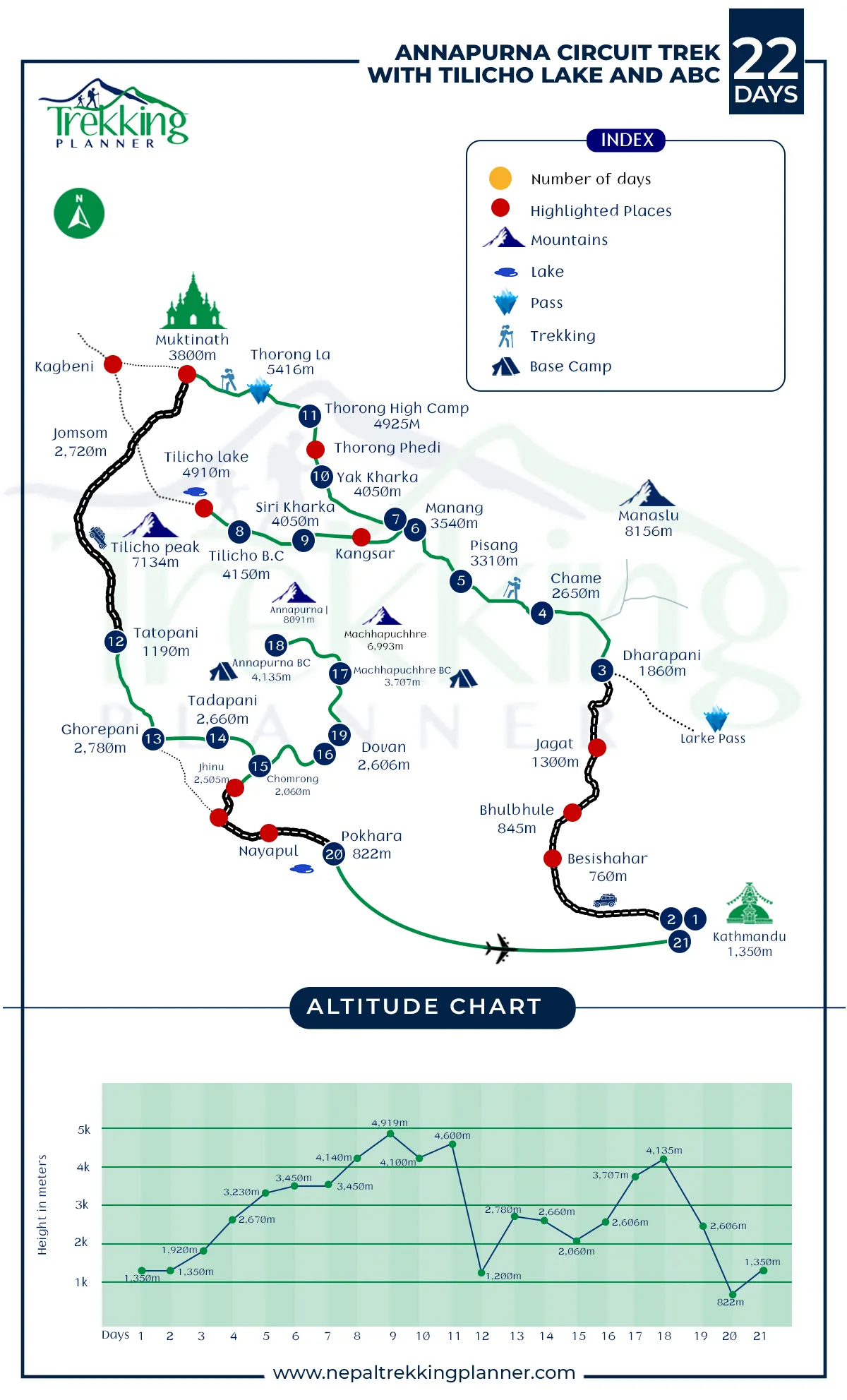
Day 1: Arrival in Kathmandu (1,350 m / 4,430 ft.) and transfer to the Hotel.

Day 2: Full day in Kathmandu with city tours and Trekking preparation 

Day 3: Drive to Dharapani 1,920 m/6299 ft, on Nepal Western highway via Besisahar- about 9-10 hrs. drive

Day 4: Trek to Chame 2,670 m/8760 ft - 5 hours.

Day 5: Trek to Pisang 3, 230 m/10597 ft - 5 hrs.

Day 6: Trek to Manang Village 3,450 m/11319 ft - 5 hrs.

Day 7: Rest day at Manang for local hikes and acclimatization.

Day 8: Trek to Tilicho Base Camp 4,140 m/13583 ft - 4 hrs.

Day 9: Trek to Tilicho Lake 4,919 m/16139 ft and at base camp – 4 hrs and same day Trek to Siri Kharka 4,110 m/13485 ft - 4 hrs.

Day 10: Trek to Yak Kharka 4,100 m/13452 ft- 06 hrs.0

Day 11: Trek to Thorang High Camp 4,600 m/15092 ft - 4 hrs.

Day 12: Trek to Muktinath 3,800 m/12468 ft crossing Thorang-La Pass 5,416 m/17769 ft- 6 hrs and Drive to Tatopani 1,200 m/ 3, 940 ft on local bus – 04 hrs

Day 13: Trek to Gorepani (2780m/9121ft) 6-7 hrs walks

Day 14: Ghorepani to Tadapani (2660m/8727ft) 4-5 hrs walks

Day 15: Tadapani to Chomrong (2060m/6759ft) 4-5 hrs walk

Day 16: Chomrong to Dovan (2606m/8550ft) 5-6 hrs walk

Day 17: Dovan to Machhapuchhre Base Camp (3707m/12163ft) 4-5 hrs walk.

Day 18: Machhapuchhre Base Camp to Annapurna Base Camp (4135m/13567ft) 2-3 hrs walk

Day 19: Annapurna Base Camp (ABC) to Dovan (2505m/8219ft) 5-6 hrs walk

Day 20: Dovan to Jhinu (1780m/5840ft) 5-6 hrs walk and drive to Pokhara (820m/2690ft) about 3 hours’ drive

Day 21: Morning explore Pokhara and afternoon fly back to Kathmandu(1350m/4430ft)

Day 22: Final departure

Note: If you want to customize the trip or custom hand-picked facilities instead of the whole package, we also have those services. So, feel free to contact us or speak with an expert  +977 9851071767

Annapurna Circuit Trek with Tilicho Lake and ABC - 22 Days Itinerary

Day 1

Arrival in Kathmandu (1,350 m / 4,430 ft.) and transfer to hotel.

Max Altitude: 1,350m (4,429ft)

As you proceed outside the Tribhuvan International Airport of Kathmandu, Nepal, a representative of Trekking Planner Nepal will be waiting for you outside with a placard of your name that eases for identification. After meeting and greeting the representative, transfer your bag to the private vehicle and drive towards your hotel in Thamel. The drive takes about 20 minutes depending upon the traffic condition. Along the way you can get a glimpse of the UNESCO World Heritage Site of Pashupatinath Temple.

Upon reaching the hotel, the representative will help you with the check in. After check-in, rest for a bit and later in the afternoon you will meet the company owner where you will discuss the trek. The discussion includes trek preparation, route overview, difficulty level, acclimatization, accommodation, food, permits, team introduction, and gear check.

After the briefing, later in the evening, you will join the company members for a welcome dinner in an authentic Nepalese restaurant. You can enjoy a variety of Nepali cuisine from starter, main course and desert with traditional dance and music. Then, as the dinner concludes, you will be escorted to your hotel. 

If you have time left you can still explore the streets of Thamel and enjoy the nightlife. Be sure to pack your belongings and prepare for the next day. Overnight in Kathmandu.

Day 2

Full day in Kathmandu with city tours and Trekking preparation

Max Altitude: 1,350m (4,429ft)

Wake up, refresh, and have breakfast at your Kathmandu hotel. After breakfast, get ready and meet your company representative in the hotel lobby for your guided sightseeing tour in Kathmandu. Today you will visit the most popular attractions of Kathmandu city, shown by our tour guide in a private vehicle. The representative will introduce you to your tour guide who will take you to UNESCO World Heritage Sites of Swayambhunath Stupa, Pashupatinath Temple, Kathmandu Durbar Square, and Boudhanath Stupa, all located in the heart of Kathmandu.

Your guide will take care of the logistics and permits required for the tour so rest assured and enjoy the locations. You can start off by visiting Swayambhunath stupa or Kathmandu Durbar Square which are the closest from Thamel.

  • Swayambhunath Stupa: Perched at the hilltop station in the heart of Kathmandu, the Swayambhunath temple is a sacred site. The stupa blends in both Hinduism and Buddhism setting an example of religious harmony around the world. Swayambhunath is also known as “Monkey Temple” due to the presence of a large number of holy monkeys around the premises. The popular attractions of the Swayambhunath are as follows:
  • Swayambhunath Stupa: It is the main highlight of Swayambhunath. It is a white-domed structure with an all-seeing Buddha's eye and painted eyebrows.
  • Harati Temple: It is a two-story pagoda-style temple gilded in gold. It is located on the northwest side of the Swayambhunath temple. The temple is known as the protector of children.
  • Anantapur Temple: It is located on the southern side of Swayambhunath, which is named after the queen of Pratap Malla, Anantapriya. The temple is dedicated to Goddess Ajima in the form of Parvati.
  • Pratappur Temple: It is a three-story brick temple in the Shikhar style, with intricate carvings. It is located on the northern side of Swayambhunath, which is named after King Pratap Malla. The temple is dedicated to God Bhairav in the form of Lord Shiva.
  • Statue of Dipankar Buddha: The statue lies in the corner behind the small statues of Swayambhunath. It is made of a single stone that dates back to the 7th century.
  • The Vajra: It is a lightning bolt that is placed in front of the Swayambhunath stupa. It is not exactly a lightning bolt, but a depiction that symbolizes hardness, indestructibility, and power.
  • Dewa Dharma Monastery: It is situated on the western side of Swayambhunath, which prioritizes meditation practices.
  • Amideva Buddha Park: The park has three giant golden Buddha statues and a beautiful garden.
  • Word Peace Pond: It lies on the western side of Swayambhunath, where the pond's center features a bronze statue of Siddhartha Gautama. There is a bowl near the statue where visitors can see coins being thrown. It is believed that a wish is granted if the coin falls inside the bowl.

With the visit to the stupa, move on to your next destination which is the Kathmandu Durbar Square. Kathmandu Durbar Square is a royal courtyard that features ancient Newari architecture. The durbar consists of temples, monuments, and royal palaces. The popular landmarks of Kathmandu Durbar Square are as follows:

  • Hanuman Dhoka Palace: A stone statue of Lord Hanuman stands at the front of Kathmandu Durbar Square, giving it the name Hanuman Dhoka Durbar Square.
  • Kumari Bahal: In the Local language, we call Kumari the Living goddess. Some books mentioned princes for her. Bahal is a local monastery in a quadrangle layout; it is the official residence of a Living Goddess. The Kumari cult is a living harmony of Hinduism and Buddhism. The selection process is similar to that of the Dalai Lama. She is a reincarnation of Goddess Taleju. We select young girls at an early age; usually, they are chosen when they are 3- 5 years old. They get retired after their first menstruation.
  • Kalabhairab: The god of justice, in the 17th century, it was used to detect the truth as a lie detector. Now people still pray for good luck.
  • Kasthamadap: 12th-century wooden temple constructed from a single giant tree. The name Kathmandu is also derived from this temple. Kathmandu means Wooden temple; this is the wooden temple. Freak Street- in 1960, many hippies came and enjoyed it.
  • Shiva Parvati Temple: Shiva and his wife are watching from a window, so we need to do good karma.
  • Nasal Chowk: The central ceremonial courtyard of the royal palace. It was last used in 2001 AD.
  • Mohan Kali Chowk: Richest artwork on stone, metal, and wood we can observe here.
  • Sundari Chowk: Royal bath with snake carving on a single piece of stone.

As the visit to the Kathmandu Durbar Square concludes, you will then move to Pashupatinath Temple. Pashupatinath is the oldest Hindu temple of Nepal and located on the banks of holy Bagmati river. The main temple is accessible to only Hindus which is dedicated to Lord Shiva. The main attractions of Pashupatinath Temple are as follows:

  • Mukhalinga: A sacred stone representing Lord Shiva's face.
  • Guhyeshwari Temple: It is a prominent Hindu shrine featuring the "yoni" emblem of goddess Sati. It represents divine feminine energy and spirituality.
  • Gorakhnath Temple: Dedicated to Guru Gorakhnath, a respected figure in Hinduism's Nath lineage.
  • Western Cremation Ghats: The Hindu cremation ritual is performed here.

After you visit Pashupatinath, you will head to Boudhanath. The drive will take about 20 minutes, depending on traffic. Boudhanath is a white-domed structure with an all-seeing Buddha eye that represents wisdom. Likewise, the stupa has a pinnacle that symbolizes Mt. Sumeru, the king of the mountains. The major attractions around the Boudhanath stupa are as follows:

  • Ajima Temple: Temple of Goddess Mamo Pusaki, who is known as the protector of the stupa. It is located to the north of the main Boudhanath stupa.
  • Historical Pond and Ghyoilisang Peace Park: the pond is located to the northwest of the Boudhanath stupa, and it is also known as Ghyoilisang in the Tamang language.
  • Guru Lhakhang Monastery: Believed to be the oldest Nyingma monastery in the area. The main attraction in the monastery is the beautiful statues of Guru Padma Sanbhava, Amitabha Buddha, and Arya Avalokiteshwara.
  • Jhamchen Lhakhang Monastery: The monastery has a 32-foot-high statue of Maitreya Buddha. The Jhamchen Lhakhang Monastery is preserving Sakya tradition and ritual practice.
  • Samtenling Monastery: This is the oldest and first-ever Tibetan monastery in Boudhanath, located on the east side of the main stupa.
  • Dilyak Yebam Monastery: Also known as the Dhapsang Monastery of the Thousand Buddhas. Here, all the Buddhists practice rituals and other religious activities.

Lastly, after the visit to Boudhanath, you can have lunch at a nearby restaurant. You can taste local cuisine including Tibetan food. Then as lunch concludes, return to your hotel in the private vehicle. When you reach the hotel, rest and have dinner at the hotel. Prepare for the trek the next day. Stay overnight in Kathmandu.

Sidetrips

  • Bhaktapur Durbar Square
  • Patan Durbar Square
  • Changunarayan Temple
  • Chandragiri Hilltop
  • Nagarkot Viewpoint
Day 3

Drive to Dharapani 1,920 m/6299 ft, on Nepal Western highway via Besisahar- about 9-10 hrs. drive

Max Altitude: 1,920m (6,299ft)

Today, wake up, refresh and have breakfast. After breakfast, get ready at the hotel lobby where a private vehicle will take you to the bus station for the drive to Dharapani. As you board the bus and join the journey, you will embark on the long drive along the western highway of Nepal while slowly transitioning from urban Nepal to the rural areas.

Most of the roads are smooth and black topped while some sections can be bumpy due to ongoing construction work. So, with the occasional view of waterfalls, traditional houses and cliffside roads you will reach Besisahar. From Besisahar, a minor road takes you through several villages like Khudi, Bulbule, and Ngadi progressively.

Then, you will follow along the route of Marsyangdi River upstream where you will be greeted with lush rice fields, and charming villages to reach Syange. From Syange you will begin the off-road uphill drive leaving the Marsyangdi river behind to reach Jagat. Jagat is a small farming village with teashops and lodges suitable for trekkers to take a short break from the drive.

From Jagat, you will continue along the zigzag road which leads to Chamje. After Chamje, you will cross the Marsyangdi river to enter the forest area with views of Annapurna and Manaslu Mountain Range. With continued drive you will get to Tal Besi located behind a beautiful waterfall. Driving ahead of Tal Besi for about half an hour, you will reach Dharapani. Dharapani is a charming village situated at the junction of Annapurna Circuit and Manaslu trekking trail.

Upon reaching Dharapani, settle in an accommodation option and have dinner. After dinner, rest and stay overnight in Dharapani.

Day 4

Trek to Chame 2,670 m/8760 ft - 5 hours

Max Altitude: 2,670m (8,759ft)

Today after breakfast, you will leave Dharapani behind and move on the route which leads to Chame. The trek continues along the winding trails through the rhododendron and pine forests. Then, you will pass traditional villages like Bagarchap and Danque before reaching the Timang village.

From there, you will follow the Marsyangdi river with a glimpse of Mount Annapurna II and Lamjung Himal. Below these snow-capped mountains you will see ancient villages and local settlements. Then with moderate level trekking you will reach Chame which is the headquarter of Manang.

Chame is a vibrant village and a key stop on the Annapurna Circuit Trek which is known for its hot springs. Upon reaching the village, you can enjoy the himalayan views and take a rejuvenating bath at the hot spring. Then, settle in your accommodation option and have dinner. After dinner, attend the trek briefing for the following day and stay overnight in Chame.

Day 5

Trek to Pisang 3, 230 m/10597 ft - 5 hrs

Max Altitude: 3,230m (10,597ft)

Begin your day 5 with a heartfelt breakfast at Chame, then pack your trekking bag and get ready to leave the village. Then, you will cross the suspension bridge hanging over the Marshyangdi river and head north through the narrow valley. Following the gentle uphill along the riverbank you will reach Bhratang which lies about 7km from Chame.

Reaching Bhratang, you can explore the charming village known for its massive apple orchards and apple pie. Then, you will gradually take the narrow trail to reach Paungda Danda which is also known as Heaven’s gate or Swarga Dwari. Paungda Danda is a 1500 meter granite rock rising from the river making it one of the most photographed landmarks on the entire circuit.

With a short break on the danda, you will continue through the pine forest for another 6km or so to reach Dhukur Pokhari. Dhukur Pokhari is filled with teahouses making it a suitable lunch or tea stop. It is also the highest point of the day which sits beside a small pond offering mountain views.   

After lunch, the trail forks with the easier trail leading to Lower Pisang, and the uphill climb leading to Upper Pisang. Then, following the upper Pisang trail, you will get to your overnight stop of Pisang. Upon reaching the village, you can see traditional stone houses, prayer flags, chortens and peaceful gompa. Then, settle in your accommodation option and have dinner. After dinner, attend the trek briefing to prepare for the following day. After the briefing, stay overnight in Pisang.

Day 6

Trek to Manang Village 3,450 m/11319 ft - 5 hrs

Max Altitude: 3,450m (11,318ft)

With the stunning morning light, wake up, refresh, and have breakfast in Pisang. Then, begin your journey on the Annapurna Circuit with Tilicho Lake and Annapurna Base Camp trek. Leave Pisang behind and set on the trail which will lead to Manang, your destination for today. Catch the trail head located in the north which takes you to an open slope with a wide view of the valley. Then, you will come across the zig zag ascent of about 400 m which is roughly over 5km. It is the most challenging part for the day but it surely rewards with the best panoramic view.

As the ascent is over, you will reach the traditional village of Ghyaru. The village is stacked with stone houses making it a perfect location for hot drinks and tea. Then, from Ghyaru, the trail continues towards the high valley. Your next destination after Ghyaru will be Ngawal which is a Tibetan style village with monasteries and mani walls. You can stop for a rest and lunch in Ngawal.

After Ngawal, descend carefully towards Braga. Braga is home to the famous Braga monastery which is perched on a hill. It is a notable place for visiting which allows for cultural insights. Then, leave Braga behind and head towards the bustling Manang village. Along the route, you will see Annapurna II, Annapurna IV, Pisang peak and Lamjung himal. Once you reach Manang, explore the village filled with teahouses, bakeries, shops and monasteries. Manang is a suitable place for acclimatization. Then, settle in an accommodation option and have dinner. Following dinner, attend the trek briefing and stay overnight in Manang.

Day 7

Rest day at Manang for local hikes and acclimatization.

Max Altitude: 3,450m (11,318ft)

Your seventh day is allocated for rest and acclimatization in the Manang village situated at 3,540 meters. Start your day with a leisurely breakfast at the comfortable teahouse of Manang. Then, select your acclimatization hike that blends light exercise with stunning scenery. One of the notable options can be a 1-2 hour round trip to Gangapurna Lake.

For the acclimatization hike to Gangapurna Lake (3,540 m), you will cross a river via a cemented path and climb past terraced fields and yak pastures. You will then reach the glacial lake of Gangapurna marked with reflection of notable peaks that dominate the horizon. Popular mountains seen during the hike are Gangapurna, Annapurna II, Annapurna III, Annapurna IV, Chulu East, Lamjung Himal and Pisang peak.

Another popular option can be the visit to Praken Gompa which is located at 3,965 m. The gompa is settled on the ridge above Manang village and holds immense cultural and spiritual significance. On a clear day, the gompa also allows for a panoramic view of the valley below and mountains above.

Lastly, you also have the option to visit Ice lake also known as Kicho Tal which is located at an altitude of 4,600 m. You will ascend through rocky slopes and open terrain to the high altitude lake which is often partially frozen giving it the name Ice Lake. In addition to the beauty of ice lake, you can also see the mountain views surrounding the lake. Capture photographs, and enjoy the views.

Acclimatization hike is a key feature of Annapurna Circuit with Tilicho Lake trek especially for beginner and intermediate trekkers. Acclimatization allows your body to adapt to the low oxygen level and prepare your body for high altitude treks in the coming days thereby minimizing the chance  of altitude sickness.

After the acclimatization hike, if time persists, you can visit the village of Manang. The day combines cultural immersion through interaction with the Manangi locals and visiting chortens or monasteries. With that, return to your accommodation option and have dinner. Attend your regular trek briefing and stay overnight in Manang.

Day 8

Trek to Tilicho Base Camp 4,140 m/13583 ft - 4 hrs

Max Altitude: 4,140m (13,582ft)

Today, after breakfast, you will leave Manang behind and get on to the trekking trial to head towards Tilicho Base Camp. Starting the trek, you will leave the main trail of Annapurna Circuit and head towards the west of Khangsar River valley. Then with gentle climb through forests, yak pastures and traditional stone houses you will reach Khangsar village. With a quick stop for lunch in Khangsar, continue onward through alpine areas and rugged terrain to reach Siri Kharka. 

Siri Kharka is an essential acclimatization stop in Annapurna Circuit trek and trekkers halt here before undertaking the high altitude landslide prone route of Tilicho Base Camp. Siri Kharka also provides amazing views of Annapurna Massif, Gangapurna, and Tilicho Peak.

After the notable pause in Siri Kharka, you will then take on the narrow path, with loose rock cliffs, and landslide prone sections. With careful footing, navigate towards the high altitude like desert landscape and arrive at Tilicho Base Camp. With your arrival in the base camp, witness the views of Tilicho Peak, Annapurna II, Gangapurna, Nilgiri and Khangsar Kang.

Then, settle in an accommodation option and have dinner. After dinner, attend the trek briefing and understand some techniques before reaching Tilicho lake on the following day. When the briefing is done, head to your room and stay overnight in Tilicho Base Camp.

Day 9

Trek to Tilicho Lake 4,919 m/16139 ft and at base camp – 4 hrs and same day Trek to Siri Kharka 4,110 m/13485 ft - 4 hrs.

Max Altitude: 4,919m (16,138ft)

Wake up early around 4-6 AM, and with breakfast at the teahouse in Tilicho Base Camp begin your walk towards Tilicho Lake. Tilicho Lake is the highest altitude lake of Nepal so prepare to face the challenging yet rewarding ascent. Also, take your essential items like warm layers, hat, gloves, sunscreen and trekking poles for the section.

After all that, begin your steady uphill climb through steep hills, loose slopes and rocky moraine. The paths are also narrow so careful footing and listening to the guide’s instructions is very important. Then, continue along the landslide prone area. With a total of about 3 hours walk, you will reach the shores of Tilicho Lake.

Enjoy the turquoise water, and panoramic view of the snowy mountains. The main highlights include breathtaking views of Tilicho Peak, Kangsar Kang, Annapurna Massif with Annapurna II, Nilgiri and Gangapurna. Immerse in the beauty and peace of Tilicho Lake, take photographs and gain unforgettable memories.

After the visit, begin the descent along the same route back to Tilicho Base Camp. With lunch, pass the base camp and continue further down. Conquer the rocky sections for another 2-3 hours to arrive at Siri Kharka. Upon reaching Siri Kharka, settle in an accommodation place and have dinner. After dinner, attend the trek briefing and stay overnight in Siri Kharka.

Day 10

Trek to Yak Kharka 4,100 m/13452 ft- 06 hrs.

Max Altitude: 4,100m (13,451ft)

Wake up, refresh, and have breakfast in the teahouse. After breakfast, pack your bags and get ready to leave Siri Kharka. Begin to descend gradually from Siri Kharka and join the main Annapurna Circuit Trekking Trail through rugged rocky slopes. Then along the alpine terrain, head towards the near-deserted Old Khangsar Village. You can also visit the thousand year old Tare Gumba or monastery here.

Afterwards, continue along the narrow path through Thorong Khola Valley consisting of gentle ascents and descents, crossing suspension bridges before climbing steadily through open alpine meadows. Then continue along the route to see low vegetation and pastureland with grazing yaks. There is also the chance to see Blue Sheep in this section before you reach the settlement of Yak Kharka. Besides that, enjoy the majestic view of Annapurna III, Gangapurna, Annapurna II, Nilgiri and Tilicho Peak in the distance.

After reaching Yak Kharka, settle in an accommodation place and have dinner. After dinner, attend the trek briefing and stay overnight in Yak Kharka.

Day 11

Trek to Thorang High Camp 4,600 m/15092 ft - 4 hrs.

Max Altitude: 4,600m (15,091ft)

Start your day early with breakfast around Yak Kharka and follow a clear trail that climbs through open meadows. You can see grazing yaks and blue sheep in the area then reach Letdar, your first key stop in the section. After a quick stop to refill water bottles and clicking photos, you will continue gradually for another 2 hours to reach Thorong Phedi.

Thorong Phedi was previously the base camp before undertaking the Thorong La Pass. The area is barren with views of Annapurna massif including Annapurna III, Gangapurna, and Chulu peak in the north. Then with lunch at Phedi, you will undertake a steady climb that takes you to Thorong High Camp.

Reaching Thorong High Camp, welcomes you with the views of giants like Annapurna II, Thorong Peak and Dhaulagiri in the distance located in the high-altitude desert-like environment. Also, the area is marked with prayer flags and cozy teahouses that provide meals and a chance to acclimatize properly.

After a surface exploration of Thorong High Camp, settle in an accommodation option and have dinner. With dinner, attend the trek briefing and stay overnight in Thorong High Camp.

Day 12

Trek to Muktinath 3,800 m/12468 ft crossing Thorang-La Pass 5,416 m/17769 ft- 6 hrs and Drive to Tatopani 1,200 m/ 3, 940 ft on local bus – 04 hrs

Max Altitude: 3,800m (12,467ft)

Today marks the most important day of the entire trek so you will have to wake up super early. With a super light breakfast, you will tackle the 2-3 hours long steep climb through rocky sections and snowy patches to reach the summit of Thorong La Pass, the highest point of the entire trek and one of the highest mountain passes of the world.

You will begin early to omit the afternoon wind and ensure a safe daylight for the long descent. Initially you will gradually climb a series of steep, well marked snowy trails. Your previous acclimatization experience and physical fitness is tested during the uphill grind where every step seems to be heavy due to low oxygen in the increasing altitude. Be sure to walk slowly and listen to your body for any signs of altitude sickness.

With the grinding walk which may feel like ages, enjoy the raw and alpine beauty of the landscape. Look out for majestic Annapurna massif, including Annapurna III, Gangapurna, Thorong Peak, Nilgiri and others. Once you reach the summit of Thorong La Pass, the ultimate reward awaits you. Thorong summit, marked with a cluster of colorful prayer flags, welcomes you with the 360-degree view of Annapurna and Dhaulagiri blended in with beautiful sunrise. Standing at the top, creates a magical sense of achievement making you full of excitement and glory.

After immersing yourself in the views, capturing photographs, and reaching the top of Thorong La Pass,  begin the return journey. You will descend through the knee-testing route with barren slopes to reach into the arid Mustang like valley in the town of Muktinath. Muktinath is a sacred pilgrimage site holding immense importance for both Hindus and Buddhists.

Arriving at Muktinath, take a short lunch break or if you are willing to visit the sacred site for a more spiritual depth, worshipping in an empty stomach is recommended. The Muktinath Temple area consists of the main temple, 108 water sprouts, and two kundas. Once you are ready, begin the exploration of the main highlights of the temple including:

1. The 108 Holy Water Spouts (Mukti Dhara)

The 108 Holy Water Spouts are located directly behind the Muktinath Temple, forming a semicircular row across the courtyard. The ice-cold water flows continuously from each spout originating from the Himalayan springs. Pilgrims mostly walk through all 108 spouts, believing that doing so will cleanse negative karma and lead to liberation.

2. Sacred Kunda (Two holy ponds- Mukti Kunda)

The Mukti Kunda is located after you pass the Mukti Dhara. These are two holy ponds known as Laxmi Kunda and Saraswati Kunda. After bathing in the 108 spouts, most pilgrims dive in the Kunda for spiritual purification.

3. Muktinath Temple (The Main Vishnu Shrine)

Muktinath is the most notable highlight of the Muktinath area. The Temple is dedicated to Lord Vishnu and is designed in the Pagoda style. It has utmost religious importance in Nepal and for those who follow Hinduism.  As you visit the Temple, you can see the main idol of Lord Vishnu made out of gold. The Temple's outskirts feature a statue of Garuda, the divine vehicle of Lord Vishnu.

4. Jwala Mai Temple (Eternal Flame Temple)

The Jwala Mai Temple is located near the water spouts, which consist of a natural, eternal flame burning from a rock wall. Natural gas emissions, a miraculous phenomenon, fuel the flame. Beneath the flame, there is a small stream of water that symbolizes the union of all the elements of earth, including water, fire, air, sky, and earth.

5. Buddhist Monastery (Narsingh Gumba)

It is the main monastery of Muktinath, which is also known as the Temple of 1000 lamps. The monastery is dedicated to Guru Rinpoche. However, Hindus also worship here regarding Narsimha, the avatar of Lord Vishnu, as the main deity. Likewise, the monastery has a central statue of Guru Rinpoche with other deities, including Drag Po and Seng Dong.

With that, completes the exploration of Muktinath temple. Then, have lunch at any suitable location of interest. Then, begin the return journey where you will drive from Muktinath to Tatopani. The drive will last about 4 hours through Kali Gandaki Gorge, one of the deepest in the world. Then, passing traditional villages, apple orchards, and high desert areas, you will reach the lower green valley of Tatopani. Tatopani is known for its naturally occurring hot springs. So after reaching Tatopani, you can get in the hot spring for a soothing, rejuvenating experience much needed after the long tiring trek.

Then, settle in your accommodation option and have dinner. After dinner, attend the trek briefing and stay overnight in Tatopani.

Day 13

Trek to Gorepani (2780m/9121ft) 6-7 hrs walks

Max Altitude: 2,780m (9,120ft)

Wake up, have breakfast, and get ready to leave Tatopani and head towards Ghorepani. Begin by crossing the iconic Kali Gandaki River one last time and begin the gradual climb. You will pass through numerous settlements and terraced fields near Ghara or Dana. Then, while enjoying the views through traditional Magar and Gurung Village like Shikha and Phalate you will reach the midway at Durbin Danda.

With some rest time in Durbin Danda, you can enjoy the clear view of Dhaulagiri Massif and Annapurna Massif. Then, you will have to start the walk through a dense rhododendron or oak forest filled with sounds of chirping birds. As you progress along the route you will reach the trekking destination of Ghorepani.

Ghorepani, a small village along the Annapurna region, is also a part of Annapurna Conservation Area. It is reputed for the sunrise and sunset view that portrays along the Dhaulagiri and Annapurna mountain. Besides that, upon reaching the village of Ghorepani, you are welcomed with views of Annapurna South, Nilgiri, Hiunchuli, Tukuche Peak and Machhapurchre in the distance.

With the mesmerizing view, settle in an accommodation option and have dinner. You can interact with the locals, and spend some quality time gaining insights about the village, its culture, religion and customs. After dinner, attend the trek briefing and stay overnight in Ghorepani.

Day 14

Ghorepani to Tadapani (2660m/8727ft) 4-5 hrs walks

Max Altitude: 2,660m (8,727ft)

The morning begins with a delicious breakfast in Ghorepani. Then, pack your bags and get ready to leave Ghorepani and head towards Tadapani. Today’s journey covers around 8-10 km where the trail is a mix of gentle climb and descents. Leaving Ghorepani behind, you will get going on a well marked trekking trail following a steady climb for the first 1-2 hours. The climb is along the peaceful rhododendron and oak forests.

Completing the climb, you will reach the key high point of Deurali Pass situated around 3,210 meters which opens a breathtaking panoramic view of the surrounding peak. From the top, the path descends gradually to reach Banthati village which is a perfect stop for quick snack, tea, rest or water refill.

Then, from Banthati, you will continue for another 2-3 hours while viewing Annapurna South, Machhapuchhre, Hiunchuli, and distant Dhaulagiri. Walking today is long but not overly strenuous making it ideal for pacing and staying hydrated. Then, with a gradual walk, you will arrive at the charming Gurung settlement of Tadapani village.

Tadapani showcases world’s famous rhododendron forests that possess red and pink blooms especially during the Spring (March to May) season. Arriving at Tadapani, you can enjoy the rich biodiversity, local Gurung life, and raw Himalayan scenery. Then, with quality time in Tadapani, settle in an accommodation option and have dinner. After dinner, attend the regular trek briefing and stay overnight in Tadapani.

Day 15

Tadapani to Chomrong (2060m/6759ft) 4-5 hrs walk

Max Altitude: 2,060m (6,758ft)

Starting after a delicious breakfast, get ready to leave Tadapani and head towards Chomrong. You will follow a well-maintained stone staircase that gently descends for the first 1-2 hours through dense forest and occasional wildlife sightings.

Then, with a gentle walk you will reach the traditional village of Ghandruk. Ghandruk is one of the culturally rich villages of Nepal which offers beautiful mountain views and warm hospitality. The village is marked with stone houses with flat slate roofs and the area provides stunning views of Annapurna South, Hiunchuli and Machhapuchhre. Also, Ghandruk is famous for its homestay experience that allows travelers to experience the local lifestyle of the Gurung people. You can taste local dishes like Dhido and Sel roti. There is also a Gurung museum that allows travelers to wear Gurung dress and understand more about the culture. 

With quality time in Ghandruk, you will continue along the gentle up and down route. Then following the steady descent, you will reach into the beautiful Chomrong village. Chomrong village serves as the gateway to Annapurna Base Camp trek that provides a majestic view of Annapurna South, Machhapuchhre, Hiunchuli and a glimpse of Annapurna I.

So, after arriving at Chomrong, immerse in the quality time and have dinner. As dinner concludes, follow with the trek briefing session. After the briefing session, head towards your room, rest, and stay overnight in Chomrong.

Day 16

Chomrong to Dovan (2606m/8550ft) 5-6 hrs walk

Max Altitude: 2,609m (8,559ft)

Today, wake up, refresh, and have breakfast at Chomrong. After breakfast, get ready to leave Chomrong and start your walk towards Dovan. Beginning the walk, you will descend through the thousand steep stone stairs also known as “stairway to heaven” and cross the suspension bridge located over the Modi Khola River. Afterwards, you will begin with the steady climb on the well marked trail to reach Sinuwa. 

Sinuwa is a traditional village in the Annapurna region and officially the entrance of Annapurna Sanctuary. Upon reaching the village you can see majestic mountains including the Annapurna South, Hiunchuli, and the iconic “Fish Tail” or Machhapuchhre.

Similarly, you can keep a close eye for sighting wildlife including the Himalayan Monal, the national bird of Nepal. Then, walk further through pine, bamboo, and rhododendron forests in an uphill climb to reach the midway at Bamboo village. Teahouses present in Bamboo welcome you for a replenishing lunch, rest and water refill. Then, with the short break, walk through the thick bamboo woodland and complete the 2-3 hours final ascent to reach Dovan.

Dovan is a quiet teahouse stop which gives you the proper introduction of Annapurna Sanctuary. You can see the rich biodiversity, with possible wildlife sightings. Also, the views of Annapurna South, Machhapuchhre, Hiunchuli and Annapurna I are seen at a glance. With the exploration of the area, settle in an accommodation option. You can have dinner there and attend the trek briefing. Afterwards, head to your room and stay overnight in Dovan.

Day 17

Dovan to Machhapuchhre Base Camp (3707m/12163ft) 4-5 hrs walk.

Max Altitude: 3,707m (12,162ft)

Wake up, refresh, and have breakfast at Dovan. After breakfast, get ready to leave Dovan and head towards Macchapuchre Base Camp (MBC). Today’s walk brings you deep inside the Annapurna Sanctuary while providing a close view of mountain views.

Beginning the walk, you will follow the well-marked rocky and stone paved trail with steady uphill climb. With that, you will reach the settlement of Deurali where you can rest and refill water in a short breath. Afterwards, continue along the route with a mix of forest sections and more exposed rocky terrain to reach Machhapuchhre Base Camp.

Machhapuchhre Base Camp is the foot of Mount Machhapurchhre also known as Fish tail. The MBC has a small number of teahouses that cater trekker’s needs. Once you reach MBC, you can see 360-degree breathtaking views of Mount Machhapuchhre, Annapurna I, Annapurna South, Gangapurna, and Hiunchuli. You can also see the glacier field and white snow covering the area making it a white heaven.

As you approach dawn, you can also see the glowing golden red sunlight reflecting on the white peaks that slowly depart through the horizon. Sunset and sunrise in the area gives spectacular visuals mesmerizing every visitor that witnesses it.

Then, settle in your accommodation option. The facilities remain pretty basic with limited hot showers, unreliable WIFI and charging cost. But the remoteness does provide an authentic himalayan experience. Afterwards, dinner is served followed by the regular trek briefing. Later, head to your room, make yourself comfortable for cold evenings, and stay overnight in Machhapuchhre Base Camp. 

Day 18

Machhapuchhre Base Camp to Annapurna Base Camp (4135m/13567ft) 2-3 hrs walk

Max Altitude: 4,135m (13,566ft)

Today, you will have to wake up early in the morning and with a light breakfast, you will move towards the marvelous destination of Annapurna Base Camp. Beginning the walk, leave MBC, and carry on with a gentle steady climb. As the climb ends, you are welcomed with open glacial fields with no major traditional settlements. You can only see some small rocky shelters and prayer flags.

Moving forwards approximately halfway through the trek, you can see a small rocky viewpoint or rest point where many trekkers pause to catch a breath. Then moving forward for about a few hours you will arrive at the Annapurna Base Camp. Congratulations!

Once you reach Annapurna Base Camp, you are greeted with mesmerizing view of Annapurna I, Annapurna III, Annapurna South, Machhapuchhre, Gangapurna, Khangsar Kang, Hiunchuli, Singhu Chuli, Gandarba Chuli, Bharha Chuli and others.

With the 360 degree panoramic view of mountains, enjoy the quality time and immerse in the view. Capture photographs, shoot some timelapse and celebrate the true achievement of reaching the Annapurna Base Camp. Also, you can spend time admiring the landscapes and also find the statue of Maurice Herzog, the first mountaineer to conquer Annapurna I summit in 1950. Also you can see the memorial site of Park Young Seok who lost his life trying to summit Annapurna South in 2011.

The ABC located at 4,135m provides an amazing sunrise or sunset so if you are on time be sure to enjoy the sunrise or sunset view especially the golden sunrays hitting the snow-capped peaks. It is truly a mesmerizing site to see. But due to the high altitude, the area can get cold quickly. So make sure to prepare yourself accordingly. Then, with the quality time in the base camp spend the rest of the afternoon and evening relaxing and staying hydrated.

Settle in your accommodation option where you can have a carb-rich meal for lunch and dinner. Also be sure to observe the raw beauty of the area and enjoy the close mountain view from your accommodation window. You can have a discussion with the guide to understand more about tomorrow’s schedule and plan. Then with dinner, you will stay overnight in Annapurna Base Camp.

Day 19

Annapurna Base Camp (ABC) to Dovan (2505m/8219ft) 5-6 hrs walk

Max Altitude: 2,505m (8,218ft)

On the 19th day your dream of visiting the Annapurna Circuit, Tilicho Lake and Annapurna Base Camp has finally come true and now it's time to continue the return journey. So, with breakfast at the accommodation in Annapurna Base Camp with the most awe-inspiring mountain view, get ready to leave ABC and head to Dovan.

Starting the return journey, you will retrace your walk through a well-marked trail along the Modi Khola River valley firstly reaching MBC. Then from MBC, you will continue downhill through the narrow rocky corridor and avalanche prone section to reach Deurali which literally means “the pass”. Then, from there you will follow the rugged, exposed environment inside the Annapurna Sanctuary.

Afterwards, continuing along the route, you will pass the Hinku Cave, which is a big natural rock that is used by porters for shelter during bad weather. You can also see the Weeping wall, which is a tall rock cliff with many thin waterfalls.

With that, walking a little further, you will finally arrive at Dovan which is a traditional village located in lower Annapurna Sanctuary. The village has a simple teahouse, filled with pine and rhododendron forest. So settle in the accommodation option and have dinner. After dinner, attend the trek briefing for tomorrow and stay overnight in Dovan.

Day 20

Dovan to Jhinu (1780m/5840ft) 5-6 hrs walk and drive to Pokhara (820m/2690ft) about 3 hours’ drive

Max Altitude: 820m (2,690ft)

After waking up, have breakfast, get ready, and leave Dovan behind and walk towards Jhinu. You will start through the forested village of Dovan and follow along the Modi Khola river. From there, descend through the thick bamboo and rhododendron forests filled with green scenery. Then, moving forward you will reach Bamboo where you can rest and stay hydrated for a while. With some time for tea or snack you will continue towards the lower foothills to reach Sinuwa which is a traditional Gurung village.

From Sinuwa, you will cross a suspension bridge and climb a series of stone steps to reach Chhomrong. With a short break in Chhomrong you will descend through the steep stone step through forest and terraced farmlands to arrive at Jhinu Danda. Arriving at Jhinu Danda you can rest and later walk 15-20 minutes downhill to reach the famous natural hot springs beside the Modi Khola river.

With that, you will then hop onto a jeep which will take you to Pokhara. It will be a perfect way to end the trip and put some relaxation in your tired legs. The route is somewhat filled with off-road sections so prepare accordingly. Along the jeep drive, you will go through oak trees, rhododendrons, and cascading waterfalls. With the drive of about 3 hours you will reach Pokhara where you can celebrate the end of your trek.

Reaching Pokhara, settle in your accommodation option and have dinner. If time permits, you can stroll around the lakeside area of Pokhara filled with restaurants, cafes, and pubs. With some quality time, return to your hotel, attend the trek briefing and stay overnight in Pokhara. 

Day 21

Morning explore Pokhara and afternoon fly back to Kathmandu (1350m/4430ft)

Max Altitude: 1,350m (4,429ft)

Today is your final exploration day in Annapurna Circuit, Tilicho Lake and Annapurna Base Camp trek. So wake up, refresh and have breakfast in Pokhara. Then, pack your bags and get ready for the Pokhara Sightseeing Tour. You will visit some of the popular attractions of Pokhara which include:

Lakeside Pokhara: You will visit Phewa Lake, the second-largest lake in Nepal. You can spend quality time while boating across the lake, visiting the Tal Barahi temple in the middle. The lakeside area is a vibrant space with restaurants and pubs. It is also a good place for walking and peace.

Tal Barahi Temple: It is located in the center of Phewa Lake and is dedicated to the boar manifestation of Ajima. The temple is two-storied and represents the protester deity of female force. You can see pilgrims carrying male animals and fowls across the lake for sacrifice.

Bindabasini Temple: Located in the old part of Pokhara Bazaar, it is the oldest Hindu temple of Pokhara. You can seek blessings and offer offerings at the temple devoted to Goddess Bindhyabasini, regarded as an incarnation of Goddess Kali. It is believed that the central part of the goddess was brought from India.

Devi's Fall: It is a waterfall that forms a 500-foot-long underground tunnel before disappearing. The name is dedicated to a Swiss woman who lost her life while swimming there. The Davis fall area is beautifully landscaped and caters to tourists. The garden around the waterfall is perfect for spending quality time and taking photographs.

Gupteshwor Mahadev Cave: It is a large limestone cave that has a statue of the Hindu God Shiva. The limestone cave has an underground waterfall, proving the water from the Devi'sDevi's fall runs below the cave. The waterfall running down a small pool is one of the highlights of the Gupteshwor cave. Other than that, the cave has a large Shiva lingam at its entrance.

World Peace Stupa: It is a white, dome-shaped hilltop stupa located in Anadu Hill. The stupa symbolizes purity and offers a stunning view of Annapurna and Pokhara. The World Peace Stupa features four images of the Buddha, each facing a different direction. The peace pagoda has several trekking trails that cross Phewa Lake, or one can cycle along tracks to the top of the hill. Reaching the hilltop can be part of a blissful silence and cool breeze. You can meditate or interact with the local monks.

Pumdikot: It consists of a 51-foot-tall Shiva statue, which has religious significance. The Shiva statue is in a sitting position, with the right hand raised in a gesture of blessing. The left hand holds a Trishul, which symbolizes power to destroy for balance. There are 108 stone-paved steps to reach the top of the Shiva statue.

After the sightseeing tour, have some lunch at a suitable spot. Then, a private vehicle will drop you to the Pokhara airport to fly back to Kathmandu. Once you reach the airport, board the plane and with 35 minutes of flight you will get back to Kathmandu. Upon reaching Kathmandu, the representative of Trekking Planner Nepal Pvt. Ltd. will drive you back to your hotel in Kathmandu. Reaching the hotel, head to your room and rest for a while.

Later in the evening you will have a farewell dinner where you will meet the company people and discuss further about the trek and your experience with us. We will celebrate your successful completion of the trek and have a quality time. As dinner concludes, we will transfer you to your hotel where you will spend the night.

Day 22

Final departure

Max Altitude: 1,350m (4,429ft)

This is your last day in Nepal. According to your flight schedule, a private vehicle will pick you up and take you to Tribhuvan International Airport. We will then bid you a final goodbye, hoping to see you again. If you liked the experience with Trekking Planner Nepal, be sure to leave us a review on TripAdvisor. Then, with the last say, we will leave you at the airport to board the plane. Farewell and Best Wishes.

Still Confused?
No worries — team is ready to guide you everystep of the way.

Dates & Availability

Trip Duration
22 Days
Trip Starts & Ends Point
Kathmandu / Kathmandu
Plan your schedule
  • This Trek departs every day of the year privately.
  • For a sharing basis, pre-booking is required, as there need to be arrangements for a sharing basis.
  • This trip is fully customizable. We can customize the trip as per your needs.
  • This trip is available on a fixed departure and a private group basis.
  • This trip can be booked privately if you’re traveling solo, privately, or with family. Have a big group? We can help as per your needs. We can help you make it fit your budget.
  • We accept instant booking and online payment.
  • If the given date is not appropriate for you, please get in touch with us; Trekking Planner also organizes various trips in small groups that can suit you. We recommend you reserve a seat for yourself by booking with us right away for a wonderful experience.
  • (Call or email now for a private trip: [email protected]mobile +977-9851071767 (24 hours)—Whatsapp, WeChat, and Viber—so that Trekking Planner can happily manage your trip on dates favorable for you.

Interactive Map

StartMid DaysEnd

Essential Information

What are Required Annapurna Circuit Trek Permits?

The Annapurna Circuit with Tilicho Lake and Annapurna Base Camp Trek typically requires two essential permits to enter the protected areas of the Annapurna region and trek these regions. These permits help support the efforts of conservation, to contribute for the protection of the trails and ensure the safety of visitors throughout their journey.

Annapurna Conservation Area Permit (ACAP):

The Annapurna Conservation Area Permit (ACAP) is mandatory for all trekkers entering the Annapurna Conservation Area, Nepal's largest protected conservation region. The permit allows access to popular destinations, including Manang, Tilicho Lake, Thorong La Pass, Muktinath, Ghorepani, and Annapurna Base Camp. Permit checkpoints are located at various points along the trekking route, and trekkers must present their permit whenever requested by authorities.  

Trekkers' Information Management System (TIMS) Card:

The Trekkers’ Information Management System (TIMS) Card is a mandatory, basic registration document/permit which the trekkers need for all the treks in Nepal. It is jointly issued by the Nepal Tourism Board (NTB) and Trekking Agencies’ Association of Nepal (TAAN). It holds trekker’s personal details, itinerary, contacts and other essential information to ensure safety of trekkers. 

To obtain these permits, trekkers generally need a valid passport, a passport-sized photograph, and the required permit fees. When you book the Annapurna Circuit with Tilicho Lake and Annapurna Base Camp Trek with Trekking Planner Nepal, we take care of all the necessary permit arrangements on your behalf, allowing you to focus entirely on enjoying your Himalayan adventure.

Please note that permit requirements and government regulations may change over time. We always ensure that the latest permit procedures are followed before the start of your trek.

What is the Best time for Annapurna Circuit?

Annapurna Circuit Trek with add on trips of Tilicho and ABC is suitable to do all year round. However, the best time for the trek is during spring and autumn where the weather is moderate with clear sky. All of these three treks have similar high altitude himalayan conditions. So trekkers can expect heavy snowfall during winter, rainfall during monsoon, blooming vegetation during spring and visibility during autumn. Here is a breakdown for the best time for Annapurna Circuit with Tilicho Lake and Annapurna Base Camp:

  1. Spring (March to May): Spring is an excellent time for Annapurna Circuit Trek with Tilicho Lake and Annapurna Base Camp. The weather in and around the Annapurna region during spring is generally stable with mild daytime temperatures and comfortable trekking conditions. During this season, the average temperature is roughly 15-25℃ (59-77°F) at lower altitudes and 5-15℃ (41-59°F) at higher altitudes. Rhododendron forests bloom into vibrant shades of red, pink and white creating spectacular scenery along the trail at lower regions. Rainfall or Snowfall may occur occasionally especially at higher altitudes. 
  2. Summer (June to August): The summer season coincides with Nepal’s monsoon season, hence it brings frequent rainfall to the Annapurna region especially at lower regions. The trails below the rain shadow areas can become muddy, slippery and very prone to leaches. The average daytime temperature is roughly 18-30℃ (64-86°F) at lower elevations and 10-20℃ (50-68°F) at higher elevations. However, the upper parts of the Annapurna Circuit, particularly around Manang and Mustang, receive much less rainfall due to their location in the Himalayan rain shadow. The hills are lush green, Waterfalls are at their max intensity and the trails are much more peaceful than peak trekking seasons, during summers.
  3. Autumn (September to November): Autumn is widely regarded as the best time for the Annapurna Circuit trek with Tilicho Lake and Annapurna Base Camp. After the monsoon rains, the air becomes exceptionally clear, providing crystal-clear views of the Himalayan peaks. Stable weather, dry trails, and pleasant temperatures create ideal trekking conditions throughout the journey. The average daytime temperature is roughly 15-25℃ (59-77°F) at lower elevations and 5-12℃ (41-54°F) at higher elevations during this period. This season also coincides with Nepal's major festivals, such as Dashain and Tihar, allowing trekkers to experience local traditions and cultural celebrations along the route. 
  4. Winter (December to February): Winter offers a peaceful trekking experience in the Annapurna region with fewer visitors and stunning snow-covered mountain landscapes. The average daytime temperature roughly ranges from 10-18℃ (50-64°F) at lower elevations and 0-5℃ (32-41°F) at higher elevations. Night time temperatures at higher elevations roughly range from -10 to -20℃ (14 to -4°F). Hence, the lower sections of the trek remain relatively comfortable and challenges increase as ascend higher.Heavy snowfall may occasionally block trails or make the trails inaccessible temporarily.Despite these challenges, winter rewards well-prepared trekkers with quiet trails, crisp mountain views, and a unique Himalayan atmosphere.

Types of Accommodation Available in Annapurna Circuit Tour

Trekking in the Annapurna region gives you a chance to visit some of the hospitable places along the route. Whether you are walking in the Annapurna Circuit, heading towards Tilicho Lake or climbing up to Annapurna Base Camp, accommodation options are an integral part of the experience.

The accommodation options in the Annapurna range according to the budget of the travelers. You can find places starting from cheap basic teahouses to expensive luxury houses for a warm overnight stay. While you are on the Annapurna trekking trail, teahouses are available throughout the route but luxury houses are situated only in large villages with better infrastructures. Also, for an intermediate price, you can find lodges and guesthouses that are common in bigger villages. Here is a brief description of the accommodation options available during the trek:

Teahouses: A teahouse is the most basic shelter a trekker can hope for during the Annapurna region trek. Although basic, these teahouses are the primary accommodation on all the three treks. Most of these accommodations are run by local families and are found in almost every village at a cheap price. A typical teahouse has a twin sharing room with a basic bed and blanket. There is also a communal dining hall with a stove where meals like dal bhat, noodles and soup are served.

However, trekkers do not get the facility of an attached bathroom as only shared bathrooms are available, especially at higher altitude. So trekkers need to head out of their room to use the bathroom which can be tiring especially during the night. Also, for the overnight stay, trekkers need to prepare their sleeping bags as rooms are unheated and poorly insulated. At high altitude places like Thorong Phedi, Tilicho Base Camp or ABC, teahouses only provide basic facilities with limited water supply and fewer amenities. Other facilities like Wi-fi and hot showers are only available at an extra cost.

Lodges/Guesthouses: Lodges and guesthouses are another type of accommodation options for trekkers in the Annapurna region. These places are simple yet provide comfortable stays in the mountain region of Nepal. Guesthouses and lodges are usually run and owned by locals of the region from the Gurung, Magar or Thakali families in almost every village. Also, these overnight stops offer a warm and hospitable atmosphere at an affordable price.

A typical room at the lodges or guesthouses have a twin sharing room with two single beds, basic mattresses, pillow, blankets, night lamp and table. In larger villages, the rooms are slightly better with wooden floors, windows and attached bathrooms. So trekkers can have the bathroom facility inside the room with no need to go outside in the cold for a quick bathroom break. Similarly, there is always a cozy communal dining hall with a heated furnace for warmth.

But remember, not all the lodges have attached bathrooms, especially in the higher altitude. So, if you are up in the mountains, bathrooms may need to be shared. Places like ABC, Deurali, or Thorong Phedi have basic facilities with limited running water. Wi-fi, hotshowers, and electricity is available but often costs extra. But lodges and guesthouses do give a gentle introduction to the authentic himalayan lifestyle of Nepal.

Luxury Houses: For the most comfortable overnight experience in Annapurna, trekkers need to book the stay at Luxury houses. These places provide a higher level of comfort in comparison to teahouses and guesthouses. But, these places are only available in the larger villages like Pokhara, Jhinu Danda, Chhomrong, Ghandruk, and Ghorepani. At the higher altitude, there are only limited places where the option of staying in Luxury houses is possible.

A typical room in luxury houses is well-furnished with maximum possible amenities. There are also options of private rooms with comfortable double beds, thick mattresses, heaters or electric blankets and large windows for a gorgeous mountain view. Most of the rooms have an attached bathroom with a hot shower, western-style toilets, and sometimes bathtubs. The dining areas are spacious and cozy while serving a variety of cuisines from Nepali, continental, Italian and Asian dishes with fresh ingredients and better presentation.

These properties often have free Wi-Fi, 24 hour hot water, power backup, laundry service, spa or massage facilities. However note that, true luxury options are limited above 2500 meters and even luxury lodges at higher altitudes, facilities may be simple due to the remote location.

Amenities Provided During Annapurna Circuit with Tilicho Lake Trek

Annapurna region is filled with amenities that make up for a comfortable overnight stay. The most important amenities include electricity, hotshower, bathroom, wifi, and drinking water. Here is a brief description for the facilities and its availability during the trek:

1. Electricity/Charging: It is one of the most important amenities for trekking in any region of Nepal. Electricity is required to charge your devices in order to connect with your loved ones back home. Similarly, electricity is required to keep your body warm by operating heaters and electric blankets. During the Annapurna Circuit, Tilicho lake, and Annapurna Base Camp trek, electricity is available throughout however the reliability decreases as the altitude begins to increase. So higher the altitude there is less chance for better electricity.

Also, even if electricity is available, charging your devices still requires an additional cost. While the power is mainly used for lighting and limited to device charging, the power supply is often weather dependent. But in case of lower altitude, electricity is often relatively reliable. On the Annapurna Circuit, villages from Besisahar up to Manang electricity is reliable and on the ABC trek, villages from Nayapul to Chomrong have better electricity.

Charging sockets are usually Type C or D (European two-pin style), but for better accessibility a universal adapter is highly recommended. Also, in the higher altitude charging is generally done in the common dining area and it may be restricted to certain hours with extra cost, typically around NPR 100-500 per device or per hour.

For a budget-friendly experience, some practical tips can be to carry a strong power bank (10000-20000 mAh). One can also carry solar chargers or use power-saving mode on your devices.

2. Bathroom/Hot shower: Bathroom facility in Annapurna Circuit, Tilicho sidetrip, and Annapurna Base Camp is typically basic. The higher the altitude the facilities become simpler and remote. In the high altitude, the bathrooms are shared with one or two bathrooms located outside the teahouses.

However, in the lower elevations bathrooms are more comfortable. In the Annapurna Circuit, the areas including Besisahar, Chame and Manang have western private bathroom facilities. On the ABC trek, villages like Nayapul, Ulleri, Ghandruk and Chhomrong also have similar Western style toilets with better lodges providing attached bathrooms.

But, as the altitude rises, the facilities become basic. Above 3500 meters, on the Annapurna Circuit, ABC or Tilicho Lake area, most of the teahouses have shared squat-style toilets. These toilets are often placed outside the teahouses which requires manual flushing with a bucket of water.

For hotshower, the lower altitude villages are well-equipped and do not require additional cost. Additional cost is only required in high altitude where hot showers are less reliable. Lodges and guesthouses in such areas are dependent on solar power or gas so availability drops on bad weather days. At the highest altitude like Thorong Phedi, Tilicho Base Camp or ABC itself, hotshowers are highly limited and do cost extra. In such places, hot showers are either solar or bucket. So, some trekkers skip showers due to cold conditions and opt for wet wipes or quick washes.

3. Communication, WiFi, and Internet Facility: Communication and internet facility is available during trekking in Nepal however, these facilities are limited and inconsistent throughout the trek. The connectivity highly depends upon the weather, altitude and location with better service available in lower altitude as compared to high elevation. Connectivity in some high altitude areas is near to absent so trekkers need to prepare accordingly.

Trekking Planner Nepal Pvt. Ltd. provides all our trekkers with free Nepalese Sim Card (Ncell) however there is a small additional cost for the data. The sim will help you to access the internet in the absence of     Wifi allows you to call and message your loved ones. But the data will not be reliable throughout the trek especially if you are along the mountain pass or high altitude.

Typically on the Annapurna Circuit, cell phone coverage is good from Besisahar to Manang but beyond that it becomes weak especially around Yak Kharka, Thorong Phedi, and Thorong La Pass. Also, for the Tilicho Lake sidetrip, mobile signal is pretty good up to Manang but above that it is non-existent till Tilicho Base Camp and near the lake. Similarly, in the ABC trek, the signal is reliable till Chhomrong but becomes weak beyond Machapuchhre Base Camp (MBC) and at ABC itself.

It is also necessary to understand that Wifi is available throughout the region; however, it works best in lower altitudes and can fluctuate in many high altitude regions. In the lower region, Wifi or internet is widely available and is mostly free. The coverage is enough for messaging, sending photos, or checking weather conditions.

However, the Wifi facility becomes patchy in the high altitude. Most of the teahouses only offer Wifi facility in the dining area with evening access only. Also, you will need to pay an additional amount to use the Wifi facility at such high altitude. Locations such as Thorong Phedi, High Camp, Tilicho Base Camp and ABC have very low Wifi accessibility or are completely unavailable.

4. Drinking Water: Getting proper access to drinking water is crucial on the Annapurna Circuit, Tilicho Lake and Annapurna Base Camp Treks. Trekkers are recommended to drink at least 4 liters of water per day to keep the body hydrated. The main source of water is teashops present along the route  where you can buy bottled mineral water. However, as the altitude increases, the cost of bottled water increases drastically which can be gruesome for budget travelers. Also using bottled water inside the Annapurna Conservation Area is often discouraged as the plastic waste is environmentally harmful.

So, it is better to use boiled or filtered water for drinking. However, trekkers should not drink untreated tap or stream water even if it looks clear because according to experience most of the European stomach cannot handle such water. For budget travelers, it is recommended to carry purification tablets which can taste flat but is totally safe to drink. Other options can include portable water filters and UV purifiers. The best method is to carry refillable water bottles and refill water from the teahouses.

Food and Beverages Option in the Tilicho, Annapurna Circuit and ABC Trek

  1. Breakfast: Pancakes, Tibetan bread with Jam or Honey, Omelettes, Fried Eggs, Porridge, Oatmeal, Muesli with Milk, Toast with Butter/Jam, Chapati, Fried Potatoes, Rice Pudding, Seasonal Fruits and others.
  2. Lunch: Dal Bhat, Momo, Noodles, Pasta, Spaghetti, Sandwiches, Wraps, Thukpa, Pizza, Fried Rice, Vegetable Soup, French Fries, Chips and Biscuits, and others.
  3. Dinner: Dal Bhat, Thukpa, Pizza, Pasta, Potato items, Spring Rolls, Fried Rice,Noodles, Chow mein, Momos, Vegetable soups, Sherpa stew, and others.
  4. Desserts: Apple pie, Pancake with honey, Chocolate pudding, Snickers, Cookies, Biscuits, Local sweets like Sel Roti, Chocolate bars and others.
  5. Beverages: Masala Tea, Ginger Tea, Lemon Tea, Black Tea, Green Tea, Mint Tea, Garlic Tea, Hot lemon with honey, Coffee, Hot Chocolate, Soups, Boottled or filtered water.

Note: Alcoholic drinks like beer, whiskey, and rum are also available in Annapurna region. However, such drinks should be avoided, as alcohol consumption can cause dehydration and increase the chance of altitude sickness. Likewise, smoking should be prohibited, and coffee intake should be limited, as both can cause dehydration and altitude sickness.

What Are the Culture and Traditions of the Annapurna Region?

The Annapurna Circuit with Tilicho Lake and Annapurna Base Camp trek is not just a trekking journey through beautiful Himalayan landscapes but it is also an opportunity to experience the rich cultural heritage of the Annapurna region. As the trail passes through diverse villages, trekkers encounter a fascinating blend of ethnic communities, ancient traditions, and spiritual landmarks that have been preserved for generations.

The lower sections of the trail are predominantly inhabited by Gurung and Magar communities, who are well renowned for their warm hospitality, traditional stone houses, terraced farmlands and vibrant cultural practices. Visitors can observe the routine life in villages, authentic Nepali cuisine and if you are travelling during local festivities, can witness local traditional music, dance and traditional rituals of the ethnic communities.

As the trail ascends toward Manang, Yak Kharka, and Thorong La Pass, the cultural landscape gradually changes. These regions are home to Tibetan Buddhist communities, including the Manangi people, whose lifestyle has been deeply influenced by Tibetan culture. Prayer flags wave across mountain passes, mani walls that are carved with sacred Buddhist mantras (words or phrases that are believed to have special spiritual power) line the trails, and centuries-old monasteries offer a peaceful glimpse into the region's spiritual traditions. Trekkers are encouraged to walk clockwise around stupas and mani walls as a sign of respect for local customs.  

After crossing Thorong La Pass, the route descends into the Mustang region, where Tibetan Buddhist heritage continues to shape the local way of life. Ancient monasteries, traditional villages, and distinctive architecture reflect centuries of cultural and religious history. 

As the journey continues toward Annapurna Base Camp, the trail once again passes through Gurung settlements, where visitors can experience the community's unique traditions, hospitality, and mountain lifestyle. Throughout the trek, interactions with local residents, tea house owners, guides, and porters provide meaningful cultural exchanges that enrich the overall adventure. Hence, diverse traditional and cultural characteristics can be experienced in the Annapurna region. 

Travel Insurance

Travel insurance is a specialized policy that covers your expenses or finances during unexpected emergencies, trip cancellations and  lost belongings or unforeseen circumstances as a whole while travelling or trekking. Trekking Planner Nepal Pvt. Ltd. highly recommends travel insurance for anyone undertaking the Annapurna Circuit with Tilicho Lake and Annapurna Base Camp Trek.

As this trek reaches high altitudes including Thorong La Pass (5,416 m/17,769 ft) and Tilicho Lake (4,919 m/16,138 ft), comprehensive travel insurance provides valuable financial protection and peace of mind in the event of unexpected situations. However, if you are planning to buy travel insurance be sure to include the following policies.

  • Emergency Medical Evacuation: In case you need to be evacuated from a remote area, your policy should provide coverage for emergency medical evacuation by helicopter or other means.
  • Adventure Sports Coverage: Your policy should cover high-altitude trekking as an adventure sport. Be sure to check the altitude limits and make sure that your planned trek is covered.
  • Pre-existing Medical Conditions: If you have any pre-existing medical conditions, be sure to check if your policy covers them.
  • Trip Cancellation and Interruption Coverage: You should also have coverage for trip cancellation or interruption due to illness or injury related to high-altitude trekking.
  • Equipment Coverage: In case your trekking equipment gets lost or stolen, your policy should provide coverage for its replacement or repair.

Is Altitude Sickness a Concern on the Annapurna Circuit?

Altitude Sickness is one of the most important factors to consider during the Annapurna Circuit with Tilicho Lake and Annapurna Base Camp trek as this journey takes you well above 5000 meters (16,404 ft) altitude. The highest point of the trek is Thorong La Pass at 5,416 meters (17,769 ft). Similarly, Tilicho Lake itself sits at an impressive altitude of 4,919 meters (16,138 ft). At these elevations, the oxygen levels are significantly lower. Hence, making proper acclimatization essential.

Altitude Sickness is a condition that occurs when your body cannot adjust itself to lower air pressure and reduced oxygen levels at higher elevations. When it is severe, it can quickly turn into a life-threatening situation. Hence, recognizing the symptoms early is key to prevent such situations.Altitude sickness can refer to three distinct conditions:

  • Acute Mountain Sickness (AMS): This is the mildest and the most common form of altitude sickness. Some of the earliest symptoms of Acute Mountain Sickness are headache, dizziness, nausea, fatigue, loss of appetite or difficulty sleeping.
  • High Altitude Pulmonary Edema (HAPE): This is a more severe situation when the sickness affects your lungs causing them to fill with fluid. This is a medical emergency and needs immediate medical attention.
  • High Altitude Cerebral Edema (HACE): This is the most severe form of Altitude Sickness. It happens when the sickness causes your brain to swell. It is a life-threatening condition that requires medical care.

Our experienced trekking guides are trained to recognize the early signs of altitude sickness and will closely monitor your health throughout the journey. If symptoms become severe or do not improve with rest, the safest course of action is to descend to a lower altitude immediately. In serious cases, emergency evacuation can be arranged if necessary. 

Although altitude sickness can affect anyone regardless of age or fitness level, following a gradual ascent, listening to your body, and following your guide's advice significantly reduce the risk. With proper preparation and responsible trekking practices, most trekkers complete the Annapurna Circuit with Tilicho Lake and Annapurna Base Camp Trek safely while enjoying one of Nepal's most spectacular Himalayan adventures. 

Can Beginners Complete the Annapurna Circuit Trek?

Beginners with a good level of physical fitness, determination and proper preparation can complete the Annapurna Circuit with Tilicho Lake and Annapurna Base Camp Trek. However, this is considered a more challenging trek rather than a beginner friendly one due to its long duration and high altitudes. 

Over the course of 22 days, trekkers walk for several hours each day, cross the high-altitude Thorong La Pass (5,416 m/17,769 ft), visit the breathtaking Tilicho Lake (4,919 m/16,138 ft), and reach Annapurna Base Camp (4,130 m/13,550 ft). The combination of steep ascents, long trekking days, and reduced oxygen levels at higher elevations requires good endurance and mental resilience.

Previous trekking experience is not necessarily required but trekkers are strongly encouraged to prepare several weeks in advance. Trekkers are recommended to get involved in physical activities  that improve their cardiovascular endurance and strength such as hiking, jogging, cycling or stair climbing. Strengthening the legs and core, along with practicing long walks while carrying a light backpack, can also make the trek more enjoyable. 

Our carefully designed itinerary includes gradual altitude gain to help your body adjust safely to higher elevations. Throughout the journey, our experienced guides monitor your health, set a comfortable trekking pace, and provide support whenever needed.

With proper preparation, the right equipment, and a positive mindset, many first-time trekkers successfully complete the Annapurna Circuit with Tilicho Lake and Annapurna Base Camp Trek and enjoy one of Nepal's most rewarding Himalayan adventures.

Responsible Trek (What to do and Not to do)

Trekking responsibly helps preserve the natural beauty, cultural heritage and the fragile environmental eco system of the Annapurna region. Responsible Trekking is basically an ethical, environment friendly and socially respectful approach to trekking or hiking that minimizes negative impacts on the region’s environment, ecosystem or traditional and cultural practices. By following some simple guidelines, you can contribute to sustainable tourism and show respect to local communities of the Annapurna region that welcome huge numbers of  tourists every year.

What to do during the Annapurna trek?

  • Respect local traditions and customs (especially in religious sites) by dressing modestly and asking for permissions before photographing.
  • Walk clockwise around stupas and prayer wheels as a sign of respect and understanding towards Buddhist culture.
  • Carry a reusable water bottle to reduce plastic waste.
  • Dispose wastages responsibly or carry it with you until you find a designated wastage disposal center.
  • Stay on the marked trekking trails to protect the fragile vegetation and prevent soil or vegetation erosion.
  • Support local communities by staying in local tea houses/lodges and purchasing locally produced food products and handicrafts whenever possible.

What not to do during the Annapurna trek?

  • Do not litter or leave any waste along the trail during the trek including plastic food wrappers, plastic bottles or cigarette butts, etc.
  • Do not disturb the wildlife, damage plants or natural vegetation or get involved in any sort of activities that hamper the natural eco-system in the Annapurna Conservation Area.
  • Avoid disturbing or making excessive noise especially in and around monasteries, local settlements and wildlife habitats.
  • Avoid wearing excessively revealing clothes especially in and around religious and cultural sites.
  • Never leave the marked trail or attempt to cross natural passes in unsafe conditions without your guide’s advice.
  • Avoid using single-use plastics whenever possible and help keep the Himalayas clean for the future generations.

Why choose Trekking Planner Nepal Pvt. Ltd. ?

Choosing a right Trek/Tour operator is an important aspect of ensuring a safe, enjoyable and memorable Trekking adventure. At Trekking Planner Nepal Pvt. Ltd., we are committed to deliver exceptional tour and trekking experiences to our clients through professional service, experienced local guides and personalized support from the very moment you land in Nepal. Some of the virtues of choosing Trekking Planner Nepal Pvt Ltd are:

  • Experienced Local Team: Our team consists of licensed, knowledgeable and friendly trekking guides who have years of experience leading treks throughout the Annapurna region. They are well-trained in navigating routes, altitude awareness, first aid and dealing with local residents and logistical aspects ensuring your safety and enhancing your overall trekking experience.
  • Well-designed itineraries: Our itineraries are thoughtfully planned to balance adventure with proper acclimatization. We prioritize your health and comfort by allowing sufficient time to adjust to higher elevations, helping reduce the risk of altitude sickness while maximizing your enjoyment of the trek. 
  • Marking your safety and comfort as our first priority: Your safety is our highest priority. Our guides closely monitor your health and well-being throughout the trek and are prepared to respond quickly to changing weather conditions, health concerns, or emergencies. We follow responsible trekking practices and provide assistance whenever needed.
  • Authentic local experience: As a Nepal-based trekking company, we offer genuine traditional and cultural experiences and valuable local insights that only locally based professionals can provide. From traditional mountain villages, local tea houses and lodges and ancient architecture to authentic local hospitality, we help you connect with the true spirit of the Himalayas.
  • Quality service at competitive prices: Our transparent pricing, high-quality services, comfortable accommodations, reliable transportation, and dedicated customer support ensure you receive the best possible experience without any hidden costs.
  • Responsible and Sustainable Tourism: We are committed to protecting Nepal's natural environment and supporting local communities. By working with local guides, porters, tea houses, and businesses, we help promote responsible and sustainable tourism while contributing to the livelihoods of people living in the trekking regions.

From your first inquiry to your final farewell, Trekking Planner Nepal Pvt. Ltd. strives to provide professional service, honest advice, and unforgettable Himalayan adventures. Join us on the Annapurna Circuit with Tilicho Lake and Annapurna Base Camp Trek and discover why travelers from around the world trust us to guide their journeys in Nepal.

Checkout Our Other Hero Packages

  1. Annapurna Short Trek - 2 Days
  2. Mardi Himal Base Camp Short Trek-5 Days
  3. Ghorepani Poonhill Trekking - 5 Days
  4. Annapurna Base Camp Short Trekking - 8 Days
  5. Annapurna Luxury Lodge Trekking - 10 Days

Conclusion

The Annapurna Circuit with Tilicho Lake and Annapurna Base Camp Trek is one of Nepal’s most complete and rewarding trekking experiences. From charming Himalayan settlements and ancient architectures / monasteries to diverse landscapes, alpine forests, high mountain deserts and panoramic sceneries of some of the world’s tallest mountain ranges, every day in your itinerary brings a new memorable experience.

At Trekking Planner Nepal Pvt. Ltd. , we are dedicated to making your adventure safe, comfortable and truly memorable. Our extremely professional team of guides, porters and office co-ordinators along with well-designed itineraries and quality services ensure that you get the best trekking experience. If you’re ready to explore one of the world’s most iconic trekking routes, join us on the Annapurna circuit with Tilicho Lake and Annapurna Base Camp Trek and create memories that will last a lifetime. Contact Trekking Planner Nepal Pvt. Ltd. today to start planning your Himalayan adventure.

Annapurna Circuit Trek with Tilicho Lake and ABC - 22 Days Equipments

If you are preparing for a high-altitude Himalayan adventure in Nepal, there is always some confusion about what to pack. It is essential to carry the right gear and equipment for a comfortable, safe, and enjoyable experience. All trekkers should properly pack and carry all the essential items. 

However, overpacking is another common mistake that can make the journey tiring. So here is a carefully crafted packing list that includes everything you need. From general items, cloth layers, headgear, footwear, to accessories and first aid, the list consists of light and smart packing items for every challenging mountain condition.

What Does the Company Provide?

  • We give you a free duffel bag (must return), buffs, trekking cap, trekking map, and t-shirt during your pre-trip meeting in Kathmandu. The duffel bag will be used to pack your trekking supplies.
  • For every two participants, we assign one porter. The porter will carry the duffel bag, which should weigh around 10 kg/22 lbs., throughout the walk.
  • We can provide a down jacket for USD 35. In case of loss or damage, you need to pay back the cost of USD 100 per item.
  • We can provide a sleeping bag for USD 35. In case of loss or damage, USD 100 per item must be paid.
  • You can safely store your extra luggage (items not required on the trek) at the hotel in Kathmandu. Our team can happily assist and help.
  • We provide a free Nepal SIM card (Ncell) to all our trekkers during the pre-trip briefing in Kathmandu. Data packages can be purchased at an additional cost.

Note: You do not need to bring all the items mentioned below to Nepal. There are several trekking shops in Kathmandu or Pokhara where you can buy or rent high-quality gear at a reasonable price. So, feel free to pack light and purchase or rent any missing items after your arrival in Nepal. Also, members from Trekking Planner Nepal Pvt. Ltd. can also guide and assist you to find the best deals in gear and equipment in Thamel, Kathmandu.

Upper Body Layers
  • Technical fabric base layer thermals are light for warmer months, heavy for colder months
  • Technical fabric t-shirts and sleeve sweaters or high-necks
  • Fleece jacket or down jacket
  • Windproof jacket for the walk as it gets windy
  • Waterproof rain jacket
  • Sports bras (women)
Lower Body Layers
  • Thermals inner
  • Hiking pants at least 3
  • Comfortable pants for teahouses
  • Waterproof, windproof shell pants
  • Hiking shorts
  • Technical fabric/quick drying undergarments (can be washed during the trek)
  • Sleeping clothes as per the comfortability
Footwear & Accessories
  • Marino Wool or warm socks
  • Hiking socks
  • Liner socks
  • Trekking/hiking boots (waterproof recommended)
  • Crampons (for mountain passes)
  • Casual shoes or sandals that are comfortable for the time in the tea house
  • Gaiters (lightweight for rain and snow)
  • Woolen gloves for the tea house
  • Hard-shell windproof outer gloves for the walk
  • Trekking poles
Head & Sun Protection
  • Sun hat or cap (We'll provide you with a trekking cap)
  • Warm woolen hat or beanie
  • Scarf/Neck Buff (highly recommended to get saved from wind and cold)
  • Polarized sunglasses
  • Headlamp or mobile torch light for nighttime
  • Sunscreen SPF- 50+
  • Lip balm or Vaseline
  • Ointment cream
Personal & Medical Kits
  • Sunscreen SPF- 50+
  • Lip balm or Vaseline
  • Ointment cream
  • Cough Syrup and strepsils (recommended for Khumbu Cough)
  • Creams and medicines for any allergies or personal conditions
  • Small towel
  • Toilet paper, small soap, and shampoo
  • Anti-Diarrhoea, Painkillers, Blister Plasters, and Anti-Inglammatories

(Note: Our guides carry medications, oxygen cans, and first aid kits during the trip. However, personal kits and medications are recommended.)

Travel Documents
  • Passport
  • Extra copies of passport-sized photos
  • Waterproof/ziplock bags for documents and valuables
Miscellaneous
  • Reusable water bottle
  • Water bladder for daypack
  • Water purification tablets or UV purifier
  • High-protein snacks (energy bars, nuts)
  • Power bank or extra batteries
  • Universal Plug Adaptar
  • Charging Cables
  • Travel lock
  • Camera and mobile phone
  • Pillowcase (in case of allergies)
  • Sleeping clothes
  • Cards / Book
  • Thermos for hot water at night

What Makes Trekking Planner Different?

Deep Dikshya Foundation

In the Himalayan nation of Nepal filled with eight out of the fourteen world’s highest mountains lies a chance of adventure that creates unforgettable memories. With all those memories and [...]

Explore More
Sustainable Toursim
Sustainable Toursim

Trek Responsibly. Leave a Positive Impact. At Trekking Planner Nepal Pvt. Ltd., sustainable tourism in Nepal is not just [...]

Explore More
Responsible Tourism
Responsible Tourism

Responsible tourism is not just a concept, it is the guiding philosophy of Trekking Planner Nepal. As a pure Nepalese-owned trekking company with over 20 years of experience, we believe [...]

Explore More

Annapurna Circuit Trek with Tilicho Lake and ABC - 22 Days FAQs

general-infoGeneral
What is the altitude of Annapurna Base Camp and Tilicho Lake?

Annapurna Base Camp (ABC) is situated at an altitude of 4,130 meters(13,550 ft) above sea level while Tilicho Lake sits at an impressive 4,919 meters (16,138 ft) above sea level.

Where is the Annapurna Circuit with Tilicho Lake and Annapurna Base Camp located?

The Annapurna Circuit with Tilicho Lake and Annapurna Base Camp Trek is situated in the Annapurna region of North-central Nepal. The combined Annapurna Circuit trek spans across five major districts of the Gandaki Province in Nepal which are Lamjung, Mananag, Mustang, Kaski and Myagdi.

How difficult is the Annapurna Circuit Trek with Tilicho Lake and ABC?

The Annapurna Circuit Trek with Tilicho Lake and ABC is considered challenging due to its long duration, high altitudes and varied terrains. Trekkers typically walk 5 to 8 hours a day on average in some challenging conditions. However, with proper preparation, acclimatization, and guidance, most physically fit trekkers can complete the trek successfully.

How long is the Annapurna Circuit with Tilicho Lake and Annapurna Base Camp trek?

The complete itinerary of the Annapurna Circuit with Tilicho Lake and Annapurna Base Camp Trek covers a total distance of 200-240 kms (124 to 161 miles) and takes 22 days to complete.

What makes Annapurna Circuit with Tilicho Lake special?

This trek combines three of Nepal's most iconic Himalayan experiences into one unforgettable journey. You'll explore the classic Annapurna Circuit, visit the breathtaking Tilicho Lake (4,919 m/16,138 ft), one of the world's highest lakes, cross the spectacular Thorong La Pass (5,416 m/17,769 ft), and reach the beautiful Annapurna Base Camp. Along the way, you'll experience diverse landscapes, traditional mountain villages, authentic local traditions and cultures and stunning views of peaks such as Annapurna I, Dhaulagiri, Machhapuchhre (Fishtail), Manaslu, and Nilgiri, making it one of Nepal's most rewarding trekking adventures.

Itinerary and duration
How many days does the Annapurna Circuit with Tilicho Lake and Annapurna Base Camp take?

The complete trek for the Annapurna Circuit with Tilicho Lake and Annapurna Base Camp takes 22 days. This itinerary allows you to explore the Annapurna Circuit, Tilicho Lake, Thorong La pass and Annapurna Base Camp at a comfortable pace.

What is the best itinerary for Annapurna Circuit Trek with Tilicho Lake and ABC?

A well-planned 22 day itinerary is one of the best to experience this trek. It includes gradual altitude gain, proper acclimatization, and enough time to enjoy the major highlights, including Tilicho Lake, Thorong La Pass, Muktinath, and Annapurna Base Camp, while reducing the risk of altitude sickness.

Can I shorten the Annapurna Circuit with Tilicho Lake trek?

Yes. The itinerary can be shortened by using road transportation for certain sections or by skipping Annapurna Base Camp or Tilicho Lake. However, a shorter itinerary may reduce acclimatization time and cause you to miss some of the trek's most spectacular highlights.

Can I extend the Annapurna Circuit with Tilicho Lake and ABC?

Absolutely. You can extend the Annapurna Circuit with Tilicho Lake and ABC trek by adding other destinations such as Poon Hill, Khopra Ridge, Mardi Himal or you can even spend some more time exploring Pokhara. We can customize the itinerary based on your interests.

Which is the best route for Annapurna Circuit including Tilicho Lake and Base Camp?

The best route for Annapurna Circuit including the Tilicho Lake and Base Camp Trek is the typical route that starts from Besisahar, detouring via Manang to Tilicho Lake, cross the Thorong La Pass into Mustang and then hike southwards to enter Modi Khola Valley for the Annapurna Base Camp.

Best Time To Trek
What is the best season for Annapurna Circuit with Tilicho Lake and ABC?

The best time for this trek is during spring (March to May) and autumn (September to November). These seasons offer stable weather, comfortable temperatures, clear mountain views, and excellent trekking conditions for crossing Thorong La Pass and visiting Tilicho Lake and Annapurna Base Camp. 

Can I trek Annapurna Circuit in December, January, or February?

Yes, the trek is possible during the winter months but it can be more challenging due to heavy snowfall and freezing temperatures especially at higher elevations. So winter trekking requires proper preparation, flexible travel plans, and suitable equipment.

Is the monsoon season suitable for Annapurna Circuit with Tilicho Lake?

The trek is possible during monsoon season (June to August), but we wouldn’t label it as ‘suitable’. Heavy rainfall can make trails muddy and slippery, increase the chances of landslides and reduce visibility. However, areas in and around Manang receive less rainfall because they lie in the rain shadow region.

What is the weather like during Annapurna Circuit Trek in spring and autumn?

Both spring and autumn offer pleasant trekking conditions with mild daytime temperatures and excellent trails. Spring brings blooming rhododendron forests and colorful landscapes while autumn is famous for its crystal clear skies and spectacular panoramic mountain views.

Prepration and suitability
What kind of gear and clothing do I need for Annapurna Circuit + Tilicho Lake?

You'll need layered clothing suitable for fluctuating mountain weather, including a down jacket, waterproof jacket and pants, thermal base layers, trekking pants, warm gloves, a hat, sunglasses, sunscreen, and a comfortable backpack. A pair of well-broken waterproof trekking boots is also essential

Is Annapurna Circuit with Tilicho Lake suitable for first-time trekkers?

Yes, first time trekkers with a good level of fitness, determination and proper preparation can complete this trek successfully. Since the trek involves high altitudes and long walking days, always listening to your guide’s advice and recommendations is the key for a safe and enjoyable trekking experience..

What is the fitness level required for Annapurna Circuit with Tilicho Lake?

A good level of physical fitness is recommended for the Annapurna Circuit with Tilicho Lake Trek. You should be comfortable walking 5 to 8 hours a day on average on high elevation mountain trails carrying a light backpack for several days. Regular cardio exercises or hiking along with strength training for legs and core before the trek will help you enjoy the trek comfortably.

Do I need crampons for Tilicho Lake or Thorong La Pass?

Crampons are not usually required during the main trekking seasons of winter and autumn. However, if you’re trekking in winter or there is fresh snow or icy conditions especially in the higher elevations such as Tilicho Lake and Thorong La Pass, lightweight microspikes or crampons can provide extra grip and safety.

Is previous trekking experience necessary for Annapurna Circuit Trek?

No. Previous trekking experience is not mandatory, but it can be helpful. With proper physical preparation, a positive attitude, and the support of experienced guides, many first-time trekkers successfully complete the Annapurna Circuit with Tilicho Lake and Annapurna Base Camp.

Food, Accomodation and Facilities
What is the food and accommodation like on the Annapurna Circuit Trek?

The trek follows a well-established route offering comfortable accommodation facilities and a variety of meals throughout the trek. You’ll stay in local tea houses with basic but cozy facilities and enjoy different varieties of Nepali, International and Tibetan dishes. As you gain altitude, the facilities become simpler, but they remain comfortable for trekkers. 

Is luxury trekking available for Annapurna Circuit with Tilicho Lake?

Yes, luxury trekking can be arranged for parts of the journey where premium lodges are available. However, in remote areas such as Tilicho Base Camp, Thorong Phedi, and some higher villages, accommodation is limited to standard tea houses due to the region's rugged terrain.

Are there toilets and Wi-Fi facilities during the Annapurna Circuit trek?

Yes. Most tea houses provide toilet facilities, although they are usually shared at higher elevations. Wi-Fi is available in many villages for an additional fee, but internet speed and reliability may decrease as you trek into more remote areas. 

What kind of rooms are available on the Annapurna Circuit teahouses?

Most tea houses offer simple twin-sharing rooms with two single beds, mattresses, pillows, and blankets. Private rooms may be available in some tea houses/lodges, especially at lower elevations, but availability becomes more limited as you move towards higher elevations.

Health and Safety
What should I do if I get altitude sickness on Annapurna Circuit or Tilicho Lake?

If you experience symptoms of altitude sickness, such as headache, dizziness, nausea, or unusual fatigue, inform your guide immediately. Your guide will assess your condition and decide the safest course of action, which may include resting, descending to a lower altitude, or arranging emergency evacuation if necessary. Do not ever ignore your guide’s advice or continue ascending if you’re feeling unwell

How safe is the Annapurna Circuit with Tilicho Lake trek?

The trek is considered safe when you follow a well-planned itinerary, listen to the advice and suggestions from our experienced guides and allow enough time to acclimatize your body.Our guides closely monitor your health throughout the journey and prioritize your safety, especially while visiting landmarks at higher elevations such as Tilicho Lake or Thorong La Pass.

What happens in case of emergency during Annapurna Circuit Trek?

In case of an emergency, your guide will provide first aid, assess the situation, and follow the safest course of action. Depending on the location and severity of the situation, this may include evacuation by jeep or helicopter. Our team will also coordinate with the local authorities

Is helicopter rescue available on Annapurna Circuit?

Yes. Emergency helicopter evacuation is available if it is medically necessary and weather conditions permit. We strongly recommend having comprehensive travel insurance that covers high-altitude trekking and helicopter evacuation, as these services can be expensive without insurance.

Guides & Porters
Should I hire a guide and porter for Annapurna Circuit Trek?

Yes, we highly recommend hiring a licensed guide and porter for the Annapurna Circuit Trek. Your guide will lead the route, ensure your safety, manage logistics and share insights about the local culture and landscapes while a porter carries your main luggage so you can trek more comfortably.

Can I do Annapurna Circuit Trek without a guide?

No. According to the latest trekking regulations in Nepal, foreign trekkers must be accompanied by a licensed trekking guide on the Annapurna Circuit Trek. Trekking with a guide also improves your safety and overall experience. 

What is the difference between guide and porter on Annapurna Circuit?

A guide leads the trek, ensures your safety, manages the itinerary, and provides information about the local culture, history, and mountains whereas a porter carries your main luggage, allowing you to trek with only a light daypack and enjoy the journey more comfortably.

Cost, Booking, Cancellation & Gurantee
Can I join a group trek for Annapurna Circuit with Tilicho Lake?

Yes, you can join one of our fixed group departures and trek with other travelers from around the world. Group Treks are a great way to share experience, reduce costs and meet like-minded travelers.

What is the cost of Annapurna Circuit with Tilicho Lake and Annapurna Base Camp?

The cost depends on the group size, trekking season, itinerary, and services included. Please check the package price on our website or contact us for the latest pricing and available group discounts.

Is my Annapurna Circuit trek departure guaranteed once booked?

Yes. Once your booking is confirmed, your departure is guaranteed, even if you are the only participant, unless there are exceptional circumstances beyond our control. 

Does the Annapurna Circuit package price include permits and guide?

Yes, the package price includes all the required trekking permits and the services of a licensed trekking guide. Please check the package details or contact us to confirm the list of inclusions.

What is included in the price of Annapurna Circuit with Tilicho Lake trek?

The package typically includes airport transfers, required trekking permits, a licensed guide, porter service (as per package), accommodation during the trek, meals as specified in the itinerary, ground transportation, and all applicable government taxes. Please refer to the package inclusions for the complete list of services included. 

Permits & Logistics
Which permits are required for Annapurna Circuit with Tilicho Lake?

You will need the Annapurna Conservation Area Permit (ACAP) to complete the trek in the Annapurna region. Depending on the latest government regulations, additional permits may also be required. Trekking Planner Nepal will arrange all the necessary permits for you before the trek begins.

How much cash should I carry for the Annapurna Circuit Trek?

We recommend carrying enough Nepalese rupees (NPR) for personal expenses such as drinks, snacks, wifi, hot showers, charging electronics and tips for guides and porters.

How to get an Annapurna Conservation Area Permit (ACAP) and TIMS card?

If you book your trek with Trekking Planner Nepal, we will arrange all the required permits on your behalf. You simply need to provide the necessary documents, such as a copy of your passport and passport-sized photographs, before the trek. 

Is there any restriction or special permit needed for Tilicho Lake?

No. Tilicho Lake is located within the Annapurna Conservation Area, so no separate permit is required specifically for Tilicho Lake. The required trekking permits for the Annapurna region are sufficient.

What documents do I need for Annapurna Circuit Trek?

You'll need a valid passport, a Nepal tourist visa, passport-sized photographs, and valid travel insurance. If you book with Trekking Planner Nepal, we'll let you know in advance about all the documents needed to arrange your permits and trekking services.

Add on Trips
Can I combine Annapurna Base Camp with the Annapurna Circuit and Tilicho Lake?

Yes. You can combine the Annapurna Circuit Trek with Tilicho Lake and Annapurna Base Camp for a longer and more rewarding adventure. This extended itinerary lets you experience the best of the Annapurna region in a single trip. 

Can I visit Pokhara or do other activities before or after the trek?

Absolutely. We can arrange a stay in Pokhara before or after your trek. You can enjoy activities such as boating on Phewa Lake, paragliding, zip-lining, sightseeing, or simply relaxing while soaking in the beautiful mountain views. 

Is Poon Hill sunrise included in Annapurna Circuit with Tilicho Lake?

No. Poon Hill sunrise is not included in Annapurna Circuit with Tilicho Lake Trek. However, if you want to experience the famous sunrise from Poon Hill viewpoint, we can customize the itinerary for you.

Can I add Muktinath Temple visit in the Annapurna Circuit itinerary?

Yes, Muktinath temple visit can easily be added in the Annapurna Circuit itinerary. It is an important pilgrimage site for both Hindus and Buddhists and is visited by many trekkers.

Can I do Annapurna Circuit and then trek to ABC separately?

Yes, you can do the Annapurna Circuit and then trek to ABC separately but it is not usually necessary especially if you are considering a combined itinerary that includes Tilicho Lake and ABC. If you are considering a separate trek then, it will take more time and cost. Also, there can be potential overlap in lower sections between the both treks.

Talk to an Expert
Dipak Lamichhane
Travel Consultant
Dipak Lamichhane
+977 9851071767

You May Also Like

Scenic view of the Karnali River flowing through Bardiya National Park in Nepal.
Duration: 5 Days

Bardiya National Park – 4 Nights/5 Days Package

Kathmandu/PokharaKathmandu/Pokhara
Per Person
US$560US$599
Trip Details
Panoramic sunrise view of the Himalayan mountain range from Nagarkot during the Chisapani Nagarkot Trekking.
Duration: 5 Days

Chisapani Nagarkot Trekking - 5days

KathmanduKathmandu
Per Person
US$360US$399
Trip Details
Trekkers enjoying sunrise views from Kala Patthar during Everest Base Camp Premium Trekking Package Tour
Duration: 9 Days

Everest Base Camp Premium Trekking Package - 9 days

KathmanduKathmandu
Per Person
US$6399US$6599
Trip Details
Need Help? Call Us+977 9851071767