Book Now
Price from
US$399

Ghorepani Poonhill Trekking - 5 Days

1087 reviews in TripAdvisor
238 reviews in Google
19 reviews in TrustPilot
Trip Facts
Duration
5 Days
Difficulty Level
Easy
Maximum Altitude
3210m
Starts
Pokhara
Ends
Pokhara
Region
Annapurna
Group Size
1+
Activities
Trekking and Cultural Excursion
Season
March-June and Sept-Dec

Trip Introduction: Ghorepani Poonhill Trek 

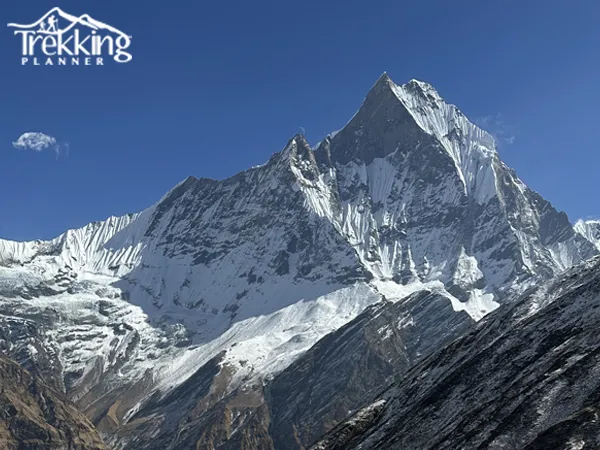
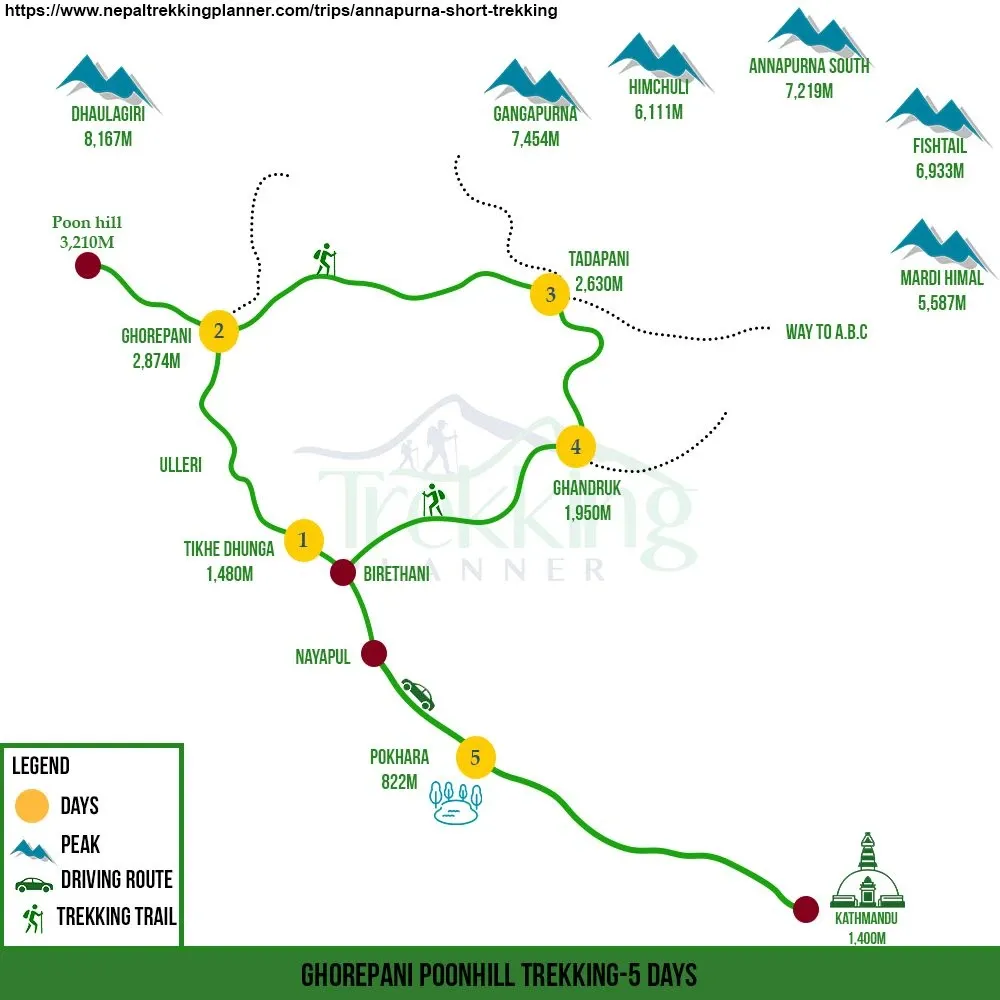
Ghorepani Poon Hill Trekking is a famous trekking path in the Annapurna Region of Nepal. It is a comparatively easy and simple trek that can be finished in 4-5 days. The trip takes you through gorgeous woods, traditional communities, and terraced fields, and provides stunning panoramic views of some of the highest Himalayan peaks, including Machhapuchre (Fishtail) 6,993 meters (22,943 feet), Nilgiri 7,061 meters (23,166 feet), Annapurna South 7,219 meters (23,684 feet), Annapurna I 8,091 meters (26,545 feet), Dhaulagiri 8,167 meters (26,795 feet), Tukuche Peak 6,920meters (22,703 feet), Hiunchuli 6,441 meters (21,132 feet), Gangapurna 7,455 meters (24,457 feet) and so on.

The trek normally begins from the small town of Nayapul which is around 40.7 km. west from Pokhara, and can be accessed by a short drive from Pokhara. The route passes through several traditional Gurung and Magar villages, including Tikhedhunga, Ghorepani, Tadapani, and Ghandruk, offering plenty of chances to learn about their distinct culture and customs. The trek is also renowned for its biodiversity, displaying a wide range of vegetation and animals along the route.

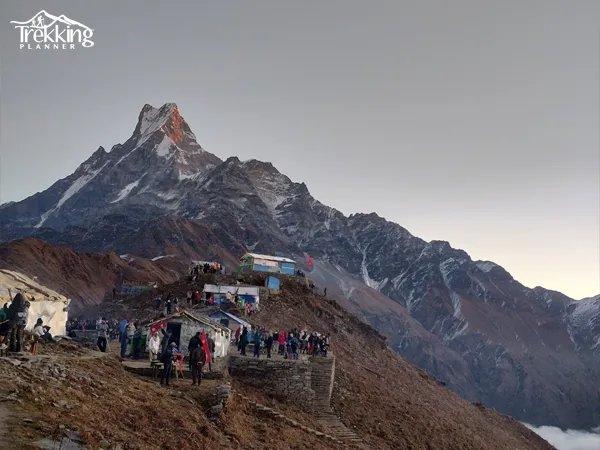
The main highlight of the trek is Poon Hill, a famous viewpoint that offers you stunning panoramic views of the Annapurna and Dhaulagiri mountain ranges. The vistas are especially beautiful at dawn when the first beams of sunlight highlight the snow-capped summits and cast a beautiful golden hue on them.

Normally, the trek is appropriate for all fitness levels and can be completed at any time of year, however, the best months to visit are September to November and March to May. Accommodation is offered in well-established tea houses along the route, which offer pleasant accommodation and delectable local cuisine.

Highlights of Ghorepani Poonhill Trek

  • Sunrise from Poon Hill: The trek to Ghorepani Poon trek is renowned for sunrise when the first rays of sunlight illuminate the snow-capped peaks.
  • Cultural encounters: Along the journey, you'll have the chance to learn about the distinct cultures and customs of the Gurung and Magar communities.
  • Beautiful forests: The route takes you through lovely rhododendrons and oak forests, which are especially lovely in the spring when the blossoms are in abundance.
  • Friendly Locals: The trek takes you through the locals of the region. The locals of the region are friendly and helpful. You will be also able to interact with their cultures and tradition and also their day-to-day lifestyle.

Advantage of booking a trip with Nepal Trekking Planner

  • Private vehicle for pick up and drop for all the passengers to the airport.
  • First-aid kit box.
  • Trekking Planner’s down jackets, t-shirt, and cap, if necessary.
  • Arrangement of emergency evacuation service (you should have insurance for emergency evacuation, which will be paid for by your travel insurance company).
  • We use an oximeter to check your pulse, oxygen saturation, and heart rate, and we provide oxygen.
  • Sim cards are provided by our company for travelers, so there won’t be any networking issues.

Why trek to Ghorepani Poonhill?

Ghorepani Poonhill is comparatively easier and is a short trail trek that is suitable for all fitness levels from beginners to expert. Trekking Planner Nepal mentions some of the reasons for Trekking to this place.

  • Stunning Scenic View: The trek offers you the most stunning view of several snowcapped mountains such as Machhapuchre (Fishtail) 6,993 meters (22,943 feet), Nilgiri 7,061 meters (23,166 feet), Annapurna South 7,219 meters (23,684 feet), Annapurna I 8,091 meters (26,545 feet), Dhaulagiri 8,167 meters (26,795 feet), Tukuche Peak 6,920meters (22,703 feet), Hiunchuli 6,441 meters (21,132 feet), Gangapurna 7,455 meters (24,457 feet) and so on. The trek also offers the popular sunrise that illuminates the snowcapped peaks and creates a beautiful golden view.
  • Cultural Experience: The route takes you through several traditional Gurung and Magar communities, where you can learn about their distinct culture and customs. The villages provide an insight into the local lifestyle and customs, and you can engage with the residents to learn more about their way of life.
  • Accommodation: There are several well-established tea houses along the route that offers comfortable lodging and delectable local cuisine. The tea houses provide a warm and cozy environment, enabling you to rest and enjoy the journey without worrying about lodging.
  • Suitable for all fitness levels: This trek is appropriate for all endurance levels because the path is not too steep or challenging. The journey is suitable for people of all ages and fitness levels, making it a popular option for families, groups, and solitary tourists.
  • Time: The length of 4-5 Days is perfect for those who want to experience the grandeur of the Annapurna Region but have limited time. The trek can be finished in a week, including travel time, making it an ideal choice for those who want to take a vacation from their busy lives and appreciate the natural beauty of Nepal.

Is Ghorepani Poonhill Trek suitable for beginners?

Comparatively, this trek is suitable for all individuals, regardless of age or physical ability, who can complete the Ghorepani Poon Hill trip. The trek is not too tough or steep, and the distance traveled each day is feasible. It is a common option for families, groups, and solo tourists looking to explore the Annapurna Area.

However, it is essential to remember that the trek requires several hours of walking each day, and some parts of the path may be difficult for people who are not used to trekking. Before going on the trek, you should prepare yourself by doing some light workouts and building up your stamina.

Furthermore, the journey includes altitude increases, and some of you may experience altitude sickness symptoms. To avoid complications, it is important to remain hydrated, rest when required, and heed the counsel of your guide. You also can consult with your doctor about your medical conditions before undertaking the trek.

Overall, the trek offers you the best time and the best cultural and scenic experience.

How to prepare for Ghorepani Poonhill short trek?

For the preparation for the trek, it is important to ensure a safe and enjoyable experience. Here are some tips on how to prepare for the trek:

  • Physical Fitness: However the trek is comparatively short and easy, still you need to be physically well-prepared. The trek involves walking for several hours each day, and some sections of the trail may be challenging for people who are not used to hiking. It is recommended that trekkers prepare themselves by doing some light exercises and building up their endurance before embarking on the trek. Cardiovascular exercises like running, cycling, and swimming are particularly beneficial.
  • Packing Essentials: Having the proper equipment and apparel is essential for a good journey. Warm apparel, rain gear, durable hiking footwear, a daypack, sunscreen, and a first aid box are all recommended for trekkers. It's also a good idea to pack a water container, a headlamp or flashlight, and a camera to record the incredible surroundings.
  • Learn properly: Before traveling to a place it is important to know about a certain place. So, you are always advised to check about that place, and learn about its rules and regulations, and limitations before embarking on the trek.
  • Acclimatization: The trek is comparatively easy trek still you need to embark on high altitude. So, proper acclimatization is necessary as you will embark on the high altitude. To prevent altitude sickness you need to take proper rest and head up slowly. Trekking Planner Nepal also facilitates you with the proper itinerary as per your requirements and budget.


Ghorepani Poonhill Trekking - 5 Days Itinerary

Day 1

Pokhara – Nayapul – Tikhedhunga- Ulleri (2,050m/6,726ft) about 4 hours' drive.

Max Altitude: 2,045m (6,709ft)
Meals: Lunch and Diner
Accommodation: Lodge/Tea House

You will start the Ghorepani Poon Hill Trek with Nepal Trekking Planner from the biggest tourist city of Nepal-Pokhara.  Joining the trek will be your guide, navigating you through the route, and your porter, carrying your luggage. The guide and porter will meet you in a predetermined location in Pokhara and take you on a drive to Ulleri, your overnight stop. The total ride will be on a private jeep, which will take approximately three hours while covering a distance of around 48 kilometers. So, prepare accordingly, as today's whole journey is a drive.

Beginning the ride from Pokhara, you will reach Nayapul, which will take about 2 hours. The section has good, well-paved roads. You will witness the remote hilly landscape of Nepal while passing through prominent villages like Naudadha, Kanre, and Lumle. After Nayapul, you will reach Tikhedunga while driving along the moderate motorable road, which will take about 2 hours. Before reaching Tikhedhunga, you will pass through the villages of Bhirethati and Hile. Tikhedunga is the gateway for various trekking routes in the Annapurna region, including the Annapurna Base Camp trek and Ghorepani Poon Hill trek. Green terraced fields and traditional Nepalese houses surround the area. From Tikhedunga, you will drive to your ultimate destination, Ulleri, which will take about an hour.

Situated at an altitude of 1,960 meters/6,430 feet, Ulleri offers stunning landscapes, traditional architecture, and warm hospitality. From Ulleri, you can also see Annapurna South and Hiunchuli. Upon reaching Ulleri, settle into an accommodation and rest. Your accommodation will have an attached bathroom facility, and if you need any other amenities, we can provide them upon request. Later in the evening, have dinner, and after dinner, your guide will brief you about the following day's activities. Then, you can rest further and spend the night in Ulleri.

Day 2

Ulleri-Ghorepani (2874m/9429ft) 4-5 hrs walks, walking distance 8 km / 4.97 miles

Max Altitude: 2,874m (9,429ft)
Meals: Breakfast + Lunch + Dinner
Accommodation: Lodge/Tea House

As you wake up, refresh and have breakfast with the backdrop of Annapurna Mountain. After breakfast, get ready to leave Ulleri. Your official trek to Ghorepani Poon Hill begins on this day. So, you will make your way to Ghorepani for an overnight stay. Today's trek will cover a 10 km distance and can take about four to five hours, depending on the pace. 

At the beginning of the trek, you will ascend uphill, which will lead you to lush forests. Especially during spring, you will witness blooming rhododendrons in these forests, which add a layer of beauty to the greenery. After finishing the journey through the forest, you will reach Banthati, which can be a suitable lunch stop. 

After a fulfilling lunch, you will continue the journey through forested terrain with alternate ascent and descent to arrive at Nangethati. After trekking for several hours, you will finally reach Ghorepani from Nangethati.

Ghorepani is a picturesque village situated at 2,850 meters that provides a spectacular view of Annapurna and the Dhaulagiri Mountain range. Likewise, after reaching Ghorepani, do not miss the sunset view, as Ghorepani is known for its sunrise and sunset views. Then, with the sunset view, settle into an accommodation place and rest. In the evening, enjoy a delicious dinner and participate in the briefing for the following day.

After the short briefing session, head to your room and rest further. Then, stay overnight in Ghorepani.

Day 3

Ghorepani- Poon Hill (3,210m/ 10,531ft) about 45 min walk–Ghorepani- Tadapani (2,660m/8,727ft) 6-7 hrs walks, walking distance 10 km / 6.2miles

Max Altitude: 3,210m (10,531ft)
Meals: Breakfast + Lunch + Dinner
Accommodation: Lodge/Tea House

Today you will wake up early in the morning to catch the mesmerizing sunrise in Poon Hill. So, as you wake up, refresh and head towards the ultimate destination of Poon Hill. It will take about 45 minutes to reach Poon Hill from Ghorepani, depending on the pace. After reaching the vantage point of Poon Hill, you will need to cross the morning ticket counter. Then, enjoy the panoramic scene from the Poon Hill viewpoint, where you can see the view of Annapurna I, Annapurna South, Machhapuchre (Fishtail), Dhaulagiri, Nilgiri, Hiunchuli, Annapurna III, Gangapurna, Tukuche Peak and others.

Then, with the panoramic view, enjoy the beautiful sunrise view that portrays a red and pink hue in the snow-capped mountain. The landscape is truly amazing, and you will enjoy every moment here. After enjoying the view, there is a café up at Poon Hill where you can have a short tea, hot chocolate and other beverages. 

With a quality time in Poon Hill, get ready to leave Poon Hill and begin the return journey to Ghorepani. Then, with a fulfilling breakfast and some time to rest in Ghorepani, you will leave Ghorepani to reach Tadapani. Starting the trek to Tadapani, there are more up and down routes, reaching 2660 meters/8727 feet. Moving along the Deurali Pass, you will walk along the hillside's ridge line with occasional rhododendrons to reach Deurali.

From Deurali, you will begin with a long descent to Banthati, where you will traverse into the valley. You will take the 1000 steps to the bottom along the stone steps. After completing the step, you will follow the river to reach the little village of Banthati, which is the potential lunch stop for today. 

After lunch, continue on the trek. You will now trek for two more hours to reach your overnight stop at Tadapani. In this section, you will follow the river that joins the Bhurungdi River and then continue on the climb down and again up to reach Tadapani.

Upon reaching Tadapani, settle into an accommodation and have dinner. After dinner, join the briefing session and rest. Stay overnight in Tadapani.

Day 4

Tadapani – Ghandruk-Landruk (1,565 m/5,135 ft) 6-7 hrs. walk, walking distance 11 km / 6.8 miles

Max Altitude: 1,990m (6,528ft)
Meals: Breakfast + Lunch + Dinner
Accommodation: Lodge/Tea House

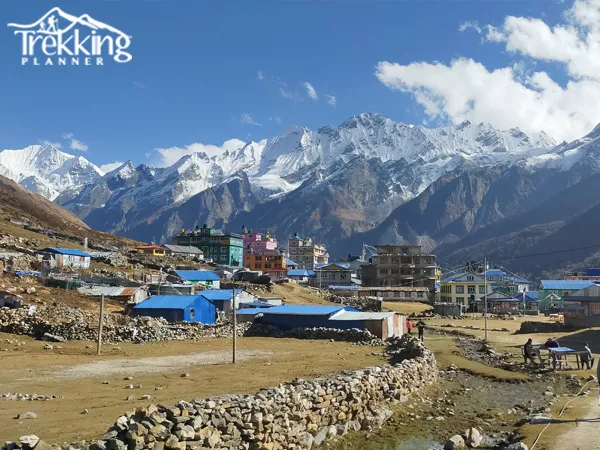
Today, as you wake up, refresh and have breakfast at Tadapani. After breakfast, get ready to leave Tadapani and head towards Landruk via Ghandruk. As you begin today's walk, you will start with a downhill, following the zigzag route to ultimately head deep into the forest. You will see occasional views of Annapurna and Fishtail along the section, but you will encounter many beautiful waterfalls. After the forest area, you will reach the cultural village of Ghandruk, where you can experience Gurung culture, tradition, and hospitality. Ghandruk is a Gurung village that offers the opportunity to blend with traditional Gurung architecture, vibrant festivals, panoramic mountain views, and other breathtaking landscapes.

Similarly, you can try local Nepalese cuisine for lunch and explore the Gurung Museum. You can also hire Nepalese costumes while enjoying the stunning views of Annapurna, Gangapurna, Hiunchuli, and Machhapuchhre. After spending quality time in Ghandruk, you will make your way to Landruk for an overnight stay.

From Ghandruk to Landruk, you will start descending along the stone steps until you reach the Modi River. Then, after crossing the Modi River through the iron bridge, you will walk uphill for about two hours to get to the vibrant village of Landruk.

Upon reaching Landruk, settle into an accommodation and wait for dinner. This is your last day of the trek, so be sure to celebrate fully. Enjoy, drink, and spend quality time with the guide and porters. After the celebration, get some rest and spend the night in Landruk.

Day 5

Landruk – Pokhara (820m/2690ft) about 4-5 hrs and 1 hrd drive

Max Altitude: 822m (2,696ft)
Meals: Breakfast + Lunch
Accommodation: Lodge/Tea House

Wake up, refresh, and have breakfast in Landruk with the fantastic backdrop of Fishtail, Annapurna South, Hiunchuli, and Annapurna III. After breakfast, pack your bags and get ready to leave the Annapurna region. Be sure to check that you have everything and that nothing is left behind.

As you leave Landruk, continue to make way towards Kande, where you will catch a jeep to ride towards Pokhara. The walk from Landruk to Kande will take about four to five hours, depending on the pace. You will walk a zigzag downhill route, making your way from the forest area to reach Kande. After reaching Kande, your guide will escort you to a private jeep, which will take you to Pokhara. You will face off-road for about an hour or more, and then you will drive along the pitched road. 

After reaching Pokhara, we will drop you at any favorable destination. Our guides will help you unload your baggage and bid you farewell. We hope to see you again in the future for another incredible adventure. Until then, best of luck for future endeavors.

The 5 Days Ghorepani Poonhill Trekking is prepared in a standard itinerary basis. Some days the trek can be shorter or longer depending upon the walking pace. Some designated overnight hotels can change due to availability of rooms and other factors.

We will follow the itinerary if there need to be changes it might get change due to the factors like bad weather, landslides, and feeling physically difficult to walk requiring more days. during these ype of cases our leader and lead head guides decide to hold full authority for Trekking Planner Nepal, providing you with enjoyable holidays.

Dates & Availability

Trip Duration
5 Days
Trip Starts & Ends Point
Pokhara / Pokhara
Plan your trek schedule
  • Ghorepani Poonhill Trekking departs every day of the year, both privately and in groups.
  • For a sharing basis, pre-booking is required, as there need to be arrangements for a sharing basis.
  • This trip is fully customizable. We can customize the trip as per your needs.
  • This trip is available on a fixed departure and a private group basis.
  • This trip can be booked privately if you’re traveling solo, privately, or with family. Have a big group? We can help as per your needs. We can help you make it fit your budget.
  • We accept instant booking and online payment.
  • If the given date is not appropriate for you, please get in touch with us; Trekking Planner also organizes various trips in small groups that can suit you. We recommend you reserve a seat for yourself by booking with us right away for a wonderful experience. Call or email now for a private trip: [email protected]mobile +977-9851071767 (24 hours)—WeChat, WeChat, and Viber—so that Trekking Planner can happily manage your trip on dates favorable for you.

Cost Details

Trip Includes

  • National Park entrance fee and Trekkers’ Information Management System( TIMS card).
  • A highly experienced, helpful, knowledgeable, friendly, English-speaking, well-trained, Government license-holding guide. Price includes his salary, food, drinks, accommodation, transport, and insurance.
  • 02 guests to 01 porter with their insurance, salary, food, accommodation, and equipment.
  • We provide an assistant to guide his salary, food, drinks, accommodation, transport, and insurance, walking with the group to support where necessary, as per the group size
  • The best available accommodation in the mountains for trekking.
  • Breakfast, lunch, dinner, and tea/coffee during the trek are the three meals a day.
  • Pokhara to starting point of the trek and the trek ending point of the trek to Pokhara by private vehicle.
  • First aid kit box.
  • Trekking Planner’s sleeping bag, down jackets, T-shirt, cap, duffle bags for porter, city and trekking route maps – if necessary.
  • Arrangement of emergency evacuation service (should have insurance for emergency evacuation, and will be paid by your travel insurance company).
  • All applicable government and local taxes per the itinerary.

Trip Excludes

  • Your Nepal Visa fees.
  • All the International air fare to and from Kathmandu .
  • All meals and accommodation in Kathmandu and in Pokhara.
  • Kathmandu to Pokhara to Kathmandu/Chitwan transportation (if you want we can organize for you with additional cost).
  • Personal travel and health insurance as well as insurance for helicopter evacuation.
  • In case of extra nights’ accommodation, lunch and dinner in city due to early arrival and late departure as well as early back/return from mountain/trekking (due to any reason) than the given time period of itinerary. We can help you arrange extra nights’ accommodation.
  • Your personal expenses such as (laundry, baggage charge, phone calls, battery recharge, bar and beverage bill, boiled or bottle water, hot and cold shower, extra porter.. etc).
  • The tips to the trekking crews and drive.
  • Extra expenses due to flight delays, strikes, weather condition or any event out of our control.

Interactive Map

StartMid DaysEnd

Infographic Map

Download

Altitude Chart

Essential Information

What is the best season for trekking to Ghorepani Poonhill?

The best time of year for trekking is during September to November as well as from March to May. The weather is usually clear and stable during these months, with moderate temperatures and little possibility of rain. During this season the views of the Himalayan Mountains is clear and stunning. However it is very essential to note, that weather in the mountains can be unpredictable, and it is always advised to check the perspective and be prepared for any weather conditions.

Climate and Weather at the trekking trail of Poonhill 

The trekking climate and weather can differ based on the season as well as elevation.

During the autumn season, the weather is usually dry and sunny from September to November, with clear skies and mild temperatures. The average daily weather is 8-18°C (46-64°F), with cool evenings and early mornings. However, temperatures can fall below freezing at higher altitudes, so it is always better to pack warm layers.

The weather is also usually dry and sunny during the spring months of March to May, with clear clouds and moderate temperatures. The average daytime weather is 7-20°C (44-68°F), with cooler temps at higher altitudes.

The weather can be chilly and snowy from December to February, with daily temps varying from 0-10°C (32-50°F) at lower altitudes and below zero at higher elevations. Snow can also make it challenging to traverse the trail, and some guesthouses may be closed due to bad weather.

Summer months from June to August can be hot and humid, with frequent showers and overcast clouds. The path may become slick and wet as a result, and there is a danger of landslides and inundation.

Overall, the Ghorepani Poonhill Trek is best done in the fall or spring months, when the weather is calm and bright and the mountain vistas are at their finest. However, it is critical to be equipped for any weather conditions and to verify the weather prediction before embarking on the trek.

Local Culture and Tradition around the trekking trail of Ghorepani

This trekking trail is an excellent chance to learn about the local culture and traditions of the people who live in Nepal's Annapurna Area. The area is home to a number of ethnic groups, including the Gurung, Magar, and Thakali, each with their own distinct culture and customs.

You will have the chance to explore small communities and engage with the locals while on the trek. You can learn about their everyday routines, tour their homes, and take advantage of their hospitality. You can also find out about their customary clothing, music, and performance.

The Gurung are famous for their traditional clothing, which includes a multicolored shirt and a long, thick garment made of sheep fleece. They also have a rich musical and performance heritage, with the renowned Gurung dance done at festivals and celebrations.

The Magars are well-known for their traditional flat-roofed homes and their skill in traditional weaving. They can also cultivate and care for animals, and their food consists of a range of native vegetables and grains.

Thakali food is well-known for recipes such as Thakali dal bhat, a lentil broth served with rice and veggies, and Thakali achar, a spicy pickle prepared with local ingredients.

Overall, the Ghorepani Poonhill Trek is an excellent chance to learn about the rich culture and traditions of the people who live in the Annapurna Region of Nepal, as well as to obtain a better understanding of their way of life.

Washing, Toilets, and Accommodation facilities at the trekking trail of Ghorepani

Accommodations and facilities on the trekking trail of can differ based on location and elevation. Trekking Planner Nepal also facilities you with the services you seeking for:

  • Washing:  Most of the guest houses along the path have shared restrooms with hot baths, though hot water is not always accessible or is restricted. It is better to bring detergent and shampoo, as these may not be always supplied. There may be a lack of flowing water in some places, requiring you to bathe with a pail of hot water.
  • Toilets:  Most guesthouses have western-style bathrooms, though squat toilets may be found in some locations. It is always a good idea to carry your own toilet tissue because it might not be available. There may be a lack of toilet amenities in some places, forcing you to use the outdoors.
  • Accommodation: Guesthouses along the trek provide basic lodging, including plain mattresses and blankets. Some guesthouses may provide shared rooms, while others may provide individual rooms for a charge. Some of the lodges charge you extra fee for hot water as well as charging.

Important Note.

  • This trip departs every day of the year.
  • This trip is fully customizable. We can customize the trip as per your need, please contact us.
  • This trip is available on both a Fixed Departure and a Private Group Basis.
  • This trip can be booked privately if you’re traveling solo or privately or with family.
  • Have a big group? We can help as per your needs.
  • We can help you make it fit your budget.
  • We accept online payment.
  • We accept an instant booking and online payments.

Useful Blogs

Equipments

If you are preparing for a high-altitude Himalayan adventure in Nepal, there is always some confusion about what to pack. It is essential to carry the right gear and equipment for a comfortable, safe, and enjoyable experience. All trekkers should properly pack and carry all the essential items. 

However, overpacking is another common mistake that can make the journey tiring. So here is a carefully crafted packing list that includes everything you need. From general items, cloth layers, headgear, footwear, to accessories and first aid, the list consists of light and smart packing items for every challenging mountain condition.

Note: You do not need to bring all the items mentioned below to Nepal. There are several trekking shops in Kathmandu or Pokhara where you can buy or rent high-quality gear at a reasonable price. So, feel free to pack light and purchase or rent any missing items after your arrival in Nepal. Also, members from Trekking Planner Nepal Pvt. Ltd. can also guide and assist you to find the best deals in gear and equipment in Thamel, Kathmandu.

What Does the Company Provide?

  • We give you a free duffel bag (must return), buffs, trekking cap, trekking map, and t-shirt during your pre-trip meeting in Kathmandu. The duffel bag will be used to pack your trekking supplies.

  • For every two participants, we assign one porter. The porter will carry the duffel bag, which should weigh around 10 kg/22 lbs., throughout the walk.

  • We can provide a down jacket for USD 35. In case of loss or damage, you need to pay back the cost of USD 100 per item.

  • We can provide a sleeping bag for USD 35. In case of loss or damage, USD 100 per item must be paid.

  • You can safely store your extra luggage (items not required on the trek) at the hotel in Kathmandu. Our team can happily assist and help.

  • Total luggage for the Kathmandu-Lukla flight is (15 kg/33 lbs.), including duffel (10 Kg/22 lbs.) and backpack (5 kg/11 lbs.).

  • We provide a free Nepal SIM card (Ncell) to all our trekkers during the pre-trip briefing in Kathmandu. Data packages can be purchased at an additional cost.

Upper Body Layers

  • Technical fabric base layer thermals are light for warmer months, heavy for colder months
  • Technical fabric t-shirts and sleeve sweaters or high-necks
  • Fleece jacket or down jacket
  • Windproof jacket for the walk as it gets windy
  • Waterproof rain jacket
  • Sports bras (women)
Lower Body Layers

  • Thermals inner
  • Hiking pants at least 3
  • Comfortable pants for teahouses
  • Waterproof, windproof shell pants
  • Hiking shorts
  • Technical fabric/quick drying undergarments (can be washed during the trek)
  • Sleeping clothes as per the comfortability
Footwear & Accessories

  • Marino Wool or warm socks
  • Hiking socks
  • Liner socks
  • Trekking/hiking boots (waterproof recommended)
  • Crampons (for mountain passes)
  • Casual shoes or sandals that are comfortable for the time in the tea house
  • Gaiters (lightweight for rain and snow)
  • Woolen gloves for the tea house
  • Hard-shell windproof outer gloves for the walk
  • Trekking poles
Head & Sun Protection

  • Sun hat or cap (We'll provide you with a trekking cap)
  • Warm woolen hat or beanie
  • Scarf/Neck Buff (highly recommended to get saved from wind and cold)
  • Polarized sunglasses
  • Headlamp or mobile torch light for nighttime
  • Sunscreen SPF- 50+
  • Lip balm or Vaseline
  • Ointment cream
Personal & Medical Kits
  • Sunscreen SPF- 50+
  • Lip balm or Vaseline
  • Ointment cream
  • Cough Syrup and strepsils (recommended for Khumbu Cough)
  • Creams and medicines for any allergies or personal conditions
  • Small towel
  • Toilet paper, small soap, and shampoo
  • Anti-Diarrhoea, Painkillers, Blister Plasters, and Anti-Inglammatories

(Note: Our guides carry medications, oxygen cans, and first aid kits during the trip. However, personal kits and medications are recommended.)

Travel Documents

  • Passport
  • Extra copies of passport-sized photos
  • Waterproof/ziplock bags for documents and valuables
Miscellaneous

  • Reusable water bottle
  • Water bladder for daypack
  • Water purification tablets or UV purifier
  • High-protein snacks (energy bars, nuts)
  • Power bank or extra batteries
  • Universal Plug Adaptar
  • Charging Cables
  • Travel lock
  • Camera and mobile phone
  • Pillowcase (in case of allergies)
  • Sleeping clothes
  • Cards / Book
  • Thermos for hot water at night

FAQs

What is the Ghorepani Poonhill Trek?

The Ghorepani Poonhill Trek is a renowned trekking route in the western Annapurna area of Nepal. It takes you through stunning scenery, mediaeval villages, and deep rhododendron forests. The trek to Poonhill, which is the main highlight of the trek, offers you stunning vistas of mountains such as Machhapuchre (Fishtail) 6,993 m, Nilgiri 7,061 m, Annapurna South 7,219 m, Annapurna I 8,091 m, Dhaulagiri 8,167 m, and so on.

How challenging is the Ghorepani Poonhill Trek?

The Ghorepani Poonhill Trek is a moderate trek appropriate for both novice and expert trekkers.he trails are well-marked, and the daily walking lengths are manageable. However, there are some uphill and downhill stretches, so a modest level of endurance and stamina is required.

What is the ideal time to visit Ghorepani Ponhill Trekking?

The best seasons to visit Ghorepani Poonhill Hike are spring (March–May) and fall (September–November). During this time of year, the weather is clear and the scenery is more evident.

Are there any medical facilities available along the way?

Some settlements along the Ghorepani Poonhill Trek provide basic medical services and pharmacies; however, supplies may be limited. It is best to bring a well-stocked first aid bag with necessary medication and to speak with a travel doctor before embarking on the trek.

Can I charge my electronic device during the trial?

The majority of teahouses along the hike route include charging stations for electronic devices such as cameras, phones, and power banks. However, keep in mind that charging fees may apply and charging ports may be limited during peak seasons. It is a good idea to have extra batteries or a portable solar charger.

Do I need to take a guide or porter for the Gorepani Poonhill Trek?

Hiring a guide or porter for the Ghorepani Poonhill Trek is now compulsory as per new government rules. A trekking guide is strongly advised, as they have intense knowledge of navigation and carry large gear. A guide can provide you with great insights into the local culture, and a porter can lighten your load and make the walk more enjoyable.

Is it safe to drink the water while trekking?

During the walk, it is not suggested to drink untreated tap water or stream water. To stay hydrated and avoid waterborne infections, drink bottled water or use water purification tablets. Bottled water is available in the teahouses throughout the journey.

How long does it take from Ghorepani to Poonhill?

The trek from Ghorepani to Poon Hill usually takes 45 minutes to an hour. The distance between Ghorepani village and Poon Hill viewpoint is around 2.5 kilometres (1.5 miles). The time it takes to reach the summit is determined by the trekker's walking speed and fitness level.

How long does the Ghorepani Poonhill Trek take to complete?

The Ghorepani Poonhill Trek usually takes 4 to 5 days to complete. The duration, however, will vary based on your itinerary and walking rate. Some trekkers might choose to extend their journey by taking side trips or visiting additional towns.

Can I watch the sunrise from Poon Hill in all weather?

The best times to see a magnificent dawn from Poon Hill are during the clear seasons of spring and autumn. While it is possible to observe the sunrise in other seasons, weather conditions such as fog or clouds may obscure the view.

Is it possible to buy or rent trekking equipment in Ghorepani?

Yes, there are shops in Ghorepani where you can buy or rent basic trekking equipment. It is, however, recommended that you have your gear ready before beginning the walk to ensure its durability and compatibility with your needs. Also, the price might get higher on the trials.

Is travel insurance necessary for the trek?

The Ghorepani Poonhill Trek does require travel insurance. Medical emergencies, evacuations, and trip cancellations or interruptions should all be covered. Make certain that your insurance policy covers high-altitude trekking. Make sure to bring a copy of your travel insurance, as you might need it in case of an emergency.

Can I take my children on the Ghorepani Poonhill Trek?

Yes, families with children can participate in the Ghorepani Poonhill Trek, especially for children. However, before embarking on the journey, it is essential to take the required measures and determine the children's physical capacities.

What are the average trekking hours per day on the Ghorepani Poonhill Trek?

On average, trekkers spend 5 to 6 hours per day trekking on the Ghorepani Poonhill Trek. The duration varies based on the group's pace and the distances between villages along the route.

Are there restroom facilities along the trekking route?

Yes, the majority of teahouses and guesthouses along the Ghorepani Poonhill Trek provide restrooms. However, keep in mind that the facilities may be basic and might need to be shared, so bring your own toilet paper and maintain good hygiene.

What is the starting point of the trek?

The trek to Ghorepani Poonhill normally starts from Nayapul, a few hours' drive from Pokhara. The walk to Ghorepani begins in Nayapul, passing through charming villages and stunning vistas.

Is it safe to trek during the summer monsoon season?

Trekking is possible during the monsoon season (June to August); however, there are concerns such as severe rain, landslides, and leeches on the trail. Views may sometimes be obscured by clouds and mist. It is essential to be well prepared with suitable gear and to have a flexible schedule in case of inclement weather.

an I trek to Poon Hill in the winter?

Yes, the Ghorepani Poonhill Trek is possible in the winter (December to February). Be prepared for colder conditions, particularly at higher elevations. Some sections of the trail may be covered in snow, making the journey more difficult. Still, the choice might be good for those seeking more adventure.

What do I do with my trash while travelling?

During the trek, proper waste disposal is essential. Most teahouses and towns have designated trash cans. Avoid leaving litter on the trail, and if feasible, bring a small reusable trash bag with you to gather your waste until you reach a proper disposal location.

Short Trip
20%
Off
Price Per Person
US$399
US$499
  • 1 paxUS$499
  • 2 - 10 paxUS$399
  • 11 - 20 paxUS$370
  • 21 - 30 paxUS$350
Need Help? Call Us!
Dipak Lamichhane
Dipak Lamichhane
Managing Director
+977 9851071767

What Our Clients Say

authorauthorauthor
10,000+ Happy Trekkers
Lorel Ipsum ingkdi gocngit slingt
5 out 5 based on the opinion of 1 people reviews

Poon Hill trek

Our fantastic guide, Nirmal, guided us for 5 days in the Annapurna region. It was magical, and we had a great time. The guide was so safe, professional and fun. We also made friends and...

M
Malin - Australia
December 29, 2023
Need Help? Call Us+977 9851071767