Trip Introduction: Upper Mustang Trek 2025-2026
Upper Mustang Trekking-17 Days is an exotic tour and one of Nepal's most mysterious and popular treks. It has been described as the desert in the Nepalese Himalayas. "Mustang' is a Tibetan-derived word meaning fertile plain' in Nepali. Geographically, it is located in the north of Annapurna at an average altitude of 4,000m and is culturally part of the Tibetan plateau. The landscape of Mustang is dry, with naturally carved sandstone pillars and discontinuous moraine terraces; these all present a naturally colorful variety of red, yellow, and brown together. The trek to Mustang is through an almost treeless and infertile landscape. You experience the strong wind blowing across the area as it is a rain-shadow area of Nepal.
The most convenient way to get to the upper Mustang is to fly from Pokhara to Jomsom and start the trek there. The flight is an attraction in itself, passing through the deepest gorge in the world. Upper Mustang Trekking is perfect for visiting the oldest Buddhist monasteries, many historic caves, and the beauty of the Himalayas. This trek brings you into the hidden world of the ancient Buddhist kingdom of Mustang, also called Lo. This semi-autonomous region is heavily Tibetan-influenced.
The trek to Lo-Manthang (the walled capital) is almost through a treeless barren landscape, a steep rocky trail, and a downhill. Panoramic views of Nilgiri, Annapurna, Dhaulagiri, and several other peaks make your trek memorable. Upper Mustang is also known as "the last forbidden" kingdom of Nepal". The landscape here is stunning.
A lifestyle of people residing calmly, even in such a harsh environment, has charm. Lo-Manthang, Chooser Cave, and Ghar Gompa are significant attractions of Upper Mustang Trekking. TiJi is the most fantastic festival in the Mustang Region. It will be a unique privilege to witness the same color, costume, dancing, and rituals displayed by these people in this place more than 600 years ago.
Before 1991, Upper Mustang was a restricted area for foreigners to enter. The Nepal Department of Immigration started issuing a small number of Special Trekking permits in 1991. Foreigners are allowed, and the Upper Mustang has become the best tourist attraction worldwide. You can do a camping trek and a teahouse trek. Tea house treks are comparatively the least costly; however, lodge-to-lodge stays are also available. So, get ready to explore this exotic trekking route with Trekking Planner Nepal to make it more convenient and memorable.
Highlights of Upper Mustang Trek
- Adventure on ancient Trans-Himalayan Salt Trade and Caravan Trail to Tibet via Mustang.
- Extension of huge South-West Tibetan plateau and world's highest table-land.
- Explore lovely Mustang villages enriched with the old traditional culture of Buddhism.
- Impressive monasteries and trails are decorated with impressive prayer walls and bells.
- Walk on high windswept-dry and arid country within beautiful landscapes.
- Grand views of snow-capped peaks of Dhaulagiri Nilgiri and Mustang Himal.
- Trekking into the former walled kingdom of Upper Mustang at Lo-Manthang.
Advantages of booking Upper Mustang trek with Trekking Planner Nepal
- Private vehicles pick up and drop off passengers at all airports.
- First-aid kit box.
- Trekking Planner’s down jackets, t-shirt, and cap, if necessary.
- Arrangement of emergency evacuation service (you should have insurance for emergency evacuation, which will be paid for by your travel insurance company).
- We use an oximeter to check your pulse, oxygen saturation, and heart rate, and we provide oxygen.
- Our company provides sim cards to travelers and trekkers, so there won’t be any networking issues.
Where does the Upper Mustang Trek Start and End?
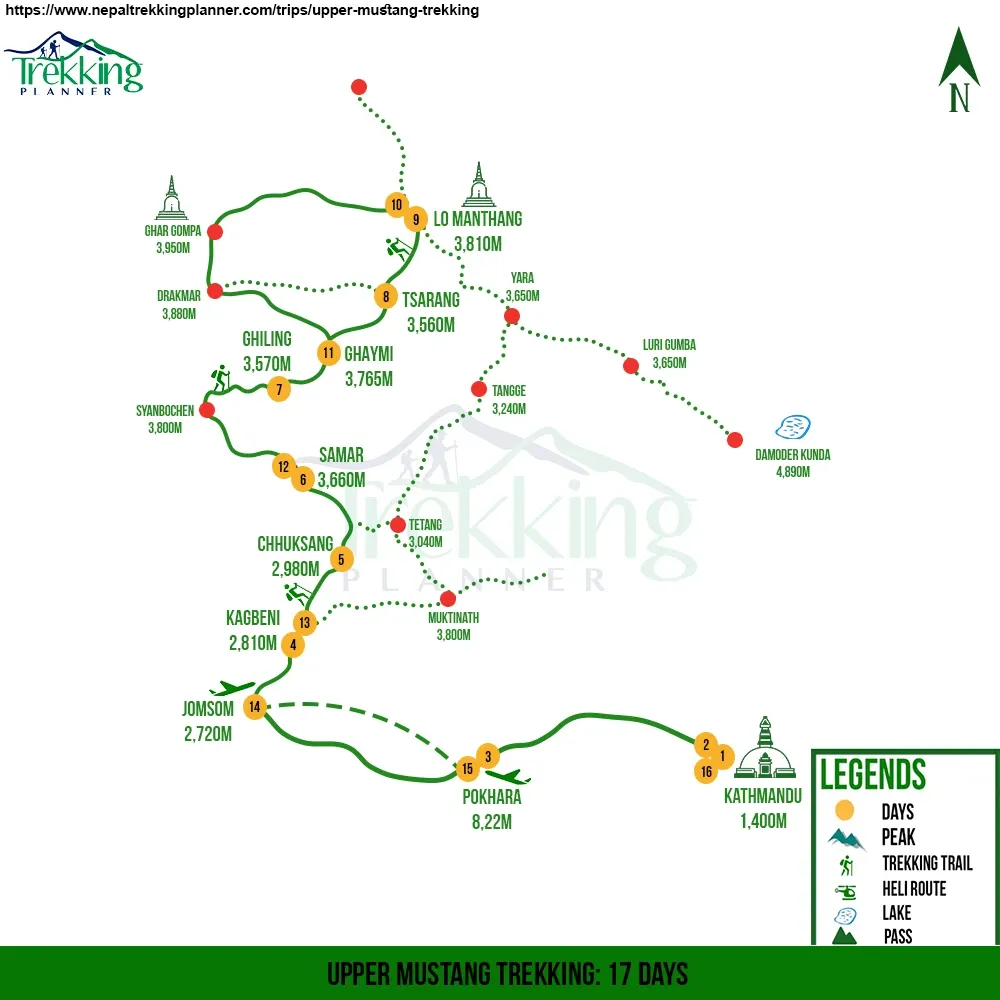
We take the air route, which follows the world's deepest gorge, Kali Gandaki Gorge, between Annapurna I (8,091m) and Dhaulagiri (8,167m) mountains. Upon arrival, collect the gear and supplies and trek for 3 hours to Kagbeni, alongside the Kali Gandaki River and the magnificent mountain view.
Kagbeni is the main entrance to this trek, and today the trail starts with an uphill for half an hour, leaving the Kali-Gandaki River behind for a while. The path leads to the harsh, barren countryside, with occasional stops, passing through a few small villages as the walk progresses to Tangbe. Another hour of good walking from Tangbe reaches Chussang.
Then, walk towards Chele village after crossing the stream through the broken canyons and ruined castle walls on the surrounding cliffs. Across the river from Chussang are some spectacular red eroded cliffs above the mouths of inaccessible caves. After crossing the small bridge, an uphill walk for 45 minutes brings you to Chele Village. From Chele village, the walk gets steeper for an hour up to the ridge at 3,130m; from here, you can get a good view of Gyagar across a vast canyon. The trek continues with a slow climb on the windswept terrain until the pass reaches 3,540m. From here, the trail heads gradually up to Samar.
After a short climb above Samar Village to a ridge and downhill leading to a large gorge past a chorten, the walk continues into another valley with juniper trees. After crossing the stream, the walk follows an uphill path to a ridge at 3,800 m. The trail climbs over another pass, and from here, the route descends to Shyangmochen, a small settlement with few tea shops.
From Geling, the trail climbs gradually through the fields up the valley's center, passing below the settlements. The walk continues a long climb across the head of the valley to the Nyi La pass (3,950 m), the trek's highest point. The key itself happens to be the southern boundary of Lo. From here, a slow descent for half an hour brings you to a junction; the right path leads directly to Tsarang, while the left leads to Ghami village, one of the main towns in the Lo region. From here, the final climb brings you to a 3,600m pass. After the last receipt, a gentle descent leads to Tsarang, an exciting village.
(The Capital of Mustang), the trail goes up and down through several exciting villages, along with the river and a nice big Chorten. This walk offers a nice mountain view and a vast, windswept landscape as you cross several passes. Finally, reach the Lo Manthang.
The people are amicable and exciting here in Lo Manthang. One of the largest villages in this trek has about 160 houses and many lamas. The school, health post, police post, and several important chortens are located outside the walls, north of the gate and east of the monastic part of the city.
Then descend and make a less short climb to Ghami, crossing a few passes with a nice view of the valley and mountain. Once you reach the Ghami, you must explore and around it. It has many important things to see.
Retrace back to Kagbeni: more descend and less ascend. Retrace your steps back to Jomsom on a very gradual walk along the Kali-Gandaki Valley. This trek offers a fantastic view of the Dhaulagiri and Nilgiri Mountains.
After an early breakfast at the hotel, your guide will take you to the airport for a short but scenic flight to Pokhara. Leisure Day in Pokhara.
How to know if upper Mustang Trekking is Right for Me?
The trek is challenging but worth it trek that takes you through a remote and beautiful part of Nepal. The hike is not for everyone, and it is essential to carefully consider your fitness level, experience, and budget before deciding if it is right for you.
Here are some factors Trekking Planner Nepal wants travelers to consider when deciding if the Upper Mustang Trek in Nepal is right for them:
- Fitness level: Upper Mustang is a determined trek that requires a good fitness level. You will be walking for several hours each day, and you will be carrying a day's backpack with your gear, while porters will be taking all your kinds of stuff during the trek. The trek is also high altitude, and you must get acclimatized to the mountains before you start trekking.
- Experience: Upper Mustang Trek is not a beginner's trek. It is vital to have some experience trekking in the Himalayas before you attempt to do this trek. You should also be comfortable with essential services and trekking skills.
- Budget: Upper Mustang is relatively expensive. You must consider the factors of permits, transportation, accommodation, food, and gear.(When you book a trek with Nepal trekking planner, food accommodation and a guide porter are included)
If you are fit, experienced, and have the budget, then the Upper Mustang Trek can be a fantastic experience. However, it is essential to consider all the factors carefully before deciding if it is right for you.
Why should I select the Upper Mustang Trek? What is the specialty?
- To experience unique culture and history: Upper Mustang is a remote and isolated region largely untouched by the outside world. A fascinating place to learn about Tibetan culture and history.
- To trek through the stunning Himalayan landscape: Upper Mustang is home to some of the most beautiful scenery in Nepal. The trek takes you through various landscapes, from towering mountains to lush valleys.
- To see the ancient Monasteries and Temples of Mustang: Upper Mustang is home to several ancient monasteries and temples. These monasteries are a testament to the rich history and culture of Mustang.
- Culture and History: Upper Mustang have a rich history and culture. The region was once part of the Tibetan Empire and retained many Tibetan traditions and customs. Visitors can learn about the region's history and culture by visiting its many monasteries, temples, and villages.
- Trekking: Upper Mustang is a popular destination for trekking enthusiasts. The region is home to several well-established trekking trails offering stunning Himalayas views. Trekking is a great way to experience the region's natural beauty and culture.
- Monasteries and Temples: Upper Mustang is home to several ancient monasteries and temples. These monasteries are a testament to the region's rich history and culture. Visitors can learn about the region's history and culture by visiting its many monasteries and temples.
- TiJi Festival: The TiJi Festival is an annual major cultural event in Upper Mustang. The festival celebrates Tibetan Buddhism and features several colorful dances and rituals. Visitors can experience the festival firsthand and learn about Tibetan culture.
Why is Upper Mustang Known as the Hidden Forbidden Kingdom of Nepal?
Mustang is known as the Forbidden Kingdom because it was once a remote and isolated region closed to foreigners. The area was once part of the Tibetan Empire and retains many Tibetan Traditions and customs. Visitors to Mustang can learn about the region's history and culture by visiting its many monasteries, temples, and villages.
The region was closed to foreigners until 1992, when the Nepalese government opened it to tourism. However, several restrictions were still in place even after it was opened to tourism. For example, visitors were required to have a special permit to enter the region, and they were not allowed to travel beyond a certain point. These restrictions were lifted in 2008, and now visitors can travel to any part of Mustang.
Despite lifting restrictions, Mustang is still known as the Forbidden Kingdom. The region is still remote and isolated and has a unique culture and history, unlike Nepal. Visitors to Mustang can experience a sense of adventure and discovery, and they can learn about a culture that is still largely untouched by the outside world.
Here are some of the reasons why Trekking in Mustang Nepal was once closed to foreigners:
- Security Concerns: The Nepalese government was concerned about the region's security and wanted to control who could enter.
- Cultural Concerns: The Nepalese government wanted to protect the region's unique culture and heritage from outside influences.
- Economic Concerns: The Nepalese government wanted to encourage tourism to the region, and they believed that opening it up to foreigners would help boost the economy.
Today, Mustang is a popular tourist destination and is no longer considered a forbidden kingdom. However, the region retains its unique culture and heritage and is a fascinating place to visit.
What to Pack for Upper Mustang Trek?
While packing for an Upper Mustang Trekking Adventure, Trekking Planner Nepal advises you to be well-prepared for the challenging terrain, high-altitude conditions, and varying weather. Here's a list of items you should be packing at least:
Clothing:
- Trekking Pants.
- Thermal Base Layers.
- Lightweight and Breathable Hiking T-shirts.
- Fleece Jacket or Down Jacket for Warmth.
- Waterproof and Windproof outer shell Gore-Tex jacket.
- Insulated Gloves and Hat.
- Hiking Socks (wool or synthetic Marino wool).
- Comfortable and Sturdy Hiking Boots and Flip Flops.
- Sun Hat Cap and Woollen and Beanie.
- Sunglasses with UV protection which are Polarized.
Gear and Equipment:
- Backpack (preferably with hip and chest belt support).
- Sleeping Bags, Hot Water Bags, and Inner Liners suitable for cold temperatures.
- Trekking Poles, Knee Caps, and Pain Relief Creams for added stability and reducing strain on joints.
- Headlamps or mobile flashlight flashlights work as well. Don't forget spare batteries in the cold are required.
- Water purification tablets or water bottles with filters.
- Lightweight and quick-drying towel and socks.
- Personal toiletries (toothbrush, toothpaste, biodegradable soap, face wipes, hand sanitiser and toilet paper etc.).
- First aid kit, including necessary medications (provided by Trekking Planner Nepal).
- Duck Tape and a sewing kit for quick repairs.
- Trekking map and compass (provided by Trekking Planner Nepal).
Miscellaneous:
- Reusable water bottle or hydration bladder and water purification tablets.
- Snacks, energy bars hydration powders for quick energy boosts.
- Cash (Nepali currency) for purchasing supplies and services along the trek.
- Power bank or portable charger for electronic devices.
- Camera or smartphone for capturing memories.
- Travel adapter and charging cables.
- Waterproof dry bags for protecting valuables and electronics.
- Trekking permits and identification documents (trekking planner Nepal arranges permits).
- It's important to pack light and prioritize essential items. The weight of your backpack should be manageable to ensure comfort during the trek for yourself and the porter. Additionally, consider the specific season and weather conditions during your walk and have a chit-chat with the office representatives, as you may need to adjust your packing list accordingly to the number of days you're travelling for.
It's recommended to consult with senior office representatives for a comprehensive packing list that suits your specific needs and the duration of your entire trekking days.
- Plan Your Trek: It is essential to plan your outing and to book your permits and accommodations well in advance with Trekking Planner Nepal. The trekking season in Upper Mustang is from September to October and March to May.
- Get Acclimatized to the Altitude: Trekking planner Nepal advises you to get acclimatized to the size before you start trekking in Upper Mustang. You can do this by spending a few days in Kathmandu or Pokhara at a lower altitude or even by keeping some acclimatization during the trek.
- Pack Light: You will carry your day bag backpack while the porter will carry the duffel bag on the trek, so it is important to pack your necessary items. Only pack the essentials, and leave anything you don't need behind.
Be prepared for the weather. The weather in Upper Mustang can be unpredictable. Be designed for all types of weather, including hot, cold, wet, and dry. Pack your raincoats and Gater's wind layers, and keep your valuable items in your day bag packs.