Book Now
Price from
US$279

Ghandruk Trekking-3 Days

1087 reviews in TripAdvisor
238 reviews in Google
19 reviews in TrustPilot
Trip Facts
Duration
3 Days
Difficulty Level
Easy
Maximum Altitude
2012m
Starts
Pokhara
Ends
pokhara
Group Size
1+
Activities
Trekking
Season
September to June

Introduction: Ghandruk Short Trek-3 Days

The Ghandruk short trek takes you to one of the most effective and scenic trekking destinations within the Annapurna Region. A superb introduction to trekking for beginners, Ghandruk Trekking has for you rattling views of distinctive and sacred Slowdown Peak, Annapurna South, and different snowy peaks; the autochthonic and well-preserved culture and tradition of the legendary Gurung community; the numerous and well-made floral and faunal diversity of conservation space; and a deep insight into mountain life. If you’re short on time and want to experience lovely Nepal, Ghandruk Trekking fits the bill. Traverse through shrub forests and terraced fields, walk on stone steps, and enjoy the nice and cozy welcome of your ever-smiling hosts during this trek. Keep within the home of the legendary Gurung community, visit the Gurung repository, and marvel at the picturesque landscape of the scenic Ghandruk village after you embark on the Ghandruk trek.

Exploring the traditional heritage of Katmandu, Ghandruk Trekking announces its start. Once we have looked at the World Heritage Sites, our journey heads on for Pokhara and the origin of Phedi. Once that is done, our walk through the picturesque landscape commences. Traversing through the forest dotted with shrubs and oak trees and a few scenic and spirited settlements like Dhampus and Tolka, we have a tendency to reach our final destination on this journey.

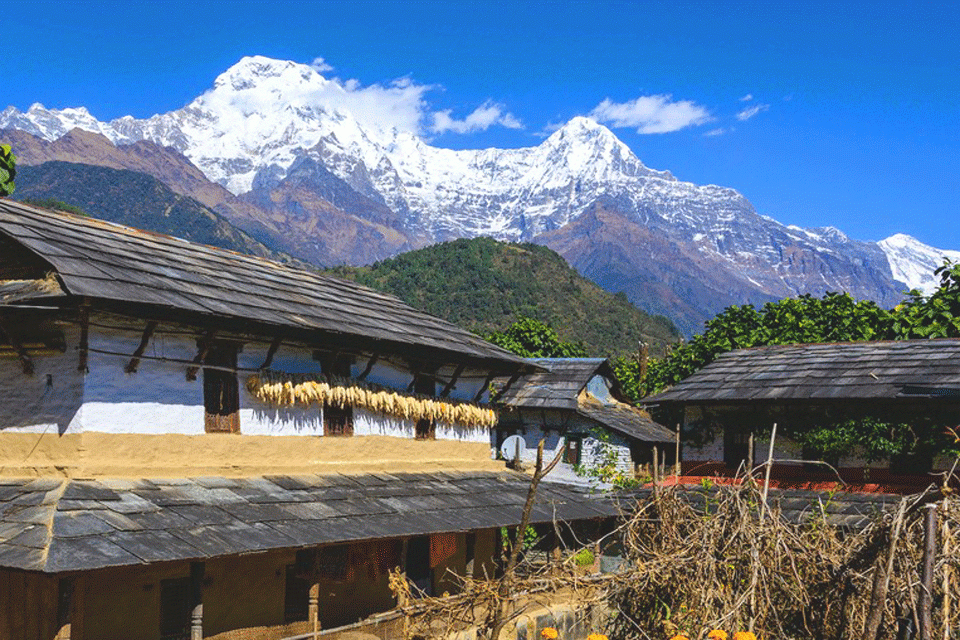
The perennial and roaring Modi watercourse, suspension bridges clad with prayer flags, unambiguously organized homes, and raw rural life are the attractions of your trek to Ghandruk village. On reaching this destination, you will notice that the trouble created was definitely worth the destination. Among the most effective places to look at the most effective of AnnapurnaHiuchuli, and slow-moving peaks, Ghandruk is the standard for well-preserved Gurung culture and traditions. The museum, a village with ancient homes weaved by stone-paved yet slim streets, and glorious welcome exhibited by the locals shall provide you with rattling expertise. Experiencing one of the most effective days of life, you shall then descend to Nayapul on the path in the course of the Modi watercourse and different little streams, visiting many rural settlements before heading to Pokhara and then Kathmandu to complete the Ghandruk Trekking.

Trekking to Ghandruk is a straightforward trek involving trekking and excursions of historical and cultural heritage. With March to May and September to December being the most popular seasons for trekking, you wish to possess a mean fitness level to travel for this trek. Whether or not you would like to travel solo or together with your family, be part of this straightforward and short trek without the danger of hypoxia. At Trekking Planner Nepal, we have a tendency to be committed to making this trip even lighter for you.


Highlights of Ghandruk Trekking

The Ghandruk village trek is one of the most popular and scenic treks in the western region of Nepal, with the distinctive culture of the Gurung ethnic group. The trek offers amazing panoramas of the snow-covered mountain ranges, including Mt. Annapurna, Mt. Fishtail (Mt. Machhapuchre), Mt. Gangapurna, and others.

  • Trekkers will be treated by stunning vistas of the Annapurna and Dhaulagiri mountain ranges and other peaks in the region throughout the journey.
  • Interacting with the local Gurung population in Ghandruk and other trailside villages offers the chance to learn about their distinctive culture, long-standing traditions, and friendly hospitality.
  • If you visit in the spring, the forests will be covered in vibrant rhododendron blooms, making for a beautiful scene.
  • Ghandruk is a great choice for novices or for those with limited time who wish to enjoy the splendor of the Himalayas.
  • Ghandruk is a simple village, and the main inhabitants of the place are Gurungs.

Advantage of booking Ghandruk short trek with Trekking Planner Nepal

  • Private vehicles pick up and drop off passengers at all airports.
  • First-aid kit box and first aid service.
  • Trekking planner's down jacket, t-shirt, and cap, if necessary.
  • Arrangement of emergency evacuation service (you should have insurance for emergency evacuation, which will be paid for by your travel insurance company).
  • We use an oximeter to check your pulse, oxygen saturation, and heart rate, and we provide oxygen.
  • Sim cards are provided by our company for travelers, so there won’t be any networking issues.

What is the specialty about Ghandruk Village?

Ghandruk Village lies in the western region of Nepal. The trek to Ghandruk village has been popular among the people in recent years due to several reasons. Some of the reasons why you should trek to Ghandruk village are the following:

  • Time Constraints: Many people only have a short amount of time in Nepal and cannot afford to make lengthier treks. The Ghandruk Trek provides a brief but gratifying Himalayan experience without taking too much time away from other vacation plans.
  • Beautiful Scenery: The Ghandruk path offers incredible views of the Annapurna and Dhaulagiri Mountain Ranges, thick forests, and terraced fields despite being a short trip. You can still take in the area's natural splendor in a shorter amount of time.
  • Cultural Experience: During Ghandruk village trekking, you get a chance to fully immerse yourself in the Gurung community's distinctive culture and way of life by visiting the traditional Gurung village of Ghandruk. The village provides a chance to get to know the residents, learn about their traditions, and take advantage of their friendly hospitality.
  • Rhododendron flowers: If you go on a trek in the spring (March to April), the trees along the trail are alive with vibrant rhododendron blooms, creating a beautiful and enchanted landscape.
  • Suitable for Beginners: The Ghandruk village trek is comparatively easy and suitable trekking for beginners or those with limited trekking experience. The trail has well-maintained paths and comfortable lodges for accommodation, making it accessible to a wide range of trekkers.
  • Physical fitness: Normally, treks to any part of Nepal are physically demanding and challenging. However, the shorter duration of the Ghandruk Trek may make it easier for certain people who choose a less challenging option.

Is a short Ghandruk Village trek suitable for beginners?

Depending on your tastes, level of physical condition, and time constraints, you may find the Ghandruk Village trip to be a good fit. The trek is suitable for both novices and those with little prior trekking experience because it is very short and easily accessible. The Ghandruk Trek can be a fantastic choice if you have a few more days and want to see the Himalayas in all their grandeur.

However, it is important to keep in mind that trekking requires several hours of daily walking and that the track may have uphill and downhill sections. For a more enjoyable experience, prior physical fitness and a basic level of endurance are helpful. It's important to speak with a doctor before starting any trek if you have any health issues or are unsure of your level of fitness.

Additionally, keep in mind that landscape, altitude, and weather can all have an impact on your hiking experience. It's important that you arrive prepared with the right attire, equipment, and travel plans. Trekking Planner Nepal is always available for advice and support if you're unsure about the trek or need help planning your vacation.
ghandruk-village

How to Prepare for Ghandruk Village Trekking?

Here are some tips and tricks Trekking Planner Nepal shares with you for the preparation of the 3-day Ghandruk Village trekking.

  • Physical Fitness: Physical fitness is required because, despite the Ghandruk Trek's moderate difficulty, there are still several hours of uphill and downhill trekking required each day. To increase your stamina and endurance, Trekking Planner Nepal advises practicing frequent aerobic exercises like walking, hiking, or jogging. Exercises for strengthening the legs and cardiovascular fitness will be very beneficial.
  • Consult a Doctor: It's important to speak with a doctor before beginning any trek, particularly if you have any current medical ailments or concerns. Your fitness level and any necessary safety measures can be discussed with them.
  • Trekking Permits: Before embarking on your trekking, make sure to get the required trekking permits. For the Ghandruk Trek, the Annapurna Conservation Area Permit (ACAP) and TIMS (Trekkers' Information Management System) card are normally necessary. Trekking Planner Nepal helps you with all necessary documents and permits.
  • Pack Wisely: Trekking Planner Nepal suggests you prepare the packing list that includes necessities like trekking clothing (moisture-wicking and warm layers), durable hiking boots, an easy-to-carry backpack, a sleeping bag, a first aid kit, a water bottle, a headlamp or flashlight, sunblock, sunglasses, and a hat. Make sure you have everything you'll need for the hike while packing minimally.
  • Trekking Gear Rental: In case you do not want to carry heavy stuff and luggage, you can even hire hiking equipment. These things are easily available in the stores of Kathmandu as well as Pokhara.
  • Keep Hydrated and Eat Well: Staying hydrated and eating a healthy diet are vital during the journey. Drink a lot of water and carry water filters or purification tablets to cleanse water from nearby sources. You can fuel up on dal bhat (rice and lentils), noodles, and other regional foods at the teahouses along the trail.
  • Weather considerations: Before you begin your walk, check the weather forecast. It's important to be ready for unusual weather changes.
  • Insurance: Travel insurance is the most important thing you need to purchase before heading to any vacation.

If you follow these instructions and get ready for the Ghandruk Village trip, you'll be prepared to take advantage of the breathtaking landscape, fascinating cultural experiences, and exciting activities that the Annapurna Region has to offer.

What is the best season or time for Ghandruk Village trekking?

The spring (March to May) and autumn (September to November) are the optimum seasons for Ghandruk Village trekking. Most trekkers like to go during these seasons since they provide the best weather and conditions for hiking.

One of the most well-liked periods to go trekking in Nepal, including the Ghandruk Trek, is in the spring. Trekking throughout the day is pleasant due to the generally consistent, nice weather and warm temperatures. Along the walk, the rhododendron woodlands spring to life with vibrant blooms, resulting in a beautiful and entrancing setting. The Annapurna and Dhaulagiri ranges of mountains may be seen well because the skies are typically clear. In comparison to the monsoon season, the possibilities of rain are very minimal, and the paths are clearly marked.

The optimum time to complete the Ghandruk Trek is in the autumn, another popular trekking season in Nepal. Cool and dry conditions bring bright skies and superb visibility for mountain views. After the monsoon rains, the landscapes are lush and green, producing a relaxing and gorgeous environment. Because of the mild temperatures, daytime hiking and nighttime sleeping are both enjoyable. A lot of regional festivals take place throughout the autumn, giving trekkers the chance to see and take part in local cultural activities.

Local Culture and Tradition at Ghandruk Village

The Gurung ethnic group makes up the majority of the inhabitants of Ghandruk Village. One of the largest ethnic groups in Nepal is the Gurung, who are renowned for their rich cultural heritage, bravery, and support of the Gurkha regiments in the British and Indian armed forces. Besides, there reside Brahmins, Chettris, Magars, and so on.

The residents of the Ghandruk village are well known for being friendly and hospitable. Visitors and trekkers are frequently welcomed with a grin and given a cup of tea as a sign of hospitality. The people of Ghandruk maintain a traditional way of life despite the growing effect of modernization and tourists. They farm crops including rice, millet, maize, and potatoes on the terraced fields that surround the community, which is where their primary source of income comes from. In Ghandruk, many Gurung people continue to dress traditionally every day. The men typically don a sleeveless jacket called a "Gurung Bhangra," as well as a knee-length wraparound garment called a "Gurung Gho" or "Bakra." Women don a colorful top called a "Gunyo Cholo" and a wraparound skirt called a "Gunyu Fari. " Throughout the year, the people passionately celebrate a number of events. With religious rites, folk dances, and feasts, important festivals like Dashain, Tihar, and Lhosar are joyfully celebrated. In Ghandruk, residents take part in traditional dances like "Ghatu," "Maruni," and "Tamu" at festivals and special occasions. Music and dance are fundamental to Gurung culture. They perform music using instruments like the tungna, a tiny stringed instrument, and the madal, a drum. Ghandruk Village still has a strong sense of community. Ghandruk Village upholds a strong feeling of community, and locals frequently gather to work on neighborhood projects or aid one another in need. The people of Ghandruk have a profound respect for the natural world. The Gurung people have a close relationship with the mountains, forests, and rivers that surround their community, which is located in a magnificent setting. Numerous Gurung residents have entered the hospitality sector as trekking tourism has grown, running teahouses and homestays and offering trekkers their services as guides and porters.

Overall, the people of Ghandruk are a prime example of the rich Gurung culture, exhibiting their deeply ingrained customs, gracious hospitality, and peaceful coexistence with the natural world. Their manner of life and customs add to Ghandruk's charm.

Is travel insurance required for the short Ghandruk trek?

Travel insurance is not mandatory, but having one can be beneficial in the event of unseen circumstances during your travel time in Nepal.

  • Medical Emergencies: Emergency medical care, hospitalization, and transportation can all be covered by travel insurance.
  • Trip Cancellation or Interruption: Unforeseen situations, such as extreme weather, political unrest, or personal crises, may force you to postpone or cut short your journey. Travel insurance can cover journey cancellations or interruptions, allowing you to recoup any saved costs.
  • Personal responsibility: If you accidentally cause property harm or hurt someone, travel insurance can cover any legal responsibility and recompense.
  • Lost or Stolen Property: Trekking entails transporting costly tools as well as personal possessions. Travel insurance can cover the loss, robbery, or destruction of your personal possessions, such as cameras, phones, and trekking equipment.

When choosing a travel insurance policy, study the terms and conditions thoroughly and ensure that the policy covers the activities you intend to do during your journey. It's also essential to disclose any pre-existing medical conditions and make sure they're protected by the insurance.

Accommodation Facilities at Ghandruk Village

The washing, toilet, and accommodation facilities of the Ghandruk Village Trek vary totally depending on the accommodation, service, and budget you choose.

  • Washing Facilities: The Ghandruk trekking path is quite established, and the tea houses or lodges where you stay usually have simple washing facilities. These amenities may include showers with cold water in common bathrooms. However, if you prefer, a hot shower is still available, but they charge an additional cost.
  • Toilet Facilities: The majority of the tea houses along the Ghandruk Trek route provide communal restrooms. These are frequently squat toilets, which are widespread throughout much of Nepal. But some tea houses provide you an attached bathroom. It depends upon the facilities and services you prefer and pay for. It's essential to maintain good hygiene because lavatory facilities may get more basic as you ascend in height.
  • Accommodations: There are several places to stay in Ghandruk, from modest tea houses to comfortable lodges. As you ascend in altitude, keep in mind that lodging quality can vary and that amenities might be more basic. Simple but wholesome meals are often served at tea rooms and lodges, and you can enjoy the warmth of the locals.

It's essential to remember that circumstances might change, and facility availability and quality may vary depending on things including the time of year, weather, and infrastructure upgrades. Trekking Planner Nepal helps you to obtain the most recent and accurate details regarding the facilities, lodges, and services available. We also help you with the service you seek. In the peak season, we book in advance so that you do not need to worry for the entire trek.

Why Trekking Planner Nepal for the Ghandruk Village Trekking?

Trekking Planner Nepal is a legally registered trekking agency operated by well-experienced and well-trained personnel for the past two decades. Here are some reasons why you should choose us for your Ghandruk Village Trek:

  • Experience: Trekking Planner Nepal has been planning treks in Nepal for more than 20 years. We have a staff of professional guides and porters that can assist you in planning and carrying out your trek in a safe and simple manner.
  • Expertise: Trekking Planner Nepal has extensive knowledge of the Ghandruk village trek. We can advise you on the best route based on your fitness level and interests.
  • Flexibility: Trekking Planner Nepal is flexible and can tailor a trek to your individual requirements. We can organize private transportation, lodging, and food.
  • Value: Trekking Planner Nepal provides exceptional value for money. Our costs are reasonable, and they provide a number of discounts and bundles.
  • Trekking Planner Nepal is the ideal option for you if you want a safe, pleasurable, and inexpensive trek.
  • Peace of mind: Trekking Planner Nepal handles all of the logistics of your trek, allowing you to rest and enjoy the experience.
  • Trekking Planner Nepal is always accessible to answer any inquiries or address any concerns you may have.
  • Trekking Planner Nepal is a family-owned and -run company. They treat their customers like friends and are always eager to assist you in having a pleasant experience.
Ghandruk Trekking-3 Days Itinerary

Day 1

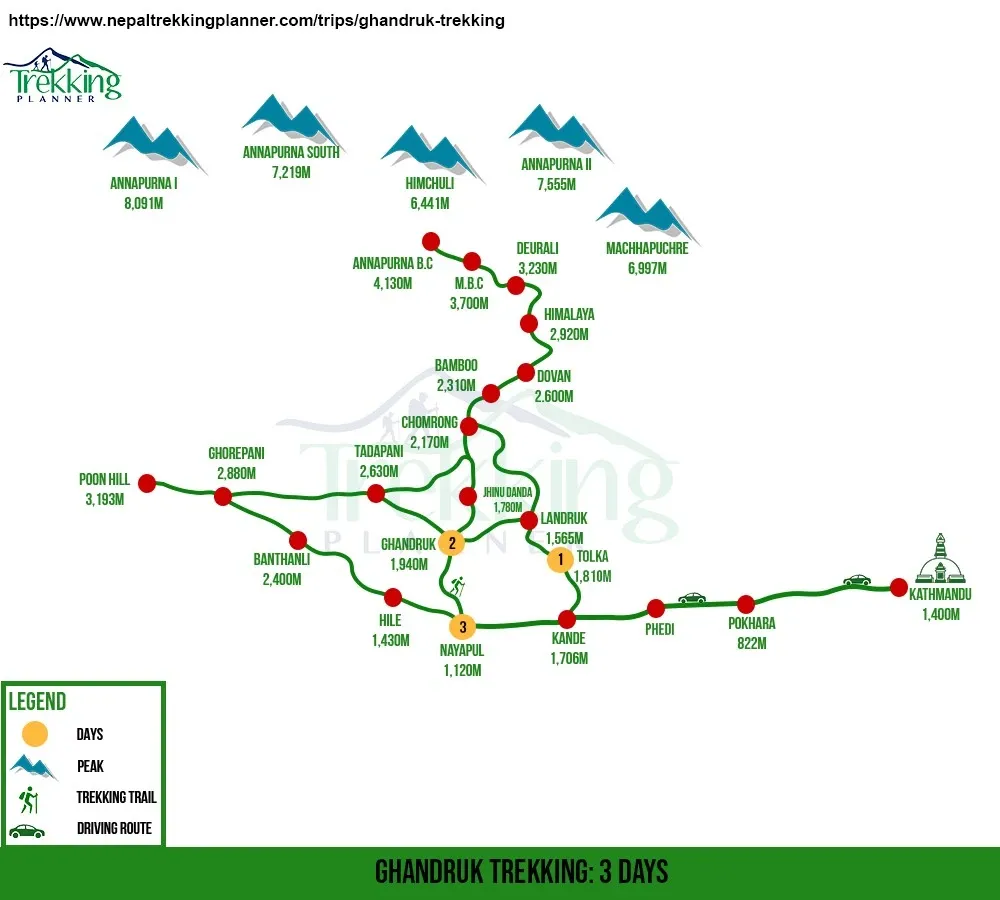
Drive to Phedi (30min) and trek to Tolka (1810m/5938ft) 4-5 hrs walk, walking distacne about 7.69 miles (12.37 km)

Max Altitude: 1,810m (5,938ft)
Meals: Lunch and Dinner
Accommodation: Namaste Guest House/International Guest House

Today after breakfast you will drive up to Phedi from where the trek begins. You will be rewarded with great views of the mountains that continue to improve as you ascend along the ridge to Dhampus (1750m at the top), from where you will have magnificent view of Fishtail and Annapurna mountain. Continues trek to Pothana where you will have lunch break. After lunch you will have up and down trek to Small settlement Tolka. Stay overnight at the tea house.

Day 2

Trek to Ghandruk (2,012 m/6,601 ft) 5-6 hrs walk, walking distance 6.2-8.7 miles/10-14 km

Max Altitude: 2,012m (6,601ft)
Meals: Breakfast, Lunch and Dinner
Accommodation: Hotel Samipya

After an early morning breakfast at the lodge, you will trek slowly downhill to Landruk from where the trail descends all the way to Modi Khola.  After crossing Modi Khola stream on a suspension bridge with a view of wild honey bee hives on the rocky cliff, from here the trail leads all the way up to a Ghandruk village. Ghandruk village is a big Gurung Settlement, kind of modern town of this trek where you can see a local museum and Buddhist Monasteries. Stay overnight at the lodge.

Day 3

Trek to Nayapul-Pokhara (30 min drive and 3 hrs drive)

Max Altitude: 822m (2,696ft)
Meals: Breakfast and Lunch

Ghandruk village is one of the best places from which you can have a great view of the Annapurna, Hiunchuli, and Fishtail, all very close by. After a wonderful short time in the Ghandruk village, trek down to the motor road.  After 30 30-minute short walk, we drive back to Pokhara. Stay overnight at the hotel.

3 Days Ghandruk Trekking provided with a standard Itinerary days where some days walks can be shorter or longer as per your physical fitness, some designated overnight stops can change, due to available rooms and other facilities and etc…….

We will follow the itinerary if its need to be changes in case of weather, landslides and difficulties on walks requiring more days where our leader and lead head guides decides holding full authority for Trekking Planner.

Dates & Availability

Trip Duration
3 Days
Trip Starts & Ends Point
Pokhara / pokhara
Plan your trek schedule

The 3-day Ghandruk trekking provides standard itinerary days where some days' walks can be shorter or longer as per your physical fitness, and some designated overnight stops can change due to available rooms and other facilities, etc.

We will follow the itinerary if it needs to be changed in case of weather, landslides, and difficulties on walks requiring more days where our leader and lead head guides decide to hold full authority for Trekking Planner Nepal.

  • This trip departs every day of the year.
  • This trip is fully customizable. We can customize the trip as per your needs; please contact us.
  • This trip is available on both fixed departure and private group bases.
  • This trip can be booked privately if you’re traveling solo or privately or with family.
  • Have a big group? We can help as per your needs.
  • We can help you make it fit your budget. 
  • We accept instant booking and online payment.

Cost Details

Trip Includes

  • Pokhara to Phedi and Nayapul to Pokhara by private vehicle.
  • Annapurna Conservation Area Permit and Trekkers' Information Management System (TIMS card).
  • A highly experienced, helpful, knowledgeable, friendly, English-speaking, well-trained government license holder guide with all his salary, food, drinks, accommodation, transport, and insurance.
  • 02 guests = 01 porter with insurance, salary, food, accommodation, and equipment (luggage per porter carries about 20 kg).
  • We provide assistance guiding his salary, food, drinks, accommodation, transport, and insurance, walking with the group to support where necessary as per the group size.
  • Accommodation in the mountains during the trekking.
  • Three meals a day: breakfast, lunch, and dinner and tea/coffee during the trekking.
  • Welcome dinner in an authentic restaurant.
  • First aid kid box.
  • Trekking planner's sleeping bag, down jackets, T-shirt, cap, duffle bags, city and trekking route maps—if necessary.
  • Arrangement of emergency evacuation service (should have insurance for emergency evacuation and will be paid by your travel insurance company).
  • All applicable government and local taxes are as per the itinerary.

Trip Excludes

  • All the International airfare from and to Kathmandu 
  • Your Nepal Visa fees 
  • All meals and accommodation in Kathmandu and Pokhara.
  • Personal travel and health insurance, insurance for helicopter evacuation.
  • In case of extra night accommodation, lunch, and dinner in the city due to early arrival and late departure as well as early back/return from the mountain/trekking (due to any reason) beyond the given time period of the itinerary.
  • Your personal expenses such as laundry, baggage charges, phone calls, battery recharges, bar and beverage bills, boiled or bottled water, hot and cold showers, extra porters, etc.
  • The tips to the trekking crews and drive.
  • Extra expenses due to flight delays, strikes, weather conditions, or any event out of our control.

Interactive Map

StartMid DaysEnd

Infographic Map

Download

Altitude Chart

Essential Information

Equipment and Gear List

trekking iconGeneral

  • Four-season (-20 degree) sleeping bag (We provide rental sleeping bags available for an additional USD 35)
  • Puffy down jacket (We provide rental jackets for an additional USD 35)
  • Daypack (25-30 liters recommended) with rain cover

HeadUpper Body

  • Sun hat or cap (We'll provide you with a trekking cap.)
  • warm woolen hat
  • Scarf/Neck Buff (highly recommended to get saved from wind and cold)
  • Headlamp or mobile flashlight for nighttime
  • Polarized sunglasses

TorsoTorso

  • Technical fabric base layer thermals are light for warmer months and heavy for colder months
  • Technical fabric t-shirts and sleeve sweaters or high-necks
  • Waterproof rain jacket
  • windproof jacket for the walk as it gets windy
  • Fleece jacket or down jacket

PantLower Body

  • thermals inner
  • Hiking pants at least 3
  • Comfortable pants for teahouses
  • Waterproof, windproof shell
  • Hiking shorts

GlovesHands

  • Woolen gloves for the tea house
  • Hard-shell windproof outer gloves for the walk

FeetFeet

  • Marino Wool or comfortable, warm socks
  • Hiking socks
  • Liner socks
  • Trekking/hiking boots (waterproof recommended)
  • Crampons (For passes)
  • Casual shoes or sandals that are comfortable for the time in the tea house
  • Gaiters (lightweight for rain and snow)

UndergarmentsUndergarments and innerwear

  • Technical/quick-drying fabric (can be washed during the trek)
  • Sports bras (women)
  • sleeping clothes as per the comfortability

MedicineFirst Aid Kits and Medications

  • Sunscreen SPF-50+
  • Lip balm or Vaseline
  • ointment cream
  • Cough Syrup and strepsils (recommended for Khumbu Cough)
  • Creams and medicines (for any allergies or diseases)

(Note: Our guides carry medications, oxygen cans, and first aid kits during the trip. However, personal kits and medications are recommended.)

Other essentialsOther Essentials

  • Passport
  • Extra copies of passport-sized photos
  • Reusable water bottle
  • Toilet paper, small soap, and shampoo
  • Water purification tablets or UV water purifier (if you plan to treat water)
  • water bladder for the day bag
  • small towel for personal use
  • Pillowcase in case of allergies to new pillows
  • High-protein snacks (such as mountain bars or nuts)
  • Waterproof/dry bags for carrying essential documents, stuff, frequently used items, and money
  • Power bank or extra batteries
  • Cameras and mobile phone
  • Cards/book
  • Pee bottle/pee funnel for women
  • Trekking poles
  • Whistle in case your voice is not loud enough to stop or start
  • Thermos for hot water during the nighttime
  • We give you a free duffel bag, trekking cap, maps, and t-shirt during your pre-trip meeting in Kathmandu. The duffel bag will be used to pack your trekking supplies.
  • For every two participants, we assign one porter. The porter will carry the duffel bag, which should weigh around 10 kg/22 lbs., throughout the walk.
  • A daypack bag for daily used stuff like cash, documents, papers, a water bottle or bladder, a camera, toiletries, sunscreen, a notebook, clothing, etc. (with a waterproof cover).
  • You can store your luggage (on-trekking items) at the hotel in Kathmandu, and we can assist and help you.
  • Total luggage for the Kathmandu-Lukla flight is 15 kg/33 lbs., including duffel (10 Kg/22 lbs.) and backpack (5 kg/11 lbs.)
  • A down jacket with a hood (cap) to be warm in altitudes above 3,000 m.
  • We can provide a down jacket for USD 35. In case of loss or damage, you need to pay back the cost of USD 200 per item.
  • We can provide a sleeping bag for USD 35. In case of loss or damage, USD 200 per item must be paid.

Note: Supplies and gear can be rented or purchased in Kathmandu. Once you are in Nepal, you can buy supplies and gear for hiking if you have spare time. Trekking Planner Nepal representatives will assist you in purchasing the equipment. Thamel a tourist hub, offers a wide range of trekking equipment at affordable prices. Don't wear short clothes inside the monasteries and religious places.

Equipments

If you are preparing for a high-altitude Himalayan adventure in Nepal, there is always some confusion about what to pack. It is essential to carry the right gear and equipment for a comfortable, safe, and enjoyable experience. All trekkers should properly pack and carry all the essential items. 

However, overpacking is another common mistake that can make the journey tiring. So here is a carefully crafted packing list that includes everything you need. From general items, cloth layers, headgear, footwear, to accessories and first aid, the list consists of light and smart packing items for every challenging mountain condition.

Note: You do not need to bring all the items mentioned below to Nepal. There are several trekking shops in Kathmandu or Pokhara where you can buy or rent high-quality gear at a reasonable price. So, feel free to pack light and purchase or rent any missing items after your arrival in Nepal. Also, members from Trekking Planner Nepal Pvt. Ltd. can also guide and assist you to find the best deals in gear and equipment in Thamel, Kathmandu.

What Does the Company Provide?

  • We give you a free duffel bag (must return), buffs, trekking cap, trekking map, and t-shirt during your pre-trip meeting in Kathmandu. The duffel bag will be used to pack your trekking supplies.

  • For every two participants, we assign one porter. The porter will carry the duffel bag, which should weigh around 10 kg/22 lbs., throughout the walk.

  • We can provide a down jacket for USD 35. In case of loss or damage, you need to pay back the cost of USD 100 per item.

  • We can provide a sleeping bag for USD 35. In case of loss or damage, USD 100 per item must be paid.

  • You can safely store your extra luggage (items not required on the trek) at the hotel in Kathmandu. Our team can happily assist and help.

  • Total luggage for the Kathmandu-Lukla flight is (15 kg/33 lbs.), including duffel (10 Kg/22 lbs.) and backpack (5 kg/11 lbs.).

  • We provide a free Nepal SIM card (Ncell) to all our trekkers during the pre-trip briefing in Kathmandu. Data packages can be purchased at an additional cost.

Upper Body Layers

  • Technical fabric base layer thermals are light for warmer months, heavy for colder months
  • Technical fabric t-shirts and sleeve sweaters or high-necks
  • Fleece jacket or down jacket
  • Windproof jacket for the walk as it gets windy
  • Waterproof rain jacket
  • Sports bras (women)
Lower Body Layers

  • Thermals inner
  • Hiking pants at least 3
  • Comfortable pants for teahouses
  • Waterproof, windproof shell pants
  • Hiking shorts
  • Technical fabric/quick drying undergarments (can be washed during the trek)
  • Sleeping clothes as per the comfortability
Footwear & Accessories

  • Marino Wool or warm socks
  • Hiking socks
  • Liner socks
  • Trekking/hiking boots (waterproof recommended)
  • Crampons (for mountain passes)
  • Casual shoes or sandals that are comfortable for the time in the tea house
  • Gaiters (lightweight for rain and snow)
  • Woolen gloves for the tea house
  • Hard-shell windproof outer gloves for the walk
  • Trekking poles
Head & Sun Protection

  • Sun hat or cap (We'll provide you with a trekking cap)
  • Warm woolen hat or beanie
  • Scarf/Neck Buff (highly recommended to get saved from wind and cold)
  • Polarized sunglasses
  • Headlamp or mobile torch light for nighttime
  • Sunscreen SPF- 50+
  • Lip balm or Vaseline
  • Ointment cream
Personal & Medical Kits
  • Sunscreen SPF- 50+
  • Lip balm or Vaseline
  • Ointment cream
  • Cough Syrup and strepsils (recommended for Khumbu Cough)
  • Creams and medicines for any allergies or personal conditions
  • Small towel
  • Toilet paper, small soap, and shampoo
  • Anti-Diarrhoea, Painkillers, Blister Plasters, and Anti-Inglammatories

(Note: Our guides carry medications, oxygen cans, and first aid kits during the trip. However, personal kits and medications are recommended.)

Travel Documents

  • Passport
  • Extra copies of passport-sized photos
  • Waterproof/ziplock bags for documents and valuables
Miscellaneous

  • Reusable water bottle
  • Water bladder for daypack
  • Water purification tablets or UV purifier
  • High-protein snacks (energy bars, nuts)
  • Power bank or extra batteries
  • Universal Plug Adaptar
  • Charging Cables
  • Travel lock
  • Camera and mobile phone
  • Pillowcase (in case of allergies)
  • Sleeping clothes
  • Cards / Book
  • Thermos for hot water at night

FAQs

What is the Ghandruk Village Trek?

A short and beautiful trekking route in Nepal's Annapurna region, the Ghandruk Village Trek is well-known for its lovely scenery, authentic cultural experiences, and amazing vistas of the mountains.

How long does the Ghandruk trek take?

The Ghandruk trek can typically be completed in about 3 to 5 days, depending on your starting point, trekking pace, and itinerary.

What time of year is ideal for the Ghandruk trek?

The spring (March to May) and autumn (September to November) seasons are ideal for the Ghandruk hike because they provide comfortable weather, clear skies, and the greatest vistas.

Is the trip to Ghandruk challenging?

For those with a reasonable level of fitness, the Ghandruk trip is regarded as a moderate trek. It involves some walking uphill and downhill, but it's often not as demanding as excursions at higher altitudes.

Do I require a guide for the trek to Ghandruk?

Yes, as per new government rules hiring either guide or a porter is compulsory. This is all for your own safety, to have a more rewarding experience and to support to the community.

Which permits are need for the Ghandruk trek?

Before embarking the trek, you must obtain the TIMS (Trekkers' Information Management System) card and the Annapurna Conservation Area Permit (ACAP). These are provided in Kathmandu as well as in Pokhara.

What options for accommodation are there along the Ghandruk trek?

Along the road, tea houses and hotels offer lodging alternatives. These offer fundamental amenities including bedrooms, communal restrooms, and food.

Are there any risks of altitude sickness on the Ghandruk trek?

Comparatively, the altitude sickness is less at Ghandruk as Ghandruk is at a lower altitude than some other treks in Nepal. Nevertheless, it's essential to adequately acclimatize and maintain hydration.

What should I bring for the trek to Ghandruk?

You can pack comfortable hiking clothes, durable walking shoes, a hat, sunglasses, sunscreen, water bottle, first aid supplies, and any necessary personal medications. Also think about bringing warm gear and a rain jacket, especially if you're trekking in the winter.

Can I take my kids on the Ghandruk trek?

As a short trekking route in Nepal, the Ghandruk trip is appropriate for families with children and senior individuals as well. Different levels of fitness can be accommodated by altering the course.

What is the starting point of the Ghandruk trek?

Normally, the starting point of Ghandruk trek depends upon the itinerary you choose. Most of the time the trek begins from Nayapul. Besides, it also starts from Phedi, Tolka and so on.

Can I extend the Ghandruk trek to other destinations?

The Ghandruk trek can be extended to include additional well-known locations including Ghorepani, Poon Hill, and Tadapani, even Annapurna Base Camp providing even more varied landscapes and cultural experiences.

Are there any monsoon-related challenges during the Ghandruk trek?

Normally, Monsoon rains begins from June to August. During monsoon the terrain become slippery and the visibility become poor. Leeches and landslides might provide problems at this time.

What is the cost of the Ghandruk trek?

The price of the Ghandruk trek might change depending on the trek's length, your lodging preferences, whether you employ a guide or porter, and your personal spending. The average costing for Ghandruk Trekking is around $200-$300.

Is there any wildlife to be seen on the Ghandruk trek?

On the trek to Ghandruk village you might encounter a variety of bird species as well as small mammals such as langurs.

Is the Ghandruk trek appropriate for solo travellers?

Yes, solo travellers can complete the Ghandruk trek. Even though you travel solo you will be with your guide or porter or both as per new government rules for your own safety. o, the trek will be more memorable and safe.

Can I do the Ghandruk trek in the winter?

The Ghandruk trek is possible in winter (December to February), but it can be cold, particularly at higher elevations. Prepare for cold temperatures and perhaps snowfall.

What are the main attractions of Ghandruk village?

Ghandruk has amazing Himalayan landscape, terraced crops, traditional Gurung culture, and the opportunity to visit the Gurung Museum.

Is there vegetarian and vegan cuisine available on the Ghandruk trek?

Yes, the majority of tea shops and lodges along the Ghandruk trek serve vegetarian and vegan fare. There may be a selection of Nepali and international dishes. So, veggies people can trek freely and easily.

Is the COVID-19 pandemic affecting the Ghandruk trek?

Travel arrangements and trekking conditions has been impacted by the COVID-19 scenario. You need to follow the procedures, health regulations, and safety precautions, consult local authorities and travel advisories.

Short Trek
7%
Off
Price Per Person
US$279
US$299
Need Help? Call Us!
Dipak Lamichhane
Dipak Lamichhane
Managing Director
+977 9851071767

What Our Clients Say

authorauthorauthor
10,000+ Happy Trekkers
Lorel Ipsum ingkdi gocngit slingt
5 out 5 based on the opinion of 2 people reviews

Short and beautiful views

I did the “Ghandruk Trekking: 3 days” tour with two friends. Even that my friend and I we were sick, the guide Achyut Mishra and the Porter were very helpful and patient with us. They...

Á
Ángela P - Austria
November 20, 2024

Village of a Thousand Steps

Initially I was going to do the three day trek ending at Ghandruk, but was not able to do so due to health reasons. Dipak immediately arranged for me to be taken directly to Ghandruk...

J
Juan K - Hong Kong
June 04, 2024
Need Help? Call Us+977 9851071767